Efficacy of Baska mask and Laryngeal mask airway supreme during positive pressure ventilation - A comparative study
- PMID: 32174654
- PMCID: PMC7047687
- DOI: 10.4103/joacp.JOACP_17_19
Efficacy of Baska mask and Laryngeal mask airway supreme during positive pressure ventilation - A comparative study
Abstract
Background and aims: Supraglottic airway devices have several roles including maintenance of a clear upper airway during general anesthesia. We primarily compared the efficacy of Baska mask (BM) and laryngeal mask airway supreme (LMAS) for the rate of first time successful placement and the seal pressure. The secondary outcome measures included laryngopharyngeal morbidity and the correct positioning of the gastric port.
Material and methods: A sample size of 30 was calculated in each study group. A total of 70 study participants were included in the statistical analysis of which 36 patients were in the BM group and 34 patients were in the LMAS group.
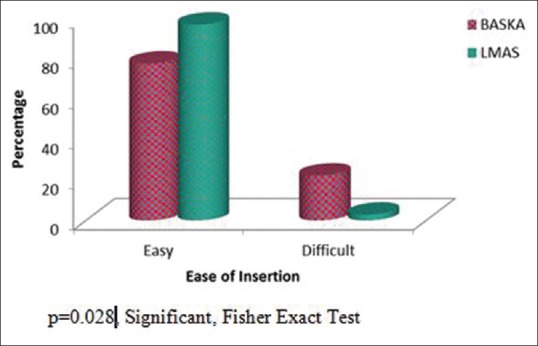
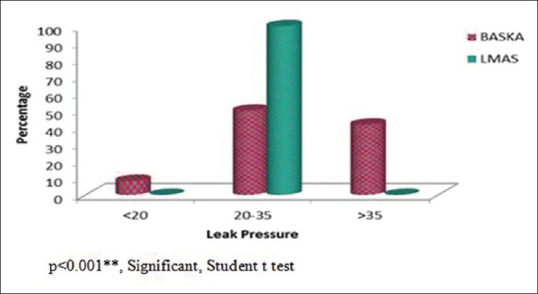
Results: The BM was successfully inserted in 28 patients (77.8%), whereas LMAS was successfully inserted in 33 patients (97.1%) in the first attempt (P = 0.028). The mean oropharyngeal seal pressure in the BM group was higher (33.28 ± 6.80 cm H2O) than compared to the LMAS group (27.47 ± 2.34 cm H2O) with a P value <0.001. There was no significant difference between the two groups in the incidence of postoperative laryngopharyngeal morbidity both in the immediate postoperative period (P = 0.479) and that seen 24 hours post operatively (P = 0.660). The nasogastric tube could easily be inserted in the entire study population.
Conclusion: From the present study, it is concluded that the BM creates a higher oropharyngeal seal pressure than the LMAS. However, the BM is more difficult to insert. The incidence of postoperative laryngopharyngeal morbidity is similar in both groups.
Keywords: Baska mask; Laryngeal mask airway supreme; efficacy; seal pressure.
Copyright: © 2020 Journal of Anaesthesiology Clinical Pharmacology.
Conflict of interest statement
There are no conflicts of interest.
Figures
References
-
- Cook T, Hagberg C. Non–laryngeal mask airway supraglottic airway devices. In: Benumof J, Hagberg CA, editors. Benumof and Hagberg's Airway Management. 3rd ed. Philadelphia, PA: Elsevier/Saunders; 2013. pp. 466–506.
-
- Baskamask.com.au [homepage on the Internet] Sydney: BVLM Pty Ltd; [Last cited on 2018 Nov 07]. Available from: http://www.baskamask.com.au/
-
- LMA Supreme [homepage on the Internet]. Teleflex. com. Pennsylvania: Teleflex Incorporated; [Last cited on 2018 Nov 08]. Available from: https://www.teleflex.com/emea/documentLibrary/documents/940689-000001_31... .
-
- Alexiev V, Ochana A, Abdelrahman D, Coyne J, McDonnell J, O'Toole D, et al. Comparison of the Baska mask with the single-use laryngeal mask airway in low-risk female patients undergoing ambulatory surgery. Anaesthesia. 2013;68:1026–32. - PubMed
-
- Al-Rawahi SAS, Aziz H, Malik AM, Khan RM, Kaul N. A comparative analysis of the Baska mask vs. Proseal laryngeal mask for general anesthesia with IPPV. Anaesth Pain Intensive Care. 2013;17:233–6.