


Trends of Repetitive Transcranial Magnetic Stimulation From 2009 to 2018: A Bibliometric Analysis
- PMID: 32174808
- PMCID: PMC7057247
- DOI: 10.3389/fnins.2020.00106
Trends of Repetitive Transcranial Magnetic Stimulation From 2009 to 2018: A Bibliometric Analysis
Abstract
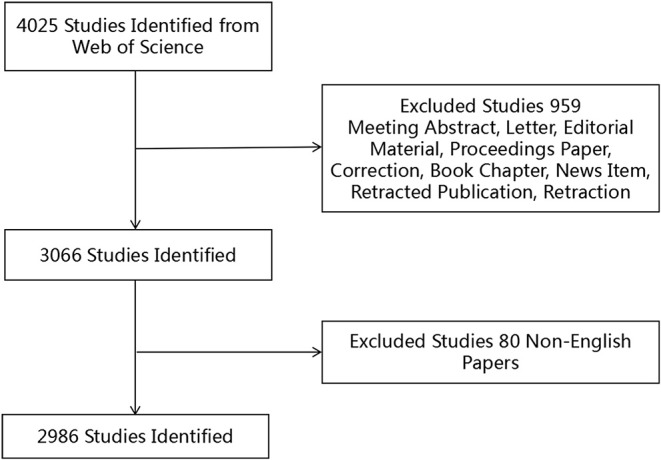
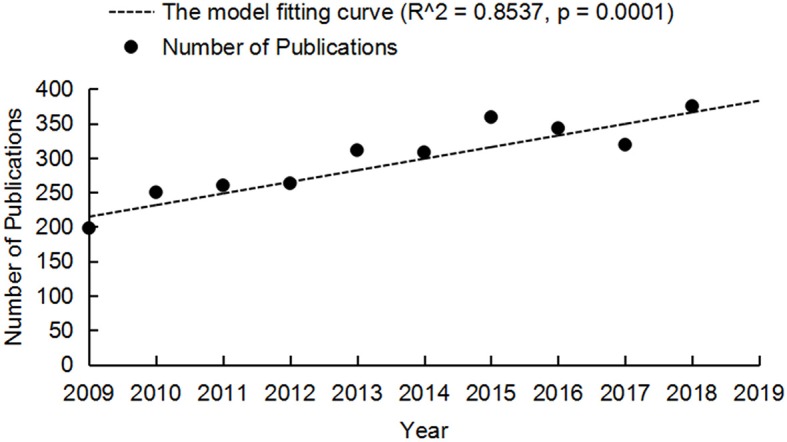
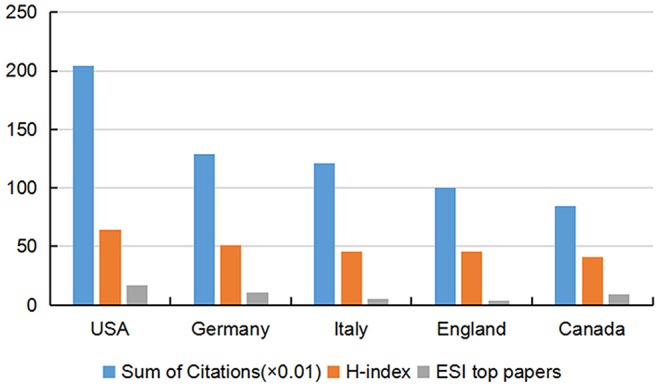
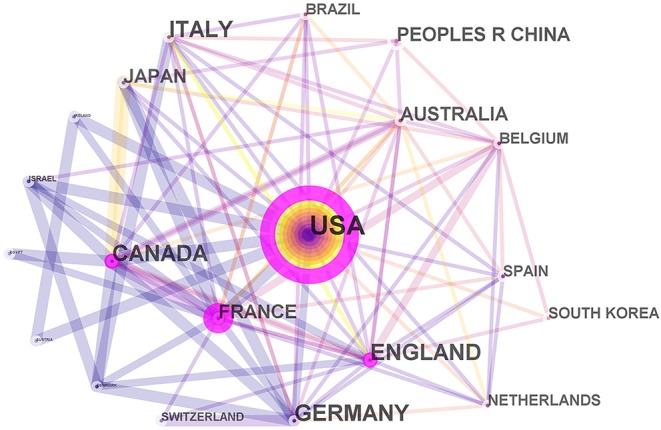
Repetitive transcranial magnetic stimulation (rTMS) technology, which is amongst the most used non-invasive brain stimulation techniques currently available, has developed rapidly from 2009 to 2018. However, reports on the trends of rTMS using bibliometric analysis are rare. The goal of the present bibliometric analysis is to analyze and visualize the trends of rTMS, including general (publication patterns) and emerging trends (research frontiers), over the last 10 years by using the visual analytic tool CiteSpace V. Publications related to rTMS from 2009 to 2018 were retrieved from the Web of Science (WoS) database, including 2,986 peer-reviewed articles/reviews. Active authors, journals, institutions, and countries were identified by WoS and visualized by CiteSpace V, which could also detect burst changes to identify emerging trends. GraphPad Prism 8 was used to analyze the time trend of annual publication outputs. The USA ranked first in this field. Pascual-Leone A (author A), Fitzgerald PB (author B), George MS (author C), Lefaucheur JP (author D), and Fregni F (author E) made great contributions to this field of study. The most prolific institution to publish rTMS-related publications in the last decade was the University of Toronto. The journal Brain Stimulation published most papers. Lefaucheur et al.'s paper in 2014, and the keyword "sham controlled trial" showed the strongest citation bursts by the end of 2018, which indicates increased attention to the underlying work, thereby indicating the research frontiers. This study reveals the publication patterns and emerging trends of rTMS based on the records published from 2009 to 2018. The insights obtained have reference values for the future research and application of rTMS.
Keywords: CiteSpace; Web of Science; bibliometrics; citation burst; frontiers; rTMS.
Copyright © 2020 Zheng, Dai, Lan and Wang.
Figures
References
-
- Alonso S., Cabrerizo F. J., Herrera-Viedma E. (2009). H-index: a review focused in its variants, computation and standardization for different scientific fields. J. Informetr. 3, 273–289. 10.1016/j.joi.2009.04.001 - DOI
-
- Bakker N., Shahab S., Giacobbe P., Blumberger D. M., Daskalakis Z. J., Kennedy S. H., et al. (2015). RTMS of the dorsomedial prefrontal cortex for major depression: safety, tolerability, effectiveness, and outcome predictors for 10 Hz versus intermittent theta-burst stimulation. Brain Stimul. 8, 208–215. 10.1016/j.brs.2014.11.002 - DOI - PubMed
Publication types
LinkOut - more resources
Full Text Sources
Miscellaneous
