


(Swiss) GraphoLearn: an app-based tool to support beginning readers
- PMID: 32175013
- PMCID: PMC7048874
- DOI: 10.1186/s41039-020-0125-0
(Swiss) GraphoLearn: an app-based tool to support beginning readers
Abstract
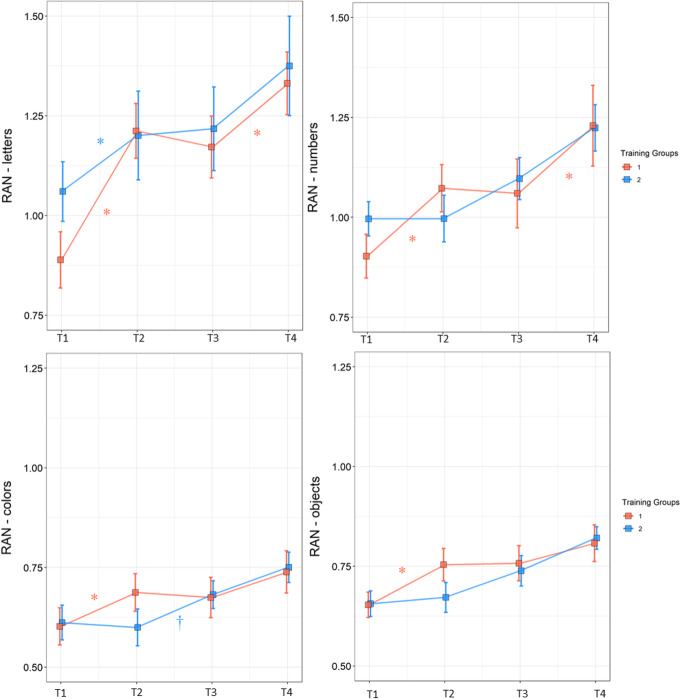
We assessed the Swiss-German version of GraphoLearn, a computer game designed to support reading by training grapheme-phoneme correspondences. A group of 34 children at risk for dyslexia trained three times a week during 14 weeks, on top of their standard school instruction. The sample was divided into two groups of 18 and 16 children, who started training at either the middle or the end of first grade. We found beneficial training effects in pseudoword reading in both training groups and for rapid automatized naming skills in the group that trained earlier. Our results suggest that both the efficiency in phonological decoding and rapid access to verbal representations are susceptible to facilitation by GraphoLearn. These findings confirm the utility of the training software as a tool to support school instruction and reading-related abilities in beginning readers. We discuss ideas to improve the content and outcomes of future versions of the training software.
Keywords: Beginning readers; Children at risk for developmental dyslexia; Computer-based training; Grapheme-phoneme learning; GraphoLearn.
© The Author(s) 2020.
Conflict of interest statement
Competing interestsThe authors declare that they have no competing interests.
Figures

References
-
- Araujo MWB, Charles CA, Weinstein RB, McGuire JA, Parikh-Das AM, Du Q, Gunsolley JC. Meta-analysis of the effect of an essential oil-containing mouth rinse on gingivitis and plaque. Journal of the American Dental Association (1939) 2015;146(8):610–622. doi: 10.1016/j.adaj.2015.02.011. - DOI - PubMed
-
- Aravena S, Tijms J, Snellings P, van der Molen MW. Predicting responsiveness to intervention in dyslexia using dynamic assessment. Learning and Individual Differences. 2016;49:209–215. doi: 10.1016/j.lindif.2016.06.024. - DOI
-
- Blumberg, F. C., & Fisch, S. M. (2013). Introduction: digital games as a context for cognitive development, learning, and developmental research. New Directions for Child and Adolescent Development, 1–9. - PubMed
LinkOut - more resources
Full Text Sources