Review
. 2020 Feb;10(1):72-82.
doi: 10.21037/cdt.2019.10.01.

Review of alternative access in transcatheter aortic valve replacement

Affiliations
Review

Review of alternative access in transcatheter aortic valve replacement

Adam Banks et al. Cardiovasc Diagn Ther. 2020 Feb.

Abstract

Transcatheter aortic valve replacement (TAVR) has surpassed surgical aortic valve replacement (SAVR) as the most common treatment strategy for severe symptomatic aortic stenosis over the past decade. As TAVR technology has continued to advance, it has been expanded from being an option only for extreme risk patients to now being the preferred option for the majority of patients with severe aortic stenosis. Recent trials have shown that TAVR is superior or non-inferior to SAVR even in patients at low surgical risk. One limitation of TAVR is the need for large bore vascular access. This has improved over time with smaller sheath sizes and improved delivery systems, but is still a significant issue in a patient population that often has many comorbidities including peripheral arterial disease. Early in the TAVR experience the only option for alternative access was transapical access, which has consistently been linked to increased procedural complications and worsened clinical outcomes. However, in recent years several centers have demonstrated the safety and efficacy of several alternative access strategies including transaxillary, transcarotid, transcaval, and direct aortic. There are no randomized data comparing these strategies, so access site approach is chosen by the multidisciplinary heart team based on patient anatomy and site expertise. We will review the current data in alternative access that in our view supports prioritizing a transaxillary or transcarotid strategy. In addition, we will describe our center's pre-procedural planning, peri-procedural approach, and propose an algorithm for alternative access.

Keywords: Transcatheter aortic valve replacement (TAVR); vascular access.


Conflict of interest statement

Conflicts of Interest: The authors have no conflicts of interest to declare.

Figures
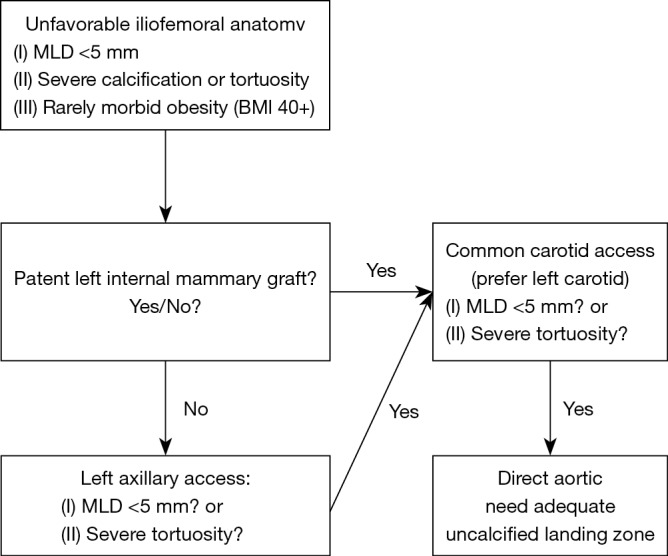
Figure 1
Figure 1
Duke Heart Center algorithm for alternative access. MLD, minimum lumen diameter.
Figure 2
Figure 2
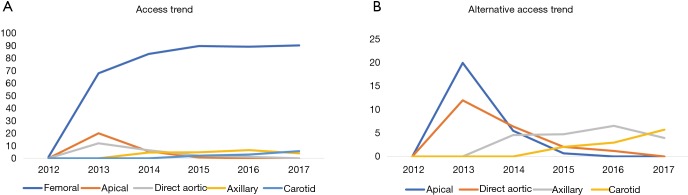
Access strategies for TAVR at Duke 2012 to 2017. (A) Percentage of access at Duke from 2012 to 2017 demonstrating 90 percent of procedures transfemoral from 2015 to 2017; (B) percentage of alternative access from 2012 to 2017 demonstrating axillary and carotid access replacing direct aortic and apical access. TAVR, transcatheter aortic valve replacement.
Figure 3
Figure 3
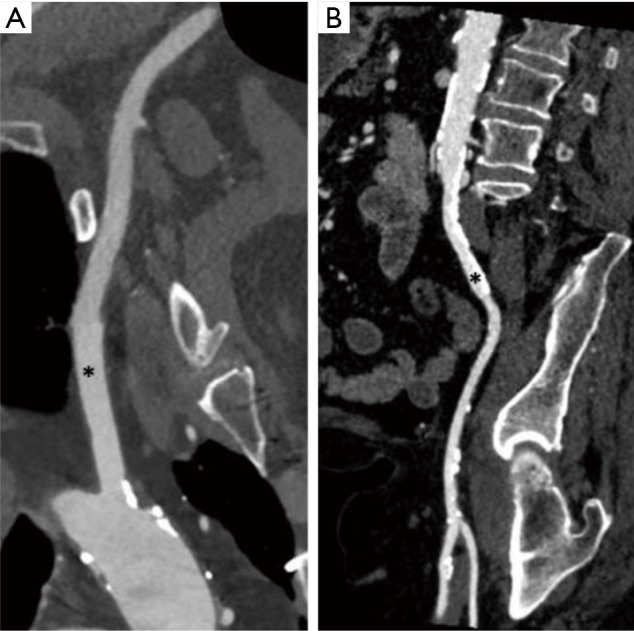
TAVR-CT in a patient that underwent left axillary access. (A) CT reconstruction from TeraRecon displaying suitable left axillary artery anatomy (marked by *) with MLD of greater than 6 mm; (B) reconstruction from TeraRecon displaying iliofemoral anatomy with extensive calcified stenosis (*) and atherosclerosis predominantly in common iliac artery. TAVR, transcatheter aortic valve replacement; MLD, minimum lumen diameter; CT, computed tomography.
Figure 4
Figure 4
Left axillary artery cutdown technique. (A) Marked incision site 1–2 finger breadths below the lateral left clavicle; (B) cutdown with isolation of superior and inferior aspect of landing zone of left axillary artery after identifying brachial plexus. 7-French sheath inserted at separate site lateral to cutdown; (C) 7-French sheath exchanged for 14-French sheath.
Figure 5
Figure 5
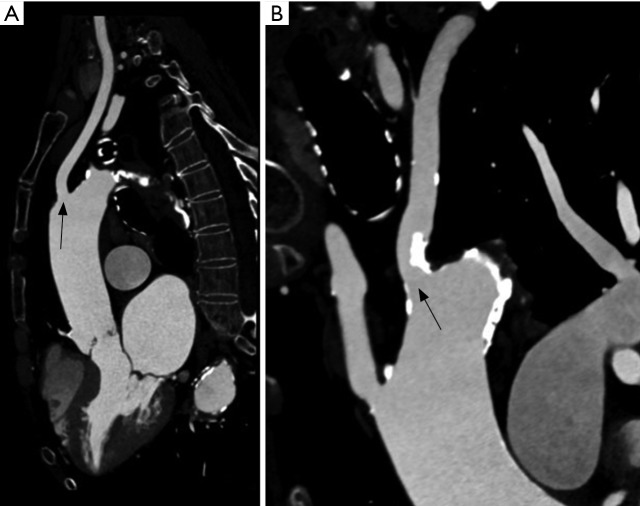
TAVR-CT in a patient that underwent left carotid access. (A) Left common carotid artery (arrow) with suitable anatomy with MLD greater than 7 mm; (B) left axillary (arrow) with significant calcified ostial stenosis that is unsuitable for a left axillary approach. TAVR, transcatheter aortic valve replacement; MLD, minimum lumen diameter; CT, computed tomography.
Figure 6
Figure 6
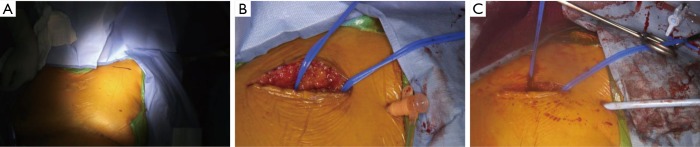
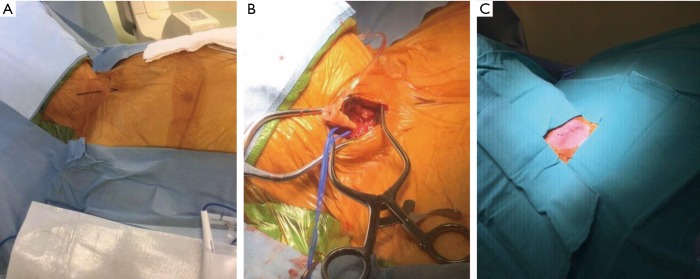
Right carotid artery cutdown technique. (A) Marked incision site for right carotid artery access; (B) cutdown with isolation of the right carotid artery; 7-French sheath inserted into the right carotid artery; (C) final carotid access site image after repair of the right carotid artery and skin closure.
Figure 7
Figure 7
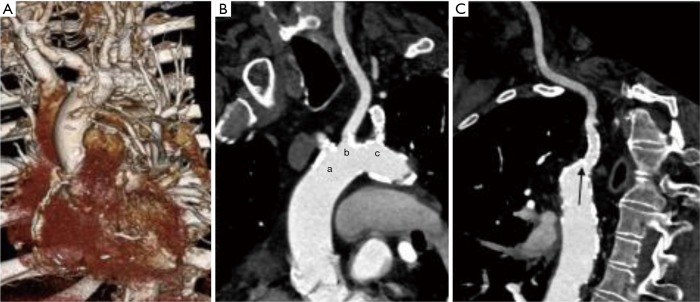
TAVR-CT in a patient that underwent direct aortic access. (A) 3D images from TeraRecon software demonstrating ascending aorta and aortic arch demonstrating appropriate landing zone above saphenous vein graft; (B) TAVR-CT images demonstrating calcified ostial stenosis of right brachiocephalic (a), left common carotid (b), and left axillary (c); (C) TAVR-CT demonstrating left axillary artery (arrow) with ostial stent. Left axillary artery was of borderline MLD and avoided given a patent LIMA to the left anterior descending artery. TAVR, transcatheter aortic valve replacement; MLD, minimum lumen diameter; CT, computed tomography.

References

    1. Popma JJ, Deeb GM, Yakubov SJ, et al. Transcatheter Aortic-Valve Replacement with a Self-Expanding Valve in Low-Risk Patients. N Engl J Med 2019;380:1706-15. 10.1056/NEJMoa1816885 - DOI - PubMed
    1. Mack MJ, Leon MB, Thourani VH, et al. Transcatheter Aortic-Valve Replacement with a Balloon-Expandable Valve in Low-Risk Patients. N Engl J Med 2019;380:1695-705. 10.1056/NEJMoa1814052 - DOI - PubMed
    1. Kundi H, Strom JB, Valsdottir LR, et al. Trends in Isolated Surgical Aortic Valve Replacement According to Hospital-Based Transcatheter Aortic Valve Replacement Volumes. JACC Cardiovasc Interv 2018;11:2148-56. 10.1016/j.jcin.2018.07.002 - DOI - PubMed
    1. Vemulapalli S, Carroll JD, Mack MJ, et al. Procedural Volume and Outcomes for Transcatheter Aortic-Valve Replacement. N Engl J Med 2019;380:2541-50. 10.1056/NEJMsa1901109 - DOI - PubMed
    1. Adams DH, Popma JJ, Reardon MJ, et al. Transcatheter Aortic-Valve Replacement with a Self-Expanding Prosthesis. N Engl J Med 2014;370:1790-8. 10.1056/NEJMoa1400590 - DOI - PubMed