


The Use of Patient-Facing Teleconsultations in the National Health Service: Scoping Review
- PMID: 32175911
- PMCID: PMC7105931
- DOI: 10.2196/15380
The Use of Patient-Facing Teleconsultations in the National Health Service: Scoping Review
Abstract
Background: The National Health Service (NHS) Long-Term Plan has set out a vision of enabling patients to access digital interactions with health care professionals within 5 years, including by video link.
Objective: This review aimed to examine the extent and nature of the use of patient-facing teleconsultations within a health care setting in the United Kingdom and what outcome measures have been assessed.
Methods: We conducted a systematic scoping review of teleconsultation studies following the Joanna Briggs Institute methodology. PubMed, Scopus, the Cochrane Library, and the Cumulative Index to Nursing and Allied Health Literature were searched up to the end of December 2018 for publications that reported on the use of patient-facing teleconsultations in a UK health care setting.
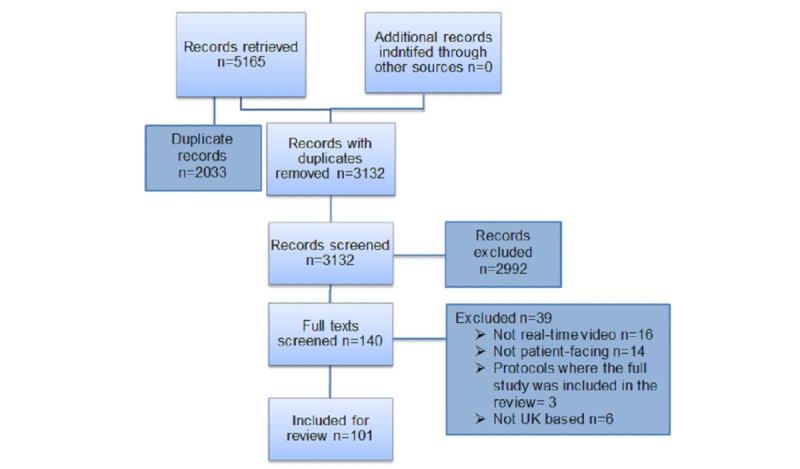
Results: The search retrieved 3132 publications, of which 101 were included for a full review. Overall, the studies were heterogeneous in design, in the specialty assessed, and reported outcome measures. The technology used for teleconsultations changed over time with earlier studies employing bespoke, often expensive, solutions. Two-thirds of the studies, conducted between 1995 and 2005, used this method. Later studies transitioned to Web-based commercial solutions such as Skype. There were five outcome measures that were assessed: (1) technical feasibility, (2) user satisfaction, (3) clinical effectiveness, (4) cost, (5) logistical and operational considerations. Due to the changing nature of technology over time, there were differing technical issues across the studies. Generally, teleconsultations were acceptable to patients, but this was less consistent among health care professionals. However, among both groups, face-to-face consultations were still seen as the gold standard. A wide range of clinical scenarios found teleconsultations to be clinically useful but potentially limited to more straightforward clinical interactions. Due to the wide array of study types and changes in technology over time, it is difficult to draw definitive conclusions on the cost involved. However, cost savings for health care providers have been demonstrated by the goal-directed implementation of teleconsultations. The integration of technology into routine practice represents a complex problem with barriers identified in funding and hospital reimbursement, information technologies infrastructure, and integration into clinicians' workflow.
Conclusions: Teleconsultations appear to be safe and effective in the correct clinical situations. Where offered, it is likely that patients will be keen to engage, although teleconsultations should only be offered as an option to support traditional care models rather than replace them outright. Health care staff should be encouraged and supported in using teleconsultations to diversify their practice. Health care organizations need to consider developing a digital technology strategy and implementation groups to assist health care staff to integrate digitally enabled care into routine practice. The introduction of new technologies should be assessed after a set period with service evaluations, including feedback from key stakeholders.
Keywords: scoping review; teleconsultation; telehealth; telemedicine.
©Micheal O'Cathail, M Ananth Sivanandan, Claire Diver, Poulam Patel, Judith Christian. Originally published in JMIR Medical Informatics (http://medinform.jmir.org), 16.03.2020.
Conflict of interest statement
Conflicts of Interest: None declared.
Figures
References
-
- NHS England. 2015. Jan, [2018-07-03]. Technology Enabled Care Services https://www.england.nhs.uk/wp-content/uploads/2014/12/TECS_FinalDraft_09....
-
- Verhoeven F, van Gemert-Pijnen L, Dijkstra K, Nijland N, Seydel E, Steehouder M. The contribution of teleconsultation and videoconferencing to diabetes care: a systematic literature review. J Med Internet Res. 2007 Dec 14;9(5):e37. doi: 10.2196/jmir.9.5.e37. https://www.jmir.org/2007/5/e37/ - DOI - PMC - PubMed
-
- NHS Long Term Plan. [2019-02-14]. https://www.longtermplan.nhs.uk/
-
- Arksey H, O'Malley L. Scoping studies: towards a methodological framework. Int J Soc Res Methodol. 2005;8(1):19–32. doi: 10.1080/1364557032000119616. http://www.tandfonline.com/doi/abs/10.1080/1364557032000119616 - DOI - DOI
Publication types
LinkOut - more resources
Full Text Sources
