


Acupuncture attenuates postoperative inflammation in patients after craniotomy: A prospective, open-label, controlled trial
- PMID: 32176032
- PMCID: PMC7440145
- DOI: 10.1097/MD.0000000000019071
Acupuncture attenuates postoperative inflammation in patients after craniotomy: A prospective, open-label, controlled trial
Abstract
Background: It is important to manage inflammation after craniotomy. It may be prudent to reduce the excessive usage of antibiotics and to add supplementary treatments like acupuncture, which would be effective and safe. However, there are only a few studies available to date on the effects of acupuncture on anti-inflammatory response after craniotomy. The aim of this study was to explore the anti-inflammatory effects of acupuncture in patients after a craniotomy.
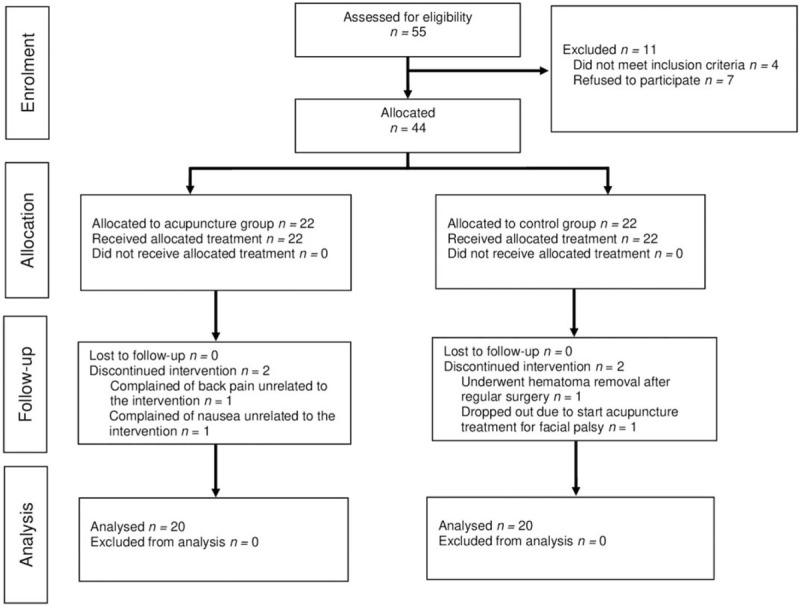
Methods: This study was a single-center, prospective, open-label, controlled trial. Forty-four subjects who underwent craniotomy for an unruptured aneurysm, facial spasm, or brain tumor were allocated to either an acupuncture group or a control group. Both groups received postoperative routine care in the Department of Neurosurgery. The subjects in the acupuncture group also received a total of 6 acupuncture treatments sessions within 8 days after craniotomy. Acupuncture treatments included acupuncture, electroacupuncture, and intradermal acupuncture. The serum interleukin (IL)-1β and IL-6, tumor necrosis factor-α (TNF-α), C-reactive protein (CRP), and erythrocyte sedimentation rate levels were assessed four times within 7 days after surgery. The presence of fever, use of additional antibiotics, presence of infection including pneumonia or urinary tract infection, and safety were also reviewed.
Results: The IL-1β levels of subjects who underwent aneurysmal clipping were significantly lower in the acupuncture group (P = .02). TNF-α levels of subjects who underwent aneurysmal clipping at the seventh postoperative day were also significantly lower in the acupuncture group (P = .03). Six cases of fever of unknown origin were observed in the control group, while none were seen in the acupuncture group, revealing that the incidence of fever was significantly lower in the acupuncture group (P = .02). No adverse events occurred during the trial.
Conclusion: Acupuncture showed a possibility of alleviating inflammation by attenuating the levels of proinflammatory cytokines and significantly reduced the incidence of fever of unknown origin in patients after craniotomy. Acupuncture would be suitable as an adjunctive therapy to alleviate inflammation after craniotomy.
Conflict of interest statement
The authors have no funding and conflicts of interest to disclose.
References
-
- van de Beek D, Drake JM, Tunkel AR. Nosocomial bacterial meningitis. N Engl J Med 2010;362:146–54. - PubMed
-
- Liu W, Ni M, Zhang Y, et al. Antibiotic prophylaxis in craniotomy: a review. Neurosurg Rev 2014;37:407–14. - PubMed
-
- Alotaibi AF, Mekary RA, Zaidi HA, et al. Safety and efficacy of antibacterial prophylaxis after craniotomy: a decision model analysis. World Neurosurg 2017;105:906–12. - PubMed
-
- Asmussen S, Maybauer DM, Chen JD, et al. Effects of acupuncture in anesthesia for craniotomy: a meta-analysis. J Neurosurg Anesthesiol 2017;29:219–27. - PubMed
-
- Xu M, Zhou SJ, Jiang CC, et al. The effects of P6 electrical acustimulation on postoperative nausea and vomiting in patients after infratentorial craniotomy. J Neurosurg Anesthesiol 2012;24:312–6. - PubMed
Publication types
MeSH terms
Substances
LinkOut - more resources
Full Text Sources
Medical
Research Materials
Miscellaneous
