


Convergent Catalytic Asymmetric Synthesis of Esters of Chiral Dialkyl Carbinols
- PMID: 32176494
- PMCID: PMC7580270
- DOI: 10.1021/jacs.0c01324
Convergent Catalytic Asymmetric Synthesis of Esters of Chiral Dialkyl Carbinols
Abstract
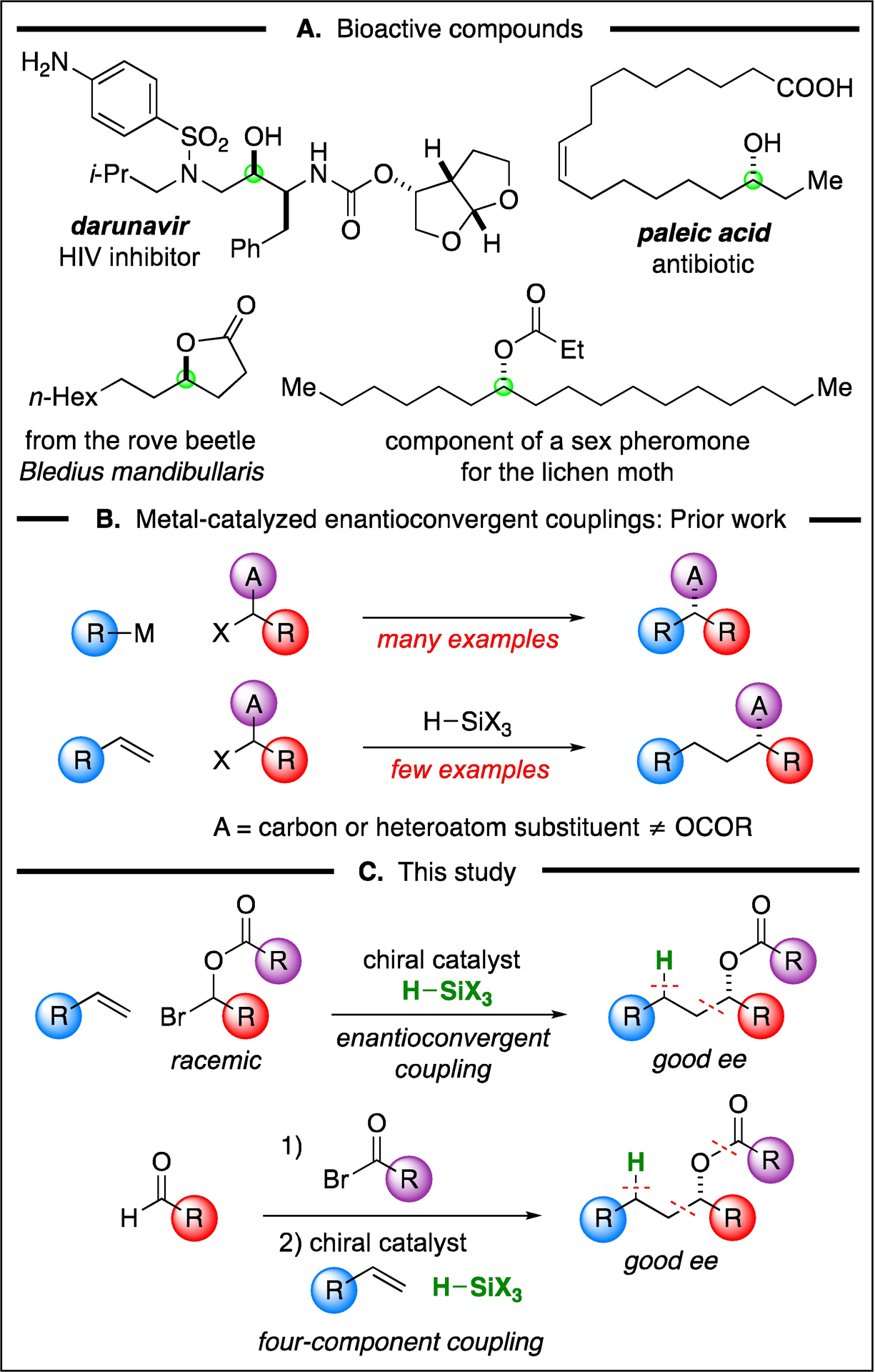
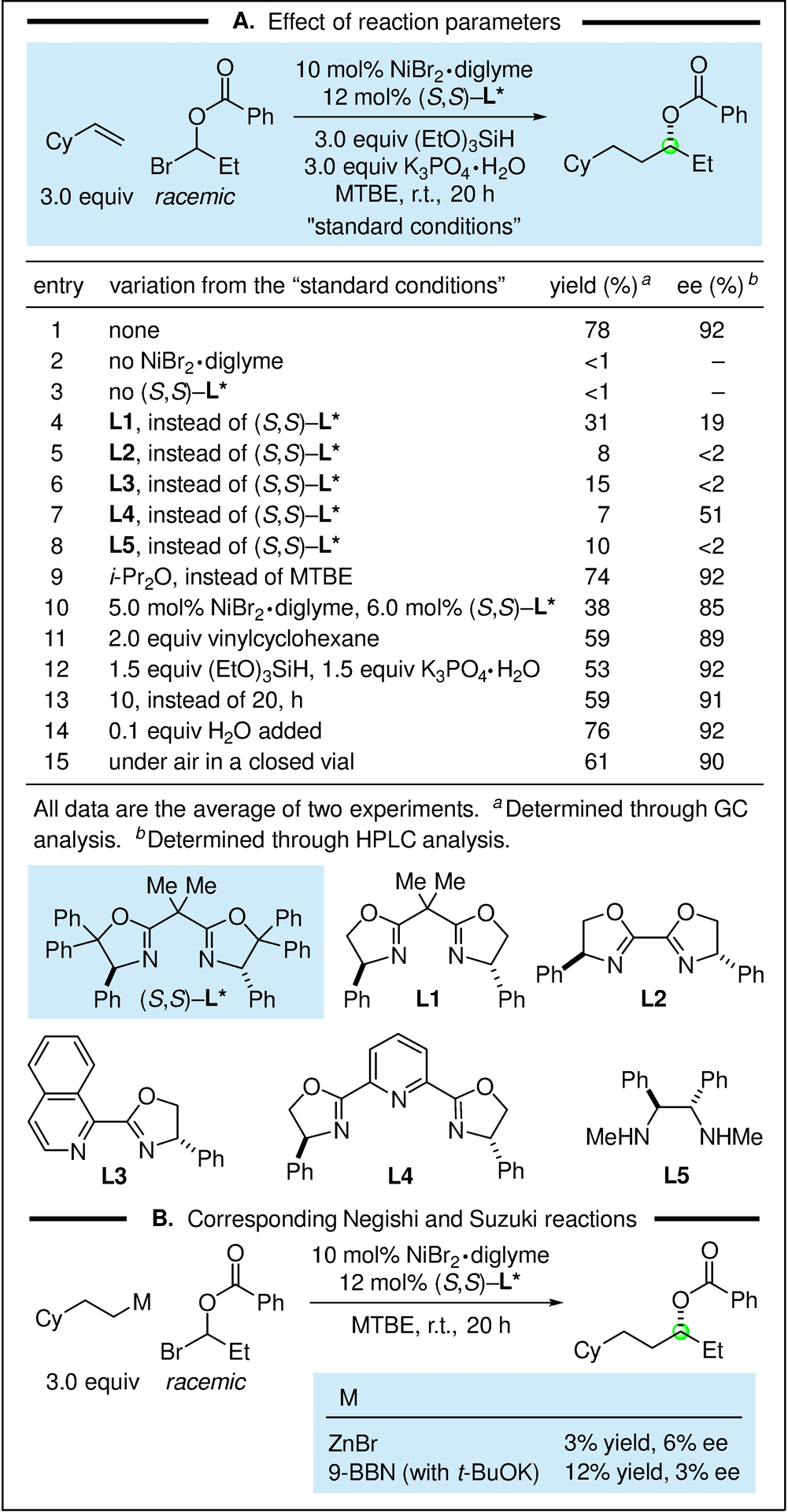
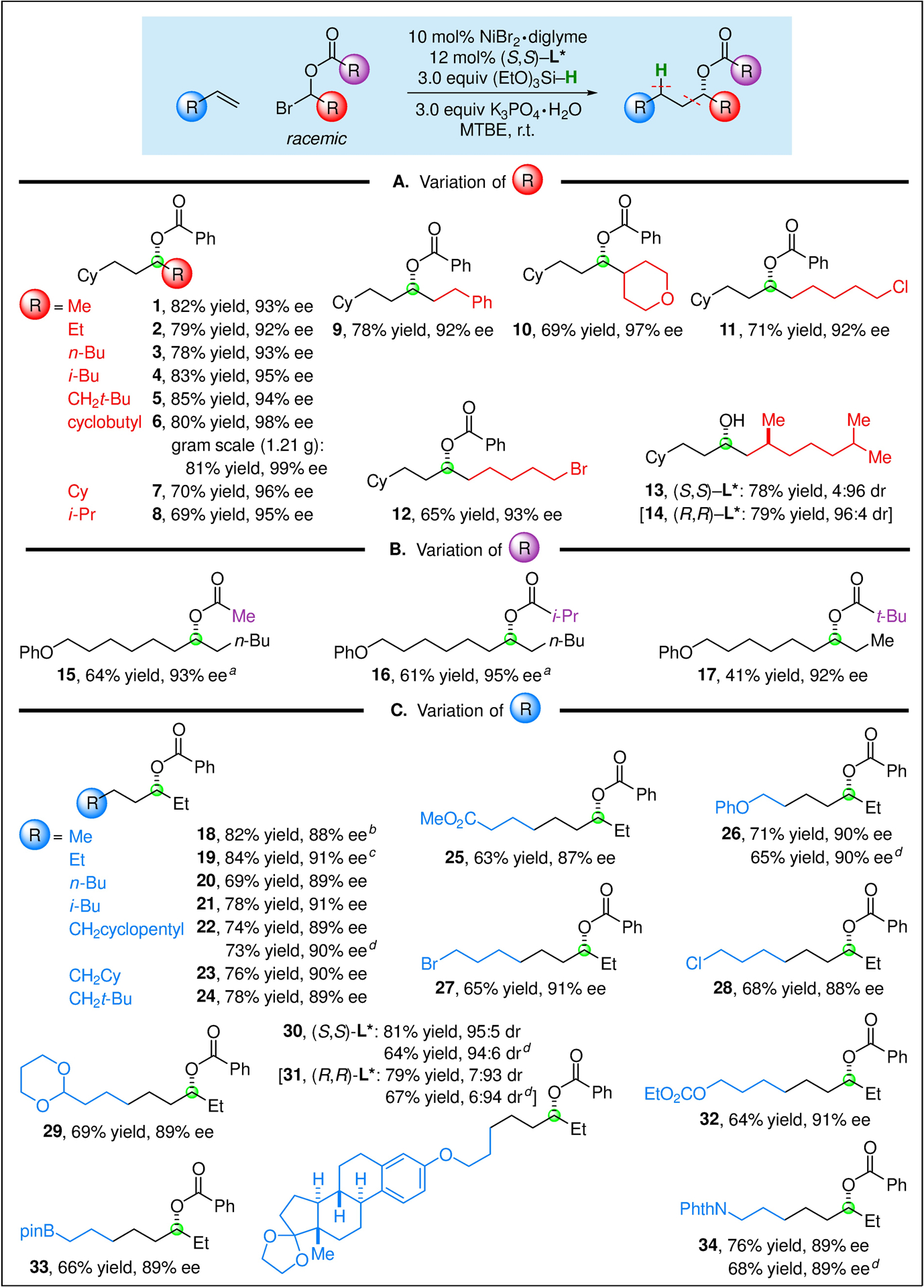
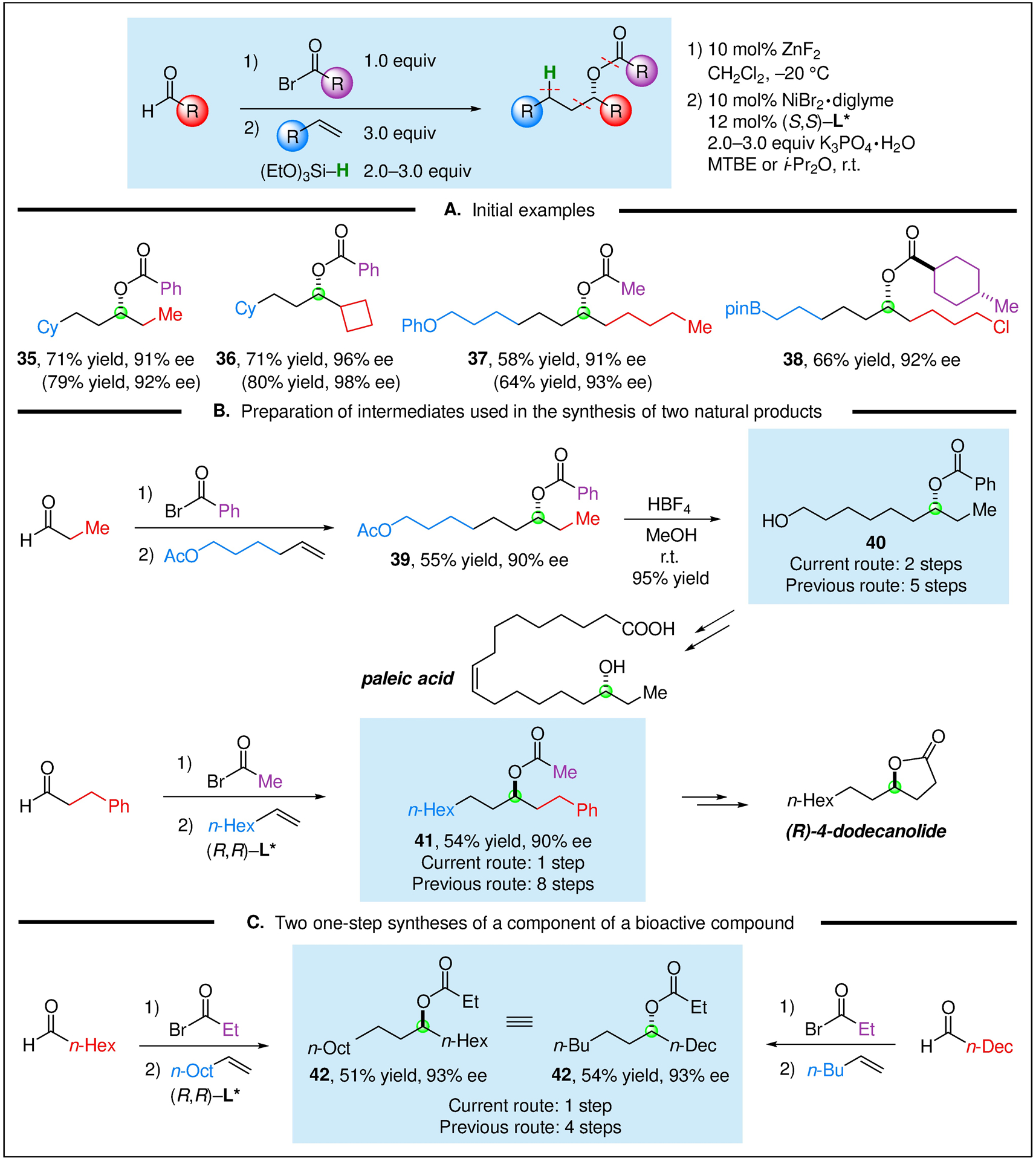
Because chiral dialkyl carbinols, as well as their derived esters, are significant as intermediates and end points in fields such as organic, pharmaceutical, and biological chemistry, the development of efficient approaches to their asymmetric synthesis is an important endeavor. In this report, we describe a method for the direct catalytic enantioselective synthesis of such esters, beginning with an alkyl halide (derived from an aldehyde and an acyl bromide), an olefin, and a hydrosilane, catalyzed by nickel, an earth-abundant metal. The method is versatile, tolerating substituents that vary in size and that bear a range of functional groups. We further describe a four-component variant of this process, wherein the alkyl halide is generated in situ, thus obviating the need to isolate either an alkyl electrophile or an alkylmetal, while still effecting an alkyl-alkyl coupling. Finally, we apply our convergent method to the efficient catalytic enantioselective synthesis of three esters that are bioactive themselves or that have been utilized in the synthesis of bioactive compounds.
Conflict of interest statement
The authors declare no competing financial interest.
Figures
References
-
- For overviews, see:
- Arai N; Ohkuma T Reduction of Carbonyl Groups: Hydrogenation Science of Synthesis, Stereoselective Synthesis; De Vries JG; Molander GA; Evans PA, Eds.; Georg Thieme Verlag: Stuttgart, 2011; Vol. 2, pp. 9–57.
- Zaidlewicz M; Pakulski MM Reduction of Carbonyl Groups: Transfer Hydrogenation, Hydrosilylation, Catalytic Hydroboration, and Reduction with Borohydrides, Aluminum Hydrides, or Boranes Science of Synthesis, Stereoselective Synthesis; De Vries JG; Molander GA; Evans PA, Eds.; Georg Thieme Verlag: Stuttgart, 2011; Vol. 2, pp. 59–131.
- Stefane B; Pozgan F Advances in Catalyst Systems for the Asymmetric Hydrogenation and Transfer Hydrogenation of Ketones Catal. Rev 2014, 56, 82–174.
-
- Ramon DJ; Yus M Alkylation of Carbonyl and Imino Groups Science of Synthesis, Stereoselective Synthesis; De Vries JG; Molander GA; Evans PA, Eds.; Georg Thieme Verlag: Stuttgart, 2011; Vol. 2, pp. 349–400.
-
- For illustrative examples, see:
- León F; González-Liste PJ; García-Garrido SE; Arribas I; Rubio M; Cadierno V; Pizzano A Broad Scope Synthesis of Ester Precursors of Nonfunctionalized Chiral Alcohols Based on the Asymmetric Hydrogenation of α,β-Dialkyl‐, α,β-Diaryl‐, and α‐Alkyl-β-aryl-vinyl Esters. J. Org. Chem 2017, 82, 5852–5867. - PubMed
- Schmidt J; Choi J; Liu AT; Slusarczyk M; Fu GC A General, Modular Method for the Catalytic Asymmetric Synthesis of Alkylboronate Esters. Science 2016, 354, 1265–1269. - PMC - PubMed
-
- Fu GC Transition-Metal Catalysis of Nucleophilic Substitution Reactions: A Radical Alternative to SN1 and SN2 Processes. ACS Cent. Sci 2017, 3, 692–700. - PMC - PubMed
- Choi J; Fu GC Transition Metal-Catalyzed Alkyl–Alkyl Bond Formation: Another Dimension in Cross-Coupling Chemistry. Science 2017, 356, eaaf7230. - PMC - PubMed
- Kaga A; Chiba S Engaging Radicals in Transition Metal-Catalyzed Cross-Coupling with Alkyl Electrophiles: Recent Advances. ACS Catal. 2017, 7, 4697–4706.
- Iwasaki T; Kambe N Ni-Catalyzed C–C Couplings using Alkyl Electrophiles. Top. Curr. Chem 2016, 374, 66. - PubMed
- Geist E; Kirschning A; Schmidt T sp3-sp3 Coupling Reactions in the Synthesis of Natural Products and Biologically Active Molecules. Nat. Prod. Rep 2014, 31, 441–448. - PubMed
Publication types
MeSH terms
Substances
Grants and funding
LinkOut - more resources
Full Text Sources
