


Provider Counseling and Women's Family Planning Decisions in the Postpartum Period
- PMID: 32176571
- PMCID: PMC8104026
- DOI: 10.1089/jwh.2019.7872
Provider Counseling and Women's Family Planning Decisions in the Postpartum Period
Abstract
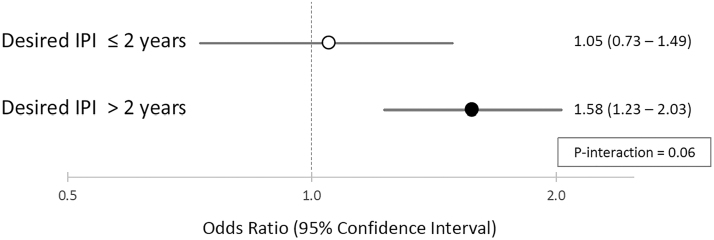
Introduction: Provider counseling may influence women's postpartum family planning decisions. Materials and Methods: We conducted an anonymous Internet-based cross-sectional survey of postpartum women regarding multiple topics, including prenatal/postpartum care and family planning. We used multivariable logistic regression to determine associations between quantity of provider counseling (indexed as number of family planning topics discussed with a health care provider) and women's decisions regarding contraception and pregnancy spacing. Results: From January to May 2016, 2,850 women completed the survey and met inclusion criteria. Among this group, the majority were white (93%), ≥30 years (63%), and had obtained a college degree or higher (74%). Approximately half (49%) desired an interpregnancy interval (IPI) >2 years, and the minority (21%) used a highly effective contraceptive method (defined as long-acting reversible contraception or sterilization). The majority of women (56%) had received counseling on three to six family planning topics (defined as "more counseling" in regression models). Women who received more counseling were more likely to use a highly effective contraceptive method (adjusted odds ratio [AOR] 1.33, confidence interval [95% CI] 1.09-1.62) but were not more likely to desire an IPI >2 years (AOR 0.96, 95% CI 0.81-1.14). Desired IPI modified the association between provider counseling and contraception (p = 0.06 for interaction): Among those desiring an IPI >2 years, more counseling was associated with use of a highly effective contraceptive method (AOR 1.58, 95% CI 1.23-2.03), but this was not observed among those desiring a shorter IPI (AOR 1.05, 95% CI 0.73-1.49). Conclusions: Contraceptive decisions depend on both provider counseling and patient goals.
Keywords: contraception; family planning education; postpartum; pregnancy interval.
Conflict of interest statement
No competing financial interests exist.
Figures
References
-
- Conde-Agudelo A, Rosas-Bermudez A, Castaño F, Norton MH. Effects of birth spacing on maternal, perinatal, infant, and child health: A systematic review of causal mechanisms. Stud Fam Plann 2012;43:93–114 - PubMed
-
- Copen CE, Thoma ME, Kirmeyer S. Interpregnancy intervals in the United States: Data from the birth certificate and the national survey of family growth. Natl Vital Stat Rep 2015;64:1–11 - PubMed
MeSH terms
Substances
Grants and funding
LinkOut - more resources
Full Text Sources
Medical
Miscellaneous
