. 2020 Mar 16;16(3):e1008341.
doi: 10.1371/journal.ppat.1008341. eCollection 2020 Mar.

Identification of amitriptyline HCl, flavin adenine dinucleotide, azacitidine and calcitriol as repurposing drugs for influenza A H5N1 virus-induced lung injury

Affiliations

Identification of amitriptyline HCl, flavin adenine dinucleotide, azacitidine and calcitriol as repurposing drugs for influenza A H5N1 virus-induced lung injury

Fengming Huang et al. PLoS Pathog. .

Abstract

Infection with avian influenza A H5N1 virus results in acute lung injury (ALI) and has a high mortality rate (52.79%) because there are limited therapies available for treatment. Drug repositioning is an economical approach to drug discovery. We developed a method for drug repositioning based on high-throughput RNA sequencing and identified several drugs as potential treatments for avian influenza A H5N1 virus. Using high-throughput RNA sequencing, we identified a total of 1,233 genes differentially expressed in A549 cells upon H5N1 virus infection. Among these candidate genes, 79 drug targets (corresponding to 59 approved drugs) overlapped with the DrugBank target database. Twenty-two of the 41 commercially available small-molecule drugs reduced H5N1-mediated cell death in cultured A549 cells, and fifteen drugs that protected A549 cells when administered both pre- and post-infection were tested in an H5N1-infection mouse model. The results showed significant alleviation of acute lung injury by amitriptyline HCl (an antidepressant drug), flavin adenine dinucleotide (FAD; an ophthalmic agent for vitamin B2 deficiency), azacitidine (an anti-neoplastic drug) and calcitriol (an active form of vitamin D). All four agents significantly reduced the infiltrating cell count and decreased the lung injury score in H5N1 virus-infected mice based on lung histopathology, significantly improved mouse lung edema by reducing the wet-to-dry weight ratio of lung tissue and significantly improved the survival of H5N1 virus-infected mice. This study not only identifies novel potential therapies for influenza H5N1 virus-induced lung injury but also provides a highly effective and economical screening method for repurposing drugs that may be generalizable for the prevention and therapy of other diseases.


Conflict of interest statement

The authors have declared that no competing interests exist.

Figures
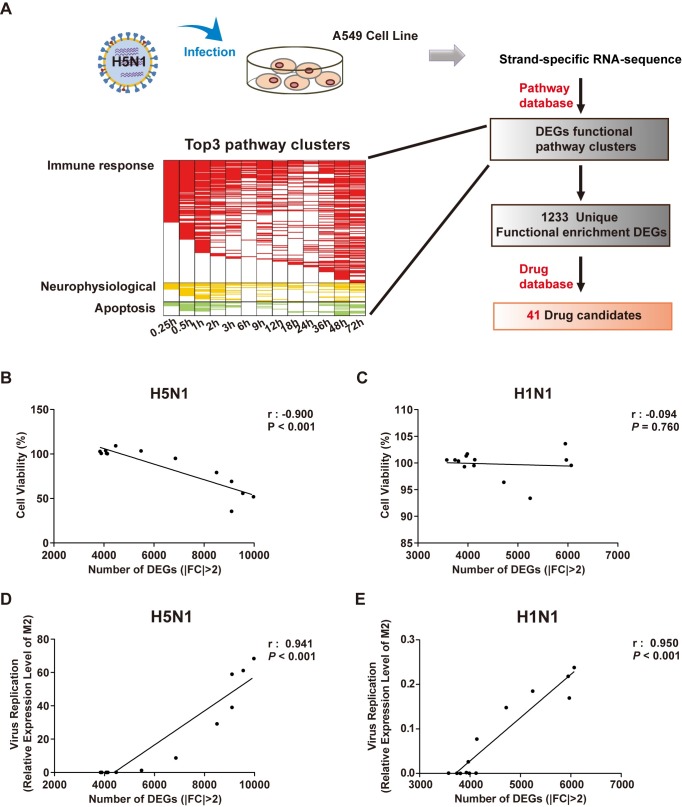
Fig 1
Fig 1. Screening of candidate drugs against H5N1 infection.
(A) Schematic diagram of strand-specific RNA sequencing for drug candidate selection and functional enrichment pathways of differentially expressed genes at 0, 15 min, 30 min, 1 h, 2 h, 3 h, 6 h, 9 h, 12 h, 18 h, 24 h, 36 h, and 48 h after H5N1 infection in A549 cells. The heatmap shows pathways related to immune responses (red), neurophysiology (yellow), and apoptosis (green), with a two-tailed P value < 0.05 and multiple-testing Benjamini & Hochberg correction < 0.05. (B-E) Correlation between the numbers of DEGs in H1N1/H5N1-infected and control cells. (B, C) Cell viability based on the MTS assay. (D, E) Virus replication based on M2 expression by RT-PCR. Cell viability and viral replication were measured at 0 h, 15 min, 30 min, 1 h, 2 h, 3 h, 6 h, 9 h, 12 h, 18 h, 24 h, 36 h, and 48 h after H5N1 or H1N1 infection. The Pearson correlation coefficient (r) and P value are provided in the graph. DEG, differentially expressed genes; FC, fold change.
Fig 2
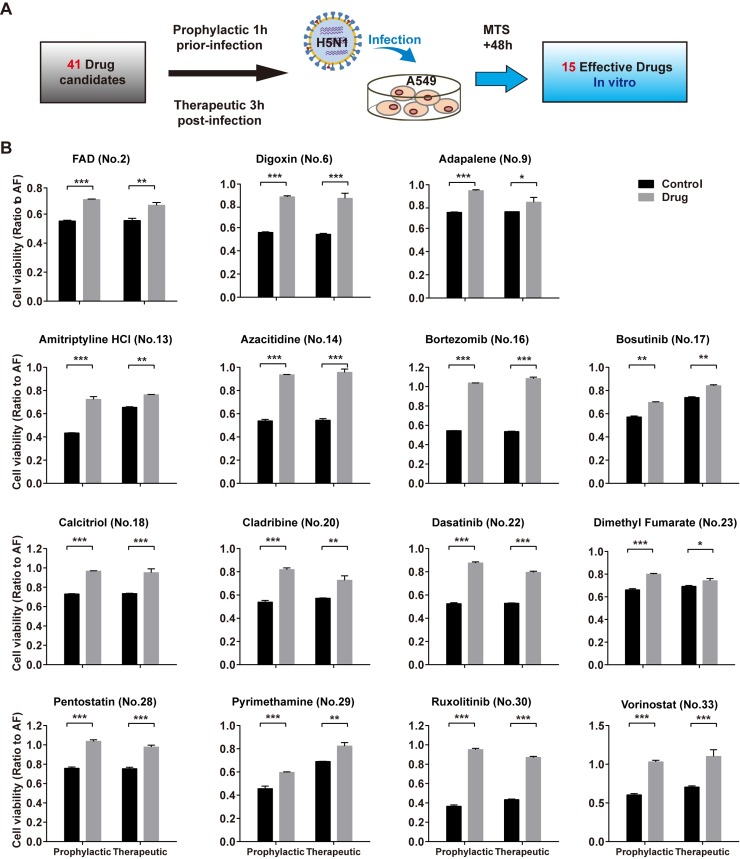
Fig 2. In vitro validation of candidate drugs against H5N1 in the A549 cell line.
(A) Flowchart of screening for drugs against H5N1 infection in A549 cells. (B) Viabilities of A549 cells based on the MTS assay at 48 h after H5N1 virus infection. Cells were treated with drug or vehicle (control) either at 1 h before infection or at 3 h after infection. Data are presented as the mean ± SEM. All experiments were repeated at least twice. *P<0.05, **P<0.01, ***P<0.001 (two-tailed multiple comparison t-test with Holm-Sidak method, n = 3 biological replicates). Detailed information about in vitro drug treatment is shown in S2 Table.
Fig 3
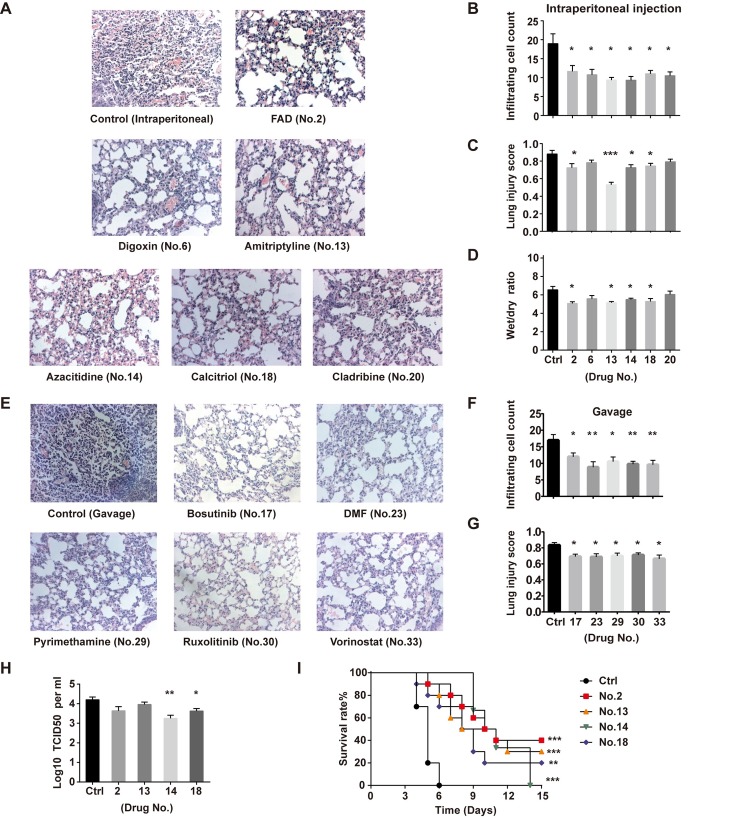
Fig 3. In vivo validation of candidate drugs against H5N1 in mice.
Animals were infected with H5N1 (106 TCID50) by intratracheal instillation and treated with drug intraperitoneally or gavage and then analyzed at 3 d after infection. (A) Images of lung pathology in mice following drug treatment by intraperitoneal injection. Magnification, 200×. For each treatment, 100 fields were analyzed (n = 4–6 mice per group). (B) Infiltrating cell numbers and (C) lung injury scores per microscopic field (mean ± SEM) are shown in the bar graphs. (D) Wet to dry weight ratios (mean ± SEM) of mouse lungs at 3 d after infection with drug treatment intraperitoneally. (E) Images of lung pathology in mice following drug treatment by gavage. Magnification, 200×. For each treatment, 100 fields were analyzed (n = 4–6 mice per group). (F) Infiltrating cell numbers and (G) lung injury scores per microscopic field (mean ± SEM) are shown in the bar graphs. (H) Viral titers of mouse lungs (mean ± SEM) are expressed as TCID50 per milliliter (n = 4–5 mice per group). All experiments were performed at least twice. *P<0.05, **P<0.01, ***P<0.001 (two-tailed one-way ANOVA). (I) Kaplan-Meier survival curves of H5N1-infected C57BL/6 mice treated with FAD (n = 10), amitriptyline HCl (n = 10), azacitidine (n = 6), and calcitriol (n = 10) or vehicle (n = 10) by intraperitoneal injection. **P<0.01, ***P<0.001 (log-rank test).
Fig 4
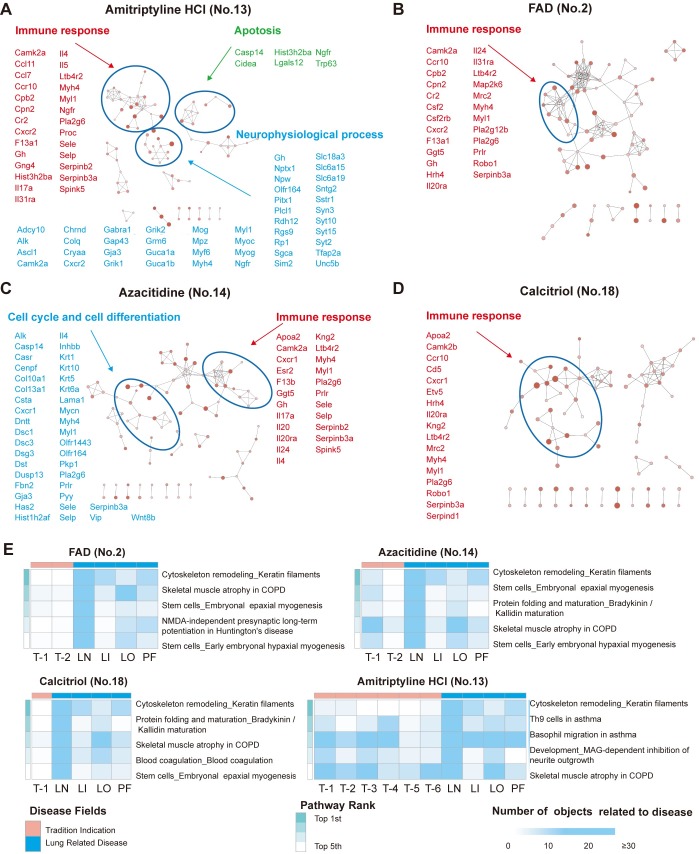
Fig 4. Functional processes and pathways influenced by amitriptyline HCl, FAD, azacitidine and calcitriol in H5N1-infected mice.
Animals (n = 3–5) administered drugs were infected with H5N1 (106 TCID50) by intratracheal instillation. Lung tissues were sampled for RNA-seq analysis at 2 d after H5N1 infection. Functional processes and pathways from DEGs influenced by drug administration were enriched by Metacore. (A-D) Process network enrichment of DEGs influenced by (A) amitriptyline HCl (no. 13), (B) FAD (no. 2), (C) azacitidine (no. 14) and (D) calcitriol (no. 18) treatment in H5N1-infected mice. Cytoscape with the Enrichment Map application was used for visualization. Nodes represent enrichment process networks; connections indicate shared objects between process networks. DEGs involved in the process networks are shown in the figure. The significance level and the object count enriched in the processes are reflected by the node color and node size, respectively. (E) Heatmaps of RNA sequencing data showing the numbers of objects related to traditional drug indications or a repurposed indication of lung-related disease in functional enrichment pathways of mouse lung tissue. Pathways with a two-tailed P value < 0.05 and multiple-testing Benjamini & Hochberg correction < 0.05 were considered significant. Abbreviations: LN, lung neoplasm; LI, lung disease (interstitial); LO, lung disease (obstructive); PF: pulmonary fibrosis; T, traditional indication-related disease. Detailed information about pathways and diseases related objects in the pathways is shown in S3–S6 Tables.

References

    1. Van Norman GA. Overcoming the Declining Trends in Innovation and Investment in Cardiovascular Therapeutics: Beyond EROOM's Law. JACC Basic to translational science. 2017;2(5):613–25. 10.1016/j.jacbts.2017.09.002 - DOI - PMC - PubMed
    1. Nosengo N. Can you teach old drugs new tricks? Nature. 2016;534(7607):314–6. 10.1038/534314a - DOI - PubMed
    1. Bauer TT, Ewig S, Rodloff AC, Muller EE. Acute respiratory distress syndrome and pneumonia: a comprehensive review of clinical data. Clinical infectious diseases: an official publication of the Infectious Diseases Society of America. 2006;43(6):748–56. - PMC - PubMed
    1. Peiris JS, Cheung CY, Leung CY, Nicholls JM. Innate immune responses to influenza A H5N1: friend or foe? Trends in immunology. 2009;30(12):574–84. 10.1016/j.it.2009.09.004 - DOI - PMC - PubMed
    1. Perwitasari O, Yan X, O'Donnell J, Johnson S, Tripp RA. Repurposing Kinase Inhibitors as Antiviral Agents to Control Influenza A Virus Replication. Assay Drug Dev Technol. 2015;13(10):638–49. 10.1089/adt.2015.0003.drrr - DOI - PMC - PubMed

Publication types

MeSH terms