. 2020 Mar 16;15(3):e0230261.
doi: 10.1371/journal.pone.0230261. eCollection 2020.

Clinical implications of APOBEC3A and 3B expression in patients with breast cancer

Affiliations

Clinical implications of APOBEC3A and 3B expression in patients with breast cancer

Yong-Seok Kim et al. PLoS One. .

Abstract

Background: We aimed to evaluate the expression of APOBEC3A (A3A), 3B (A3B) mRNA, and germline APOBEC3A/B deletion polymorphism in patients with breast cancers and to investigate the correlation between their expressions and clinicopathological characteristics.

Methods: RNA and DNA samples were extracted from 138 breast cancer tissues and adjacent normal breast tissues. The levels of A3A and A3B mRNA transcripts were determined using quantitative real-time polymerase chain reaction. Insertion and deletion PCR assays were performed to detect the A3B deletion allele. The serum concentrations of soluble programmed death-ligand 1 (sPD-L1) and interferon gamma were determined using enzyme-linked immunosorbent assays.

Results: A3B mRNA expression levels were significantly higher in triple-negative breast cancers compared to hormone receptor-positive, human epidermal growth factor receptor 2-negative breast cancers. Older age of the patient and high ki-67 expression were associated with increased expression levels of A3A and A3B mRNA. Advanced tumor stage, presence of lymph node involvement, and high histological grade were associated with increased expression levels of A3A mRNA. The APOBEC3A/B deletion allele was found in 77 (55.8%) patients. TP53 and PIK3CA mutations were detected in 62 (44.9%) and 31 (22.5%) patients, respectively. The presence of a PIK3CA mutation was associated with lower A3A mRNA expression levels. There was a weak positive relationship between A3A mRNA expression levels and serum sPD-L1 levels.

Conclusions: There was a difference in A3B mRNA expression levels according to breast cancer subtypes, and high levels of A3A and A3B mRNA expressions were associated with an aggressive phenotype. There was a high incidence of APOBEC3A/B deletion allele. Further studies are needed to identify the clinical significance of APOBEC in Asian patients with breast cancer.


Conflict of interest statement

The authors have declared that no competing interests exist.

Figures
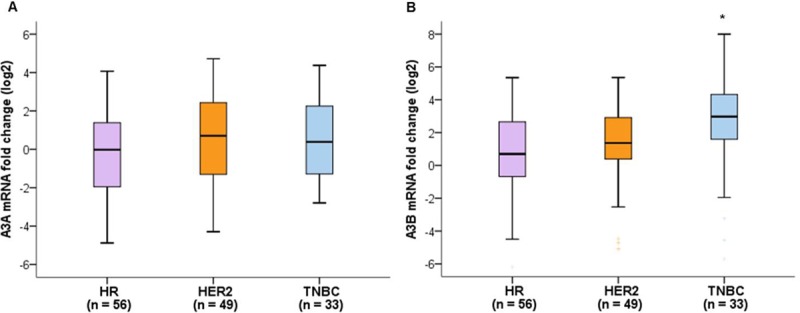
Fig 1
Fig 1. Comparative quantification of APOBEC mRNA expression according to breast cancer subtypes.
(A) A3A mRNA expression levels showed a tendency to be higher in HER2-positive breast cancer (p = 0.158). (B) A3B mRNA expression levels were significantly higher in triple-negative breast cancers compared to HR-negative, HER2-positive breast cancers (p = 0.004). The significance between groups was tested using Kruskal-Wallis test followed by Dunn’s multiple comparison post hoc test. Global p-values are indicated.*p < 0.05.
Fig 2
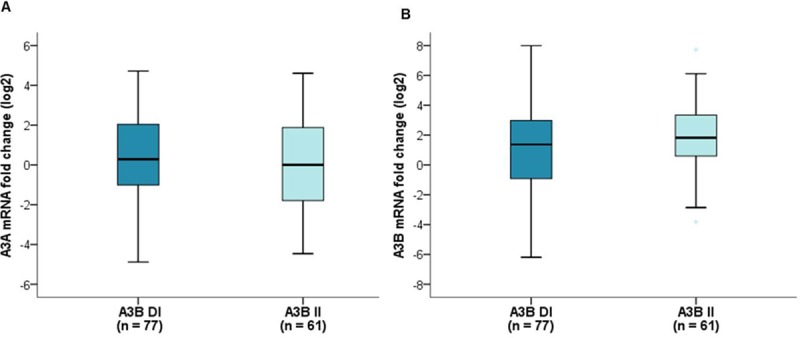
Fig 2. Comparative quantification of APOBEC mRNA expression according to the presence of the APOBEC3A/B deletion polymorphism.
(A) There was no association between A3A mRNA expression levels and A3B deletion (p = 0.299). (B) A3B mRNA expression levels showed a tendency to be lower in breast cancers with A3B deletion (p = 0.075). A3B DI, one-copy deletion; A3B II, no deletion. Mann-Whitney U test.
Fig 3
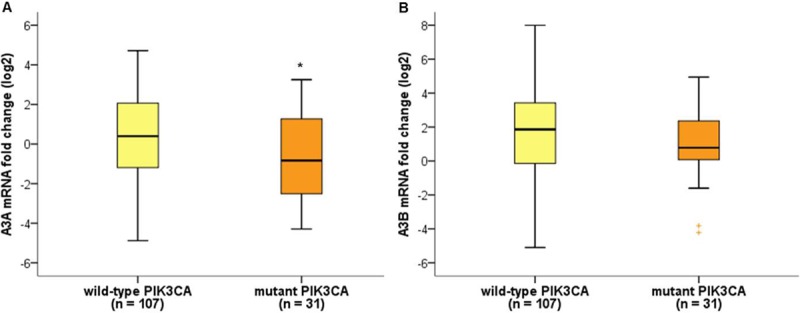
Fig 3. Comparative quantification of APOBEC mRNA expression according to PIK3CA mutation status.
(A) A3A mRNA expression levels were significantly lower in breast cancers with PIK3CA mutations (p = 0.038). (B) There was no association between A3B mRNA expression levels and PIK3CA mutation status (p = 0.127). *p < 0.05, Mann-Whitney U test.
Fig 4
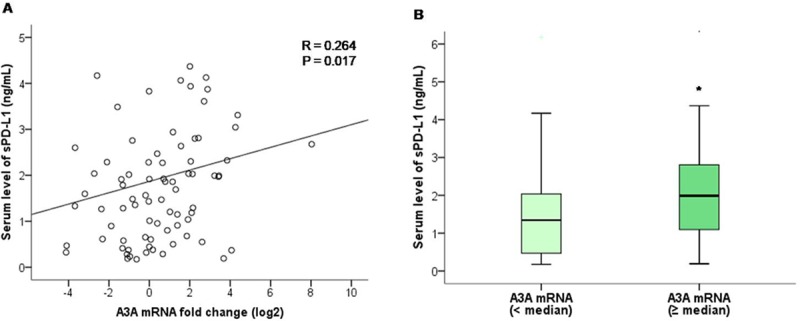
Fig 4. Correlation of serum sPDL-1 levels and APOBEC 3A mRNA expression levels.
(A) Scatter plot graph showing a positive correlation between serum sPDL-1 levels and A3A mRNA expression levels. (B) Serum levels of sPD-L1 was higher in tumors with high A3A mRNA expression levels (≥ median) than in tumors with low A3A mRNA levels (< median) (p = 0.038). *p < 0.05, Mann-Whitney U test.

References

    1. Shen Z. Genomic instability and cancer: an introduction. J Mol Cell Biol. 2011;3(1):1–3. 10.1093/jmcb/mjq057 - DOI - PubMed
    1. Yao Y, Dai W. Genomic Instability and Cancer. J Carcinog Mutagen. 2014;5. - PMC - PubMed
    1. Alexandrov LB, Nik-Zainal S, Wedge DC, Aparicio SA, Behjati S, Biankin AV, et al. Signatures of mutational processes in human cancer. Nature. 2013;500(7463):415–21. 10.1038/nature12477 - DOI - PMC - PubMed
    1. Roberts SA, Gordenin DA. Hypermutation in human cancer genomes: footprints and mechanisms. Nat Rev Cancer. 2014;14(12):786–800. 10.1038/nrc3816 - DOI - PMC - PubMed
    1. Roberts SA, Lawrence MS, Klimczak LJ, Grimm SA, Fargo D, Stojanov P, et al. An APOBEC cytidine deaminase mutagenesis pattern is widespread in human cancers. Nat Genet. 2013;45(9):970–6. 10.1038/ng.2702 - DOI - PMC - PubMed

Publication types

MeSH terms