


Trajectories of Depressive Symptoms and Neighborhood Changes from Adolescence to Adulthood: Latent Class Growth Analysis and Multilevel Growth Curve Models
- PMID: 32178245
- PMCID: PMC7143871
- DOI: 10.3390/ijerph17061829
Trajectories of Depressive Symptoms and Neighborhood Changes from Adolescence to Adulthood: Latent Class Growth Analysis and Multilevel Growth Curve Models
Abstract
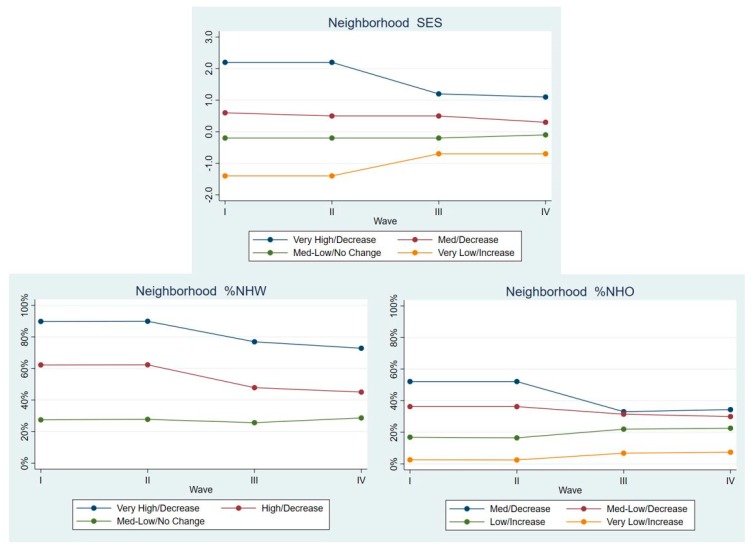
The role of neighborhood socioeconomic status (SES) and racial/ethnic composition on depression has received considerable attention in the United States. This study examines associations between trajectory patterns of neighborhood changes and depressive symptoms using data from Waves I-IV of the National Longitudinal Study of Adolescent to Adult Health. We used latent class growth analysis to determine the number and distribution of person-centered trajectories for neighborhood characteristics, and multilevel growth curve models to examine how belonging to each class impacted depression trajectories from ages 13 to 32 among non-Hispanic Whites (NHW), non-Hispanic Blacks (NHB), Hispanics, and non-Hispanic Others (NHO). The distribution of neighborhood SES classes across racial/ethnic groups suggests significant levels of economic inequality, but had no effect on depressive symptoms. A more complex picture emerged on the number and distribution of racial/ethnic composition latent class trajectories. Compared to NHB peers who lived in predominantly NHW neighborhoods from adolescence to adulthood, NHBs in more diverse neighborhoods had lower risk for depressive symptoms. Conversely, Hispanics living in neighborhoods with fewer NHWs had higher risk for depressive symptoms. Among NHOs, living in neighborhoods with a critical mass of other NHOs had a protective effect against depressive symptoms.
Keywords: depression; health disparities; latent class growth analysis; multilevel growth curve models; neighborhood changes; neighborhood socioeconomic status; racial/ethnic composition.
Conflict of interest statement
The authors have no conflicts of interest to disclose.
Figures


References
-
- Mair C., Roux A.V.D., Galea S. Are Neighbourhood Characteristics Associated with Depressive Symptoms? A Review of Evidence. J. Epidemiol. Community Health. 2008;62:940–946. - PubMed
-
- Estrada-Martínez L.M., Lee H., Shapiro E. Trajectories of Depressive Symptoms from Adolescence to Adulthood among Multiple Latino Subgroups. J. Latinx Psychol. 2019;7:322–338. doi: 10.1037/lat0000130. - DOI
-
- Goldstein R.B., Lee A.K., Haynie D.L., Luk J.W., Fairman B.J., Liu D., Jeffers J.S., Simons-Morton B.G., Gilman S.E. Neighbourhood Disadvantage and Depressive Symptoms among Adolescents Followed into Emerging Adulthood. J. Epidemiol. Community Health. 2019;73:590–597. doi: 10.1136/jech-2018-212004. - DOI - PMC - PubMed
Publication types
MeSH terms
Grants and funding
LinkOut - more resources
Full Text Sources
Medical
