


Associations between Body Appreciation and Disordered Eating in a Large Sample of Adolescents
- PMID: 32178334
- PMCID: PMC7146197
- DOI: 10.3390/nu12030752
Associations between Body Appreciation and Disordered Eating in a Large Sample of Adolescents
Abstract
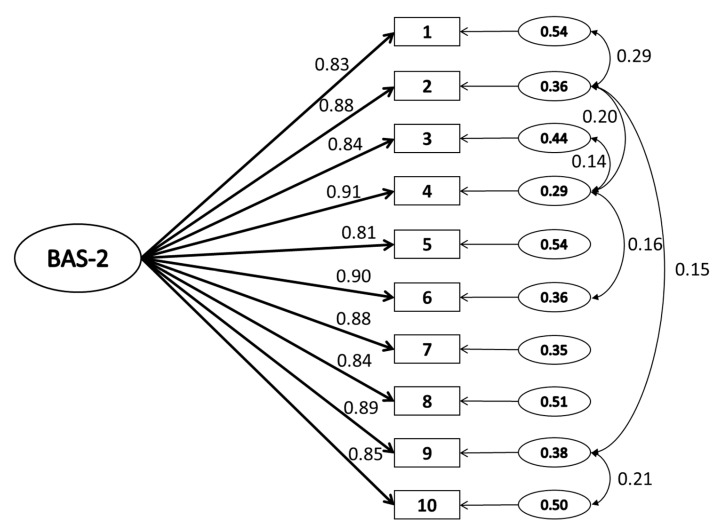
Body appreciation is one of the main facets of a positive body image. The present study aimed to examine the psychometric properties of the Lithuanian version of the Body Appreciation Scale-2 (BAS-2-LT) and test the associations between body appreciation and disordered eating in a large sample of adolescents of both genders. Method: The sample consisted of 1412 adolescents (40.2% were boys). The ages ranged from 15 to 18 years (92.4% were 17), with a mean age of 16.9 (SD = 0.5) for girls and 17.0 (SD = 0.4) for boys. Participants completed the BAS-2-LT alongside the measures of body dissatisfaction, disordered eating, body mass index, self-esteem, body functionality, and participation in sports. Linear regressions were used to test the associations between study variables and disordered eating. Results: BAS-2-LT replicated the original one-dimensional structure in girls and boys. Invariance across genders was established. The instrument showed good internal consistency and temporal stability. Body appreciation was negatively correlated with higher levels of body mass index, body dissatisfaction, and disordered eating. Positive associations were observed between body appreciation, self-esteem, body functionality, and sports participation. Higher levels of body appreciation decreased the risk of disordered eating behaviors in both genders. Conclusions: The results of the present study support the psychometric properties of BAS-2-LT. Body appreciation is associated with lower disordered eating in adolescent girls and boys. These findings present empirical support for the development of interventions programs that promote positive body images and aim to prevent disordered eating in adolescent boys and girls.
Keywords: adolescents; body appreciation; disordered eating; self-esteem; self-objectification; sports.
Conflict of interest statement
The authors declare no conflict of interest.
Figures
References
-
- Thompson J.K., Heinberg L.J., Altabe M., Tantleff-Dunn S. Exacting Beauty: Theory, Assessment, and Treatment of Body Image Disturbance. American Psychological Association; Washington, DC, USA: 1999.
-
- Tylka T.L., Wood-Barcalow N.L. What is and what is not positive body image? Conceptual foundations and construct definition. Body Image. 2015;14:118–129. - PubMed
Publication types
MeSH terms
LinkOut - more resources
Full Text Sources
Medical
