. 2020 Mar 12;25(6):1288.
doi: 10.3390/molecules25061288.

Spontaneous Hinge-Bending Motions of Angiotensin I Converting Enzyme: Role in Activation and Inhibition

Affiliations

Spontaneous Hinge-Bending Motions of Angiotensin I Converting Enzyme: Role in Activation and Inhibition

Thi Tuong Vy et al. Molecules. .

Erratum in

Abstract

The inhibition of human angiotensin I converting enzyme (ACE) has been regarded as a promising approach for the treatment of hypertension. Despite research attempts over many years, our understanding the mechanisms of activation and inhibition of ACE is still far from complete. Here, we present results of all atom molecular dynamics simulations of ACE with and without ligands. Two types of inhibitors, competitive and mixed non-competitive, were used to model the ligand bound forms. In the absence of a ligand the simulation showed spontaneous large hinge-bending motions of multiple conversions between the closed and open states of ACE, while the ligand bound forms were stable in the closed state. Our simulation results imply that the equilibrium between pre-existing backbone conformations shifts in the presence of a ligand. The hinge-bending motion of ACE is considered as an essential to the enzyme function. A mechanistic model of activation and the inhibition may provide valuable information for novel inhibitors of ACE.

Keywords: MD simulation; activation and inhibition mechanism; angiotensin converting enzyme; hinge-bending motion; spontaneous conformational change.


Conflict of interest statement

The authors declare no conflict of interest.

Figures
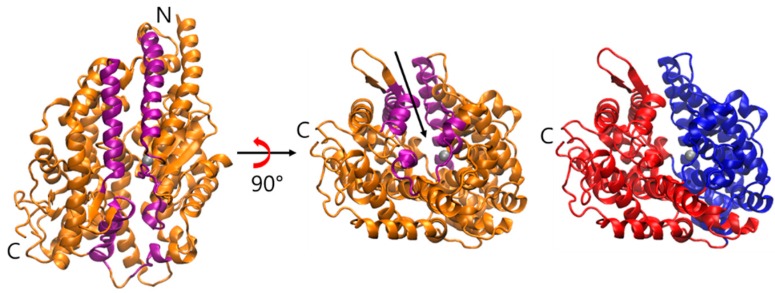
Figure 1
Figure 1
The overview of the structure of C domain of sACE (PDB ID: 4APH). The ribbon representation of sACE shows the secondary structure and the two lips (purple colored) of the mouth. N and C indicate the N- and C-terminus of the enzyme, respectively. Zinc ion is shown as a gray sphere. The rightmost panel shows two subdomains that form two sides of the active site in the cleft, and the subdomain I (residues 40–122, 297–437, 551–583) and II (residues 123–296, 438–550, 584–625) are colored by blue and red, respectively. The arrow indicates the active site near the zinc ion and the putative binding pathway of ligands. The first lip (residues 73–100, 297–304, 348–354, 370–379) belongs to subdomain I, and the second (109–131, 143–156, 267–276) belongs to subdomain II.
Figure 2
Figure 2
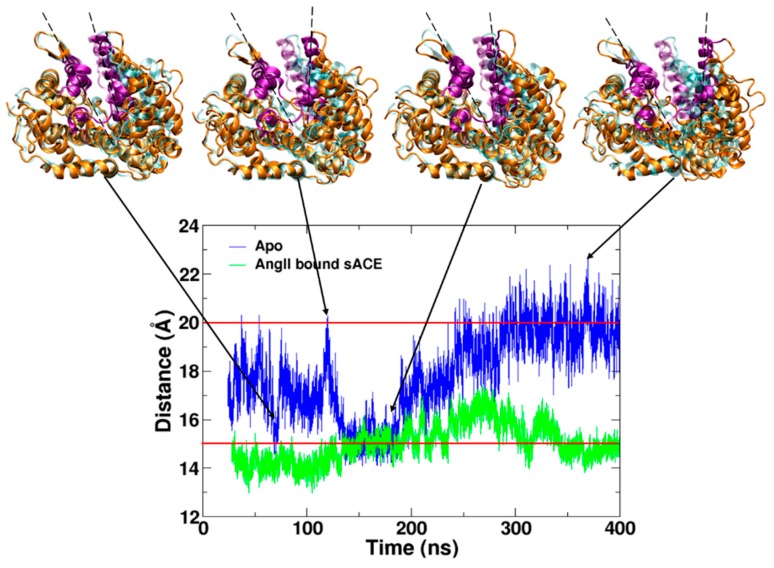
Distance between two lips of AngII bound sACE complex (green) and the Apo form (blue) along the simulation time after discarding the equilibration stage. A conformation with a distance between two lips longer than 20 Å is defined as the open state. With a distance shorter than 15 Å, the conformation is defined as the closed state. If the distance is between 15 and 20 Å, then the conformation is considered as the semi-open state. The snapshots of sACE (orange, purple for lips) are shown by superimposing the subdomain II to the crystal structure (cyan).
Figure 3
Figure 3
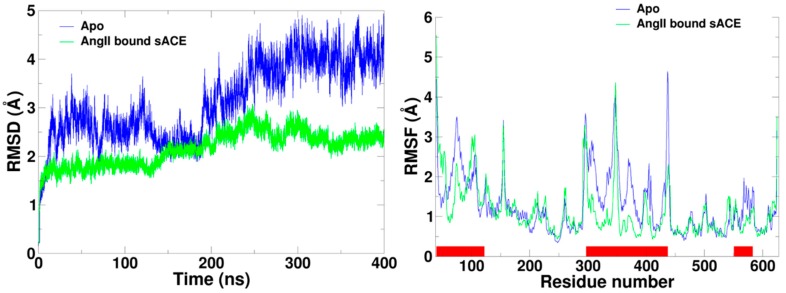
Root-mean-square deviation (RMSD) and root-mean-square fluctuation (RMSF) calculated using Cα atoms from simulations of AngII bound sACE (green) and Apo (blue). The red bars on the horizontal axis of the RMSF graph indicate the residues of subdomain I, showing its flexibility. RMSF was calculated after discarding the equilibration stage of the beginning of the MD simulations.
Figure 4
Figure 4
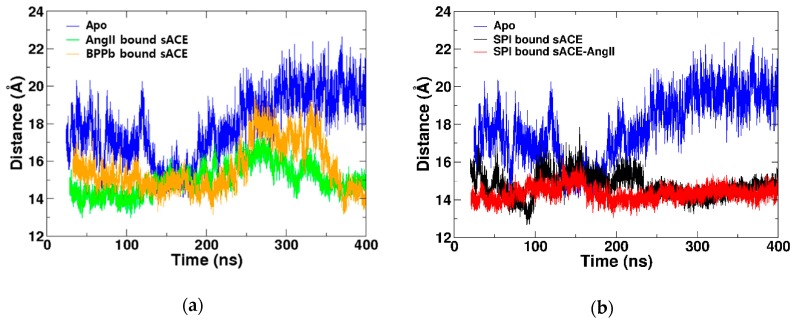
Comparison of the distances between two lips among the Apo and (a) competitive inhibitor bound forms with AngII and BPPb. (b) Mixed non-competitive inhibitor bound forms with SPI and SPI-AngII complex.
Figure 5
Figure 5
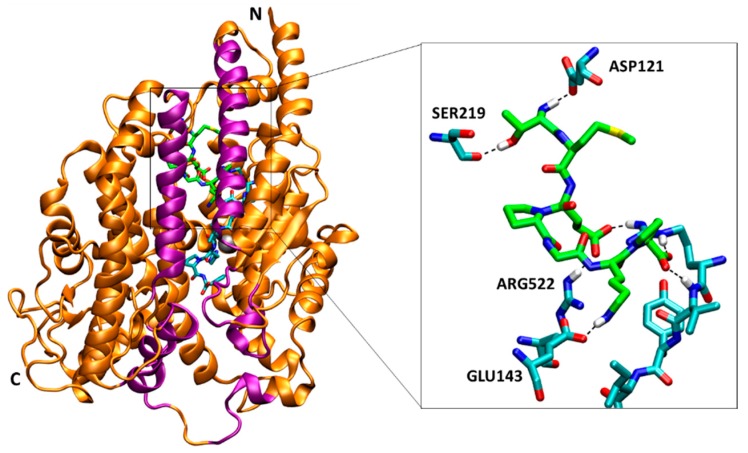
The binding site of the SPI (green carbon) next to AngII (cyan carbon) in the cleft of sACE. sACE is represented by orange ribbons (purple lips), and the zinc ion in the active site is represented by a gray sphere. AngII and ACE binding site are represented by sticks, and carbon, nitrogen, oxygen, sulfur and hydrogen atoms are colored by cyan, blue, red, yellow and white, respectively. SPI is represented by sticks, and carbon atoms are colored by green. Only residue numbers of sACE are shown in the inset figure for clarity. The snapshot was taken at 200.38 ns.
Figure 6
Figure 6
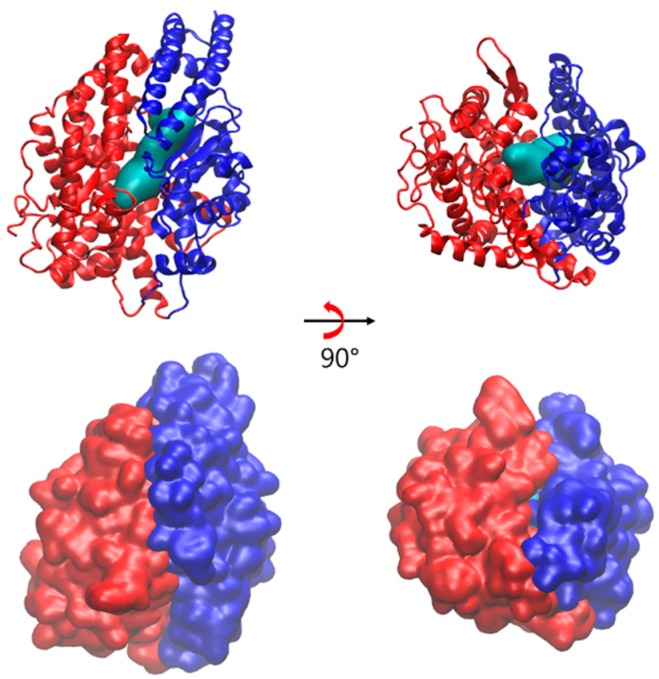
Surface representations of AngII (cyan colored) and ribbon representation of a closed state of sACE (subdomain I in blue and subdomain II in red) at the top panel and its surface representations of sACE at bottom panel.
Figure 7
Figure 7
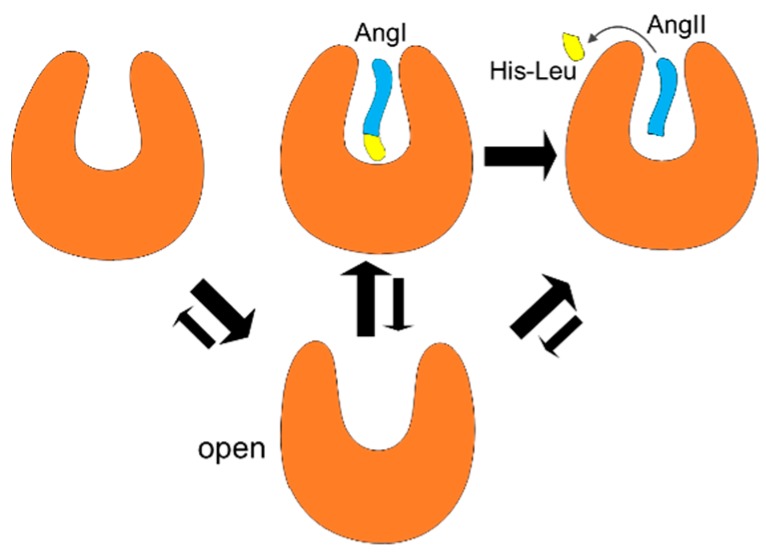
Activation mechanism of sACE and equilibrium shifts between the open conformation (lower panel) and closed conformations (upper panel) upon the presence of ligands: from the left to right in the figure, in the absence of a substrate (AngI), in the presence of substrate, and in the presence of product (AngII), respectively. Equilibrium shifts between two states are represented qualitatively by the size of arrows.

References

    1. Kearney P.M., Whelton M., Reynolds K., Muntner P., Whelton P.K., He J. Global Burden of Hypertension: Analysis of Worldwide Data. Lancet. 2005;365:217–223. doi: 10.1016/S0140-6736(05)17741-1. - DOI - PubMed
    1. Inagami T. The Renin-Angiotensin System. Essays Biochem. 1994;28:147–164. - PubMed
    1. Rawlings N.D., Barrett A.J. Evolutionary Families of Peptidases. Biochem. J. 1993;290:205–218. doi: 10.1042/bj2900205. - DOI - PMC - PubMed
    1. Fernandez J.H., Hayashi M.A.F., Camargo A.C.M., Neshich G. Structural Basis of the Lisinopril-Binding Specificity in N- and C-Domains of Human Somatic ACE. Biochem. Biophys. Res. Commun. 2003;308:219–226. doi: 10.1016/S0006-291X(03)01363-9. - DOI - PubMed
    1. Wei L., Alhenc-Gelas F., Corvol P., Clauser E. The Two Homologous Domains of Human Angiotensin I-Converting Enzyme are both Catalytically Active. J. Biol. Chem. 1991;266:9002–9008. - PubMed