


The Roles of miRNA in Glioblastoma Tumor Cell Communication: Diplomatic and Aggressive Negotiations
- PMID: 32178454
- PMCID: PMC7139390
- DOI: 10.3390/ijms21061950
The Roles of miRNA in Glioblastoma Tumor Cell Communication: Diplomatic and Aggressive Negotiations
Abstract
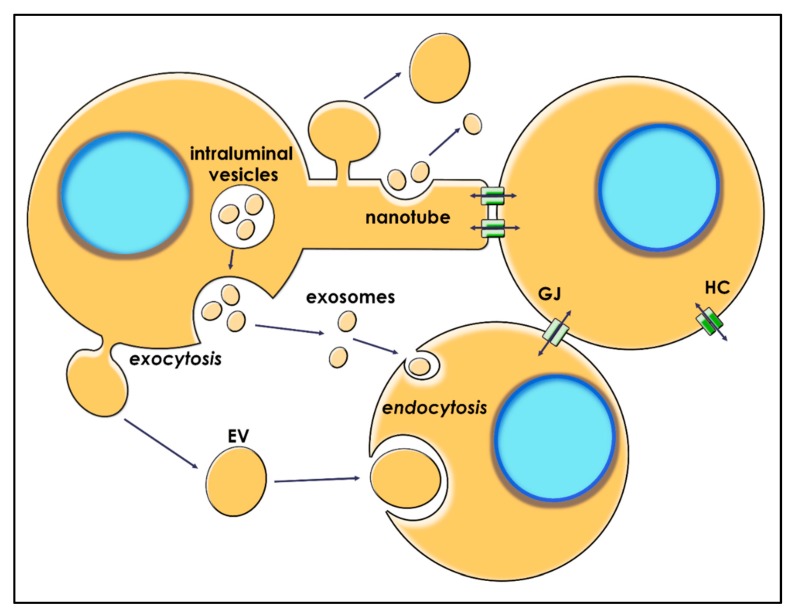
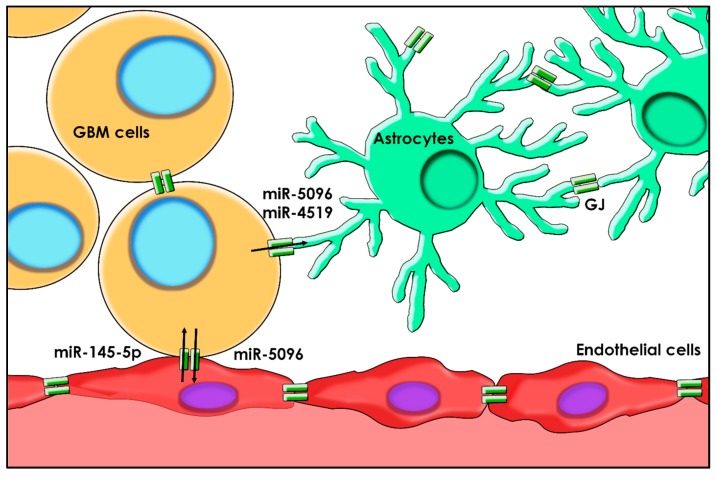
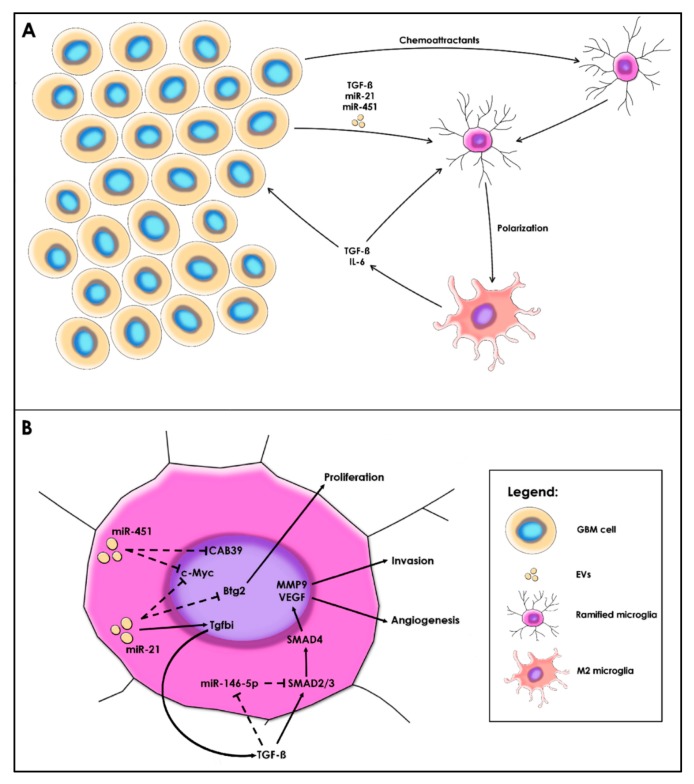
Glioblastoma (GBM) consists of a heterogeneous collection of competing cellular clones which communicate with each other and with the tumor microenvironment (TME). MicroRNAs (miRNAs) present various exchange mechanisms: free miRNA, extracellular vesicles (EVs), or gap junctions (GJs). GBM cells transfer miR-4519 and miR-5096 to astrocytes through GJs. Oligodendrocytes located in the invasion front present high levels of miR-219-5p, miR-219-2-3p, and miR-338-3p, all related to their differentiation. There is a reciprocal exchange between GBM cells and endothelial cells (ECs) as miR-5096 promotes angiogenesis after being transferred into ECs, whereas miR-145-5p acts as a tumor suppressor. In glioma stem cells (GSCs), miR-1587 and miR-3620-5p increase the proliferation and miR-1587 inhibits the hormone receptor co-repressor-1 (NCOR1) after EVs transfers. GBM-derived EVs carry miR-21 and miR-451 that are up-taken by microglia and monocytes/macrophages, promoting their proliferation. Macrophages release EVs enriched in miR-21 that are transferred to glioma cells. This bidirectional miR-21 exchange increases STAT3 activity in GBM cells and macrophages, promoting invasion, proliferation, angiogenesis, and resistance to treatment. miR-1238 is upregulated in resistant GBM clones and their EVs, conferring resistance to adjacent cells via the CAV1/EGFR signaling pathway. Decrypting these mechanisms could lead to a better patient stratification and the development of novel target therapies.
Keywords: glioblastoma; intercellular communication; miRNA; tumor microenvironment.
Conflict of interest statement
The authors declare no conflicts of interest.
Figures
References
-
- Louis D.N., Perry A., Reifenberger G., von Deimling A., Figarella-Branger D., Cavenee W.K., Ohgaki H., Wiestler O.D., Kleihues P., Ellison D.W. The 2016 World Health Organization Classification of Tumors of the Central Nervous System: A summary. Acta Neuropathol. 2016;131:803–820. doi: 10.1007/s00401-016-1545-1. - DOI - PubMed
-
- Ostrom Q.T., Gittleman H., Farah P., Ondracek A., Chen Y., Wolinsky Y., Stroup N.E., Kruchko C., Barnholtz-Sloan J.S. CBTRUS Statistical Report: Primary Brain and Central Nervous System Tumors Diagnosed in the United States in 2006-2010. Neuro-Oncology. 2013;15:ii1–ii56. doi: 10.1093/neuonc/not151. - DOI - PMC - PubMed
-
- Smith J.S., Tachibana I., Passe S.M., Huntley B.K., Borell T.J., Iturria N., O’Fallon J.R., Schaefer P.L., Scheithauer B.W., James C.D., et al. PTEN Mutation, EGFR Amplification, and Outcome in Patients With Anaplastic Astrocytoma and Glioblastoma Multiforme. JNCI J. Natl. Cancer Inst. 2001;93:1246–1256. doi: 10.1093/jnci/93.16.1246. - DOI - PubMed
Publication types
MeSH terms
Substances
LinkOut - more resources
Full Text Sources
Medical
Research Materials
Miscellaneous
