


Graded response model fit, measurement invariance and (comparative) precision of the Dutch-Flemish PROMIS® Upper Extremity V2.0 item bank in patients with upper extremity disorders
- PMID: 32178644
- PMCID: PMC7077019
- DOI: 10.1186/s12891-020-3178-8
Graded response model fit, measurement invariance and (comparative) precision of the Dutch-Flemish PROMIS® Upper Extremity V2.0 item bank in patients with upper extremity disorders
Abstract
Background: The Dutch-Flemish PROMIS® Upper Extremity (DF-PROMIS-UE) V2.0 item bank was recently developed using Item Response Theory (IRT). Unknown for this bank are: (1) if it is legitimate to calculate IRT-based scores for short forms and Computerized Adaptive Tests (CATs), which requires that the items meet the assumptions of and fit the IRT-model (Graded Response Model [GRM]);(2) if it is legitimate to compare (sub) groups of patients using this measure, which requires measurement invariance; and (3) the precision of the estimated patients' scores for patients with different levels of functioning and compared to legacy measures. Aims were to evaluate (1) the assumptions of and fit to the GRM, (2) measurement invariance and (3) (comparative) precision of the DF-PROMIS-UE v2.0.
Methods: Cross-sectional data were collected in Dutch patients with upper extremity disorders. Assessed were IRT-assumptions (unidimensionality [bi-factor analysis], local independence [residual correlations], monotonicity [coefficient H]), GRM item fit, measurement invariance (absence of Differential Item Functioning [DIF] due to age, gender, center, duration, and location of complaints) and precision (standard error of IRT-based scores across levels of functioning). To study measurement invariance for language [Dutch vs. English], additional US data were used. Legacy instruments were the Disability of the Arm, Shoulder and Hand (DASH), the QuickDASH and the Michigan Hand Questionnaire (MHQ).
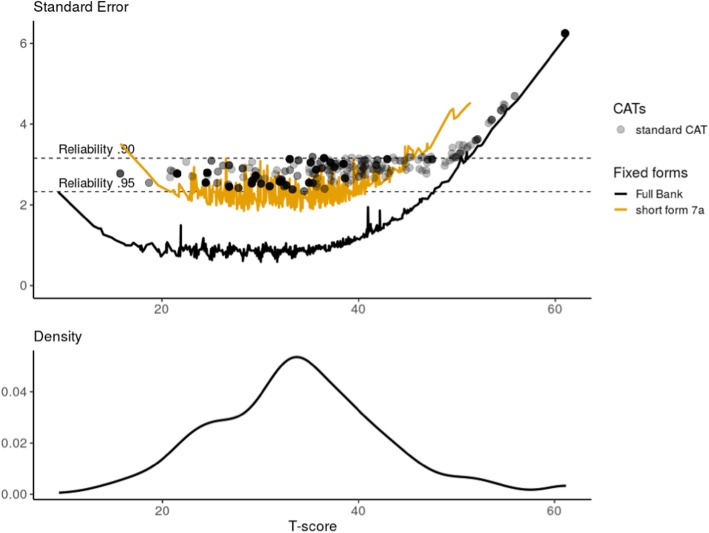
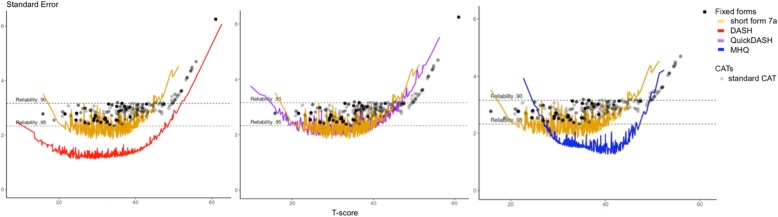
Results: In total 521 Dutch (mean age ± SD = 51 ± 17 years, 49% female) and 246 US patients (mean age ± SD = 48 ± 14 years, 69% female) participated. The DF-PROMIS-UE v2.0 item bank was sufficiently unidimensional (Omega-H = 0.80, Explained Common Variance = 0.68), had negligible local dependence (four out of 1035 correlations > 0.20), good monotonicity (H = 0.63), good GRM fit (no misfitting items) and demonstrated sufficient measurement invariance. Precise estimates (Standard Error < 3.2) were obtained for most patients (7-item short form, 88.5%; standard CAT, 91.3%; and, fixed 7-item CAT, 87.6%). The DASH displayed better reliability than the DF-PROMIS-UE short form and standard CAT, the QuickDASH displayed comparable reliability. The MHQ-ADL displayed better reliability than the DF-PROMIS-UE short form and standard CAT for T-scores between 28 and 50. For patients with low function, the DF-PROMIS-UE measures performed better.
Conclusions: The DF-PROMIS-UE v2.0 item bank showed sufficient psychometric properties in Dutch patients with UE disorders.
Keywords: Dutch-Flemish PROMIS; Item response theory; Measurement invariance; Reliability; Upper extremity.
Conflict of interest statement
CBT is president of the PROMIS Health Organization, a charitable foundation that aims to advance the science of health outcomes assessment through the use of PROMIS. CBT and LDR are coordinators of the Dutch-Flemish PROMIS National Center. AK is one of the developers of the US PROMIS-UE v2.0 item bank. The other authors declare they have no competing interests.
Figures
References
-
- Hudak PL, Amadio PC, Bombardier C. Development of an upper extremity outcome measure: the DASH (disabilities of the arm, shoulder and hand) [corrected]. The Upper Extremity Collaborative Group (UECG) Am J Ind Med. 1996;29(6):602–608. doi: 10.1002/(SICI)1097-0274(199606)29:6<602::AID-AJIM4>3.0.CO;2-L. - DOI - PubMed
-
- Kennedy CA, Beaton DE, Smith P, Van Eerd D, Tang K, Inrig T, et al. Measurement properties of the QuickDASH (disabilities of the arm, shoulder and hand) outcome measure and cross-cultural adaptations of the QuickDASH: a systematic review. Qual Life Res. 2013;22(9):2509–2547. doi: 10.1007/s11136-013-0362-4. - DOI - PubMed
MeSH terms
LinkOut - more resources
Full Text Sources
Miscellaneous
