


Leptospira infection and shedding in dogs in Thailand
- PMID: 32178664
- PMCID: PMC7077098
- DOI: 10.1186/s12917-020-2230-0
Leptospira infection and shedding in dogs in Thailand
Abstract
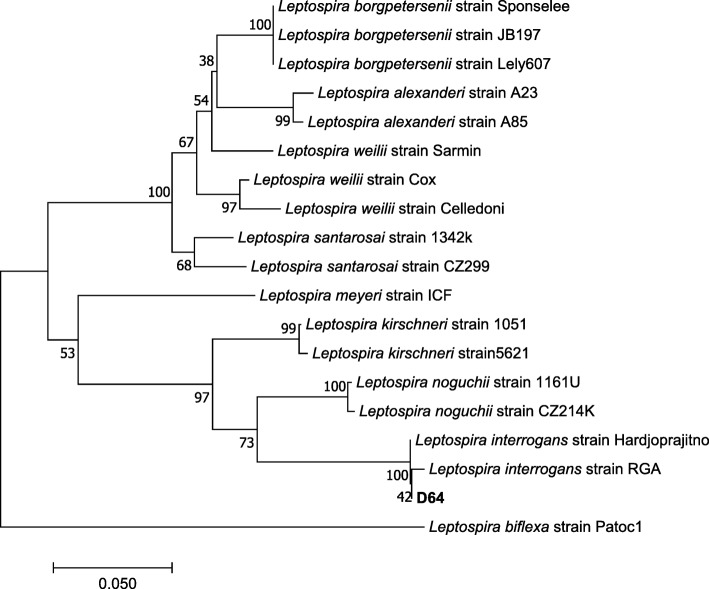
Background: Leptospirosis is a widespread zoonosis and has been recognized as a re-emerging infectious disease in humans and dogs, but prevalence of Leptospira shedding in dogs in Thailand is unknown. The aim of this study was to determine urinary shedding of Leptospira in dogs in Thailand, to evaluate antibody prevalence by microscopic agglutination test (MAT) and enzyme-linked immunosorbent assay (ELISA), and to assess risk factors for Leptospira infection. In Northern, Northeastern, and Central Thailand, 273 stray (n = 119) or client-owned (n = 154) dogs from rural (n = 139) or urban (n = 134) areas were randomly included. Dogs that had received antibiotics within 4 weeks prior to sampling were excluded. No dog had received vaccination against Leptospira. Urine was evaluated by real-time polymerase chain reaction (PCR) specific for lipL32 gene of pathogenic Leptospira. Additionally, urine was cultured for 6 months in Ellinghausen-McCullough-Johnson-Harris (EMJH) medium. Antibodies were measured by ELISA and MAT against 24 serovars belonging to 15 serogroups and 1 undesignated serogroup. Risk factor analysis was performed with backwards stepwise selection based on Wald.
Results: Twelve of 273 (4.4%; 95% confidence interval (CI): 2.0-6.8%) urine samples were PCR-positive. In 1/273 dogs (0.4%; 95% CI: 0.01-1.1%) Leptospira could be cultured from urine. MAT detected antibodies in 33/273 dogs (12.1%; 95% CI: 8.2-16.0%) against 19 different serovars (Anhoa, Australis, Ballum, Bataviae, Bratislava, Broomi, Canicola, Copenhageni, Coxi, Grippotyphosa, Haemolytica, Icterohaemorrhagiae, Khorat, Paidjan, Patoc, Pyrogenes, Rachmati, Saxkoebing, Sejroe). In 111/252 dogs (44.0%; 95% CI: 37.9-50.2%) immunoglobulin M (IgM) and/or immunoglobulin G (IgG) antibodies were found by ELISA. Female dogs had a significantly higher risk for Leptospira infection (p = 0.023).
Conclusions: Leptospira shedding occurs in randomly sampled dogs in Thailand, with infection rates comparable to those of Europe and the USA. Therefore, the potential zoonotic risk should not be underestimated and use of Leptospira vaccines are recommended.
Keywords: Canine; Culture; Dogs; ELISA; Leptospira; MAT; PCR; Risk factors; Seroprevalence; Zoonosis.
Conflict of interest statement
NPa is employed at IDEXX Laboratories, Ludwigsburg. This laboratory offers the IDEXX
MGAG and AAA work at the OIE and National Collaborating Centre for Reference and Research on Leptospirosis and commercially performed MAT and phylogenetic analysis in the present study.
EMB and JAW work at the Department of Infectious Diseases and Immunology, Faculty of Veterinary Medicine, Utrecht University and commercially performed IgM and IgG ELISA in this study.
None of these companies played a role in the study design, in the collection and interpretation of data, or in the decision to submit the manuscript for publication.
KH has given talks for MSD, Merial, Boehringer Ingelheim, and IDEXX. She participated in research funded by or using products from MSD, Merial, Boehringer, Zoetis, Megacor, Biogal, and Scil.
There is no commercial conflict of interest as the information generated here is solely for scientific dissemination. The authors declare that they have no competing interests.
Figures
References
-
- World Health Organization (WHO). Neglected tropical diseases, hidden successes, emerging opportunities. Geneva; 2009. http://whqlibdoc.who.int/publications/2009/9789241598705_eng.pdf. Accessed 4 Feb 2019.
-
- Tangkanakul W, Smits HL, Jatanasen S, Ashford DA. Leptospirosis: an emerging health problem in Thailand. Southeast Asian J Trop Med Public Health. 2005;36(2):281–288. - PubMed
-
- ProMED-mail . Leptospirosis - Thailand (03): Nakhon Si Thammarat: ProMED-mail. 2017.
MeSH terms
Substances
LinkOut - more resources
Full Text Sources
Molecular Biology Databases
