


A citizen science study of short physical activity breaks at school: improvements in cognition and wellbeing with self-paced activity
- PMID: 32178667
- PMCID: PMC7077117
- DOI: 10.1186/s12916-020-01539-4
A citizen science study of short physical activity breaks at school: improvements in cognition and wellbeing with self-paced activity
Abstract
Background: School-based physical activity and running programmes, such as The Daily Mile™, are increasing in popularity globally. The aim of this research was to examine the acute impact of such classroom physical activity breaks on cognition and affective wellbeing.
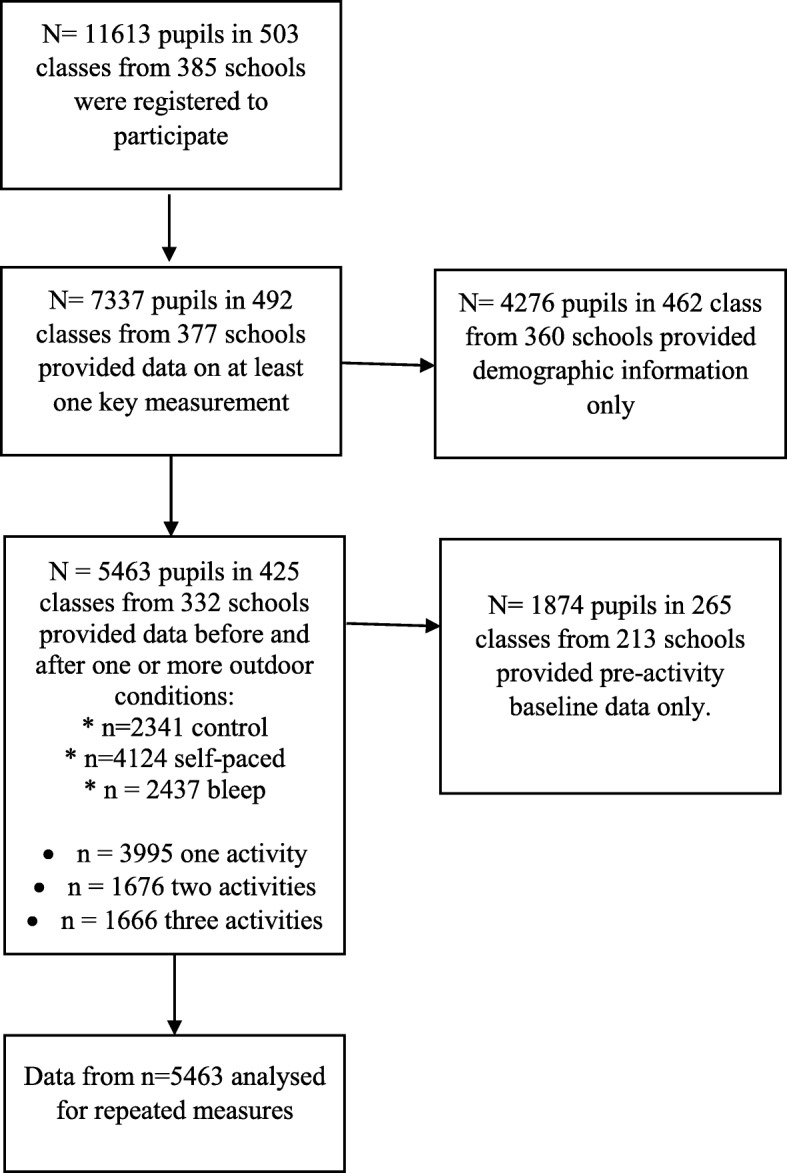
Methods: A total of 5463 school pupils from 332 schools took part in a citizen science project with a repeated measures design. They completed tasks of cognition (inhibition, verbal, and visuo-spatial working memory) and the Children's Feeling Scale and Felt Arousal Scale before and after three different outdoor activities: a classroom break of 15 min of self-paced activity, a near maximal exhaustion activity (the bleep test), and a no-exercise control group where pupils sat or stood outside. Wellbeing and fitness were examined as mediators of the relationship between outdoor activity and cognition.
Results: Fifteen minutes of self-paced outdoor activity was beneficial for pupils' cognition and wellbeing in comparison to both other activities (Cohen's d effect sizes ranging from 0.04 to 0.22; small). The relationship with cognition was not mediated by participants' fitness level and was only partially mediated by wellbeing. Change scores for alertness were higher after the bleep test compared to the control activity but similar for all other outcomes.
Conclusions: Taking a break from the classroom to complete 15 min of self-paced physical activity should be considered a worthwhile activity by class teachers, school management, and policymakers. Additionally, more intense physical activity should not be considered to be detrimental.
Keywords: Acute physical activity; Children; Cognition.
Conflict of interest statement
JB and CM currently sit on the research advisory group for The Daily Mile™ Foundation but did not at the time of study design and data collection. They receive no payment or expenses for this, and their role is to advise concerning research priorities only. The Daily Mile™ Foundation had no role in the present research. The other authors declare that they have no competing interests.
References
-
- Donnelly JE, Hillman CH, Castelli D, Etnier JL, Lee S, Tomporowski P, Lambourne K, Szabo-Reed AN. Physical activity, fitness, cognitive function, and academic achievement in children: a systematic review. Med Sci Sports Exerc. 2016;48(6):1197–1222. doi: 10.1249/MSS.0000000000000901. - DOI - PMC - PubMed
-
- Singh Amika S, Saliasi Emi, van den Berg Vera, Uijtdewilligen Léonie, de Groot Renate H M, Jolles Jelle, Andersen Lars B, Bailey Richard, Chang Yu-Kai, Diamond Adele, Ericsson Ingegerd, Etnier Jennifer L, Fedewa Alicia L, Hillman Charles H, McMorris Terry, Pesce Caterina, Pühse Uwe, Tomporowski Phillip D, Chinapaw Mai J M. Effects of physical activity interventions on cognitive and academic performance in children and adolescents: a novel combination of a systematic review and recommendations from an expert panel. British Journal of Sports Medicine. 2018;53(10):640–647. doi: 10.1136/bjsports-2017-098136. - DOI - PubMed
-
- Daly-Smith Andy J, Zwolinsky Stephen, McKenna Jim, Tomporowski Phillip D, Defeyter Margaret Anne, Manley Andrew. Systematic review of acute physically active learning and classroom movement breaks on children’s physical activity, cognition, academic performance and classroom behaviour: understanding critical design features. BMJ Open Sport & Exercise Medicine. 2018;4(1):e000341. doi: 10.1136/bmjsem-2018-000341. - DOI - PMC - PubMed
Publication types
MeSH terms
Grants and funding
LinkOut - more resources
Full Text Sources
Medical
Research Materials
