


Automated Hypofractionated IMRT treatment planning for early-stage breast Cancer
- PMID: 32178694
- PMCID: PMC7077022
- DOI: 10.1186/s13014-020-1468-9
Automated Hypofractionated IMRT treatment planning for early-stage breast Cancer
Abstract
Background: Hypofractionated whole-breast irradiation is a standard adjuvant therapy for early-stage breast cancer. This study evaluates the plan quality and efficacy of an in-house-developed automated radiotherapy treatment planning algorithm for hypofractionated whole-breast radiotherapy.
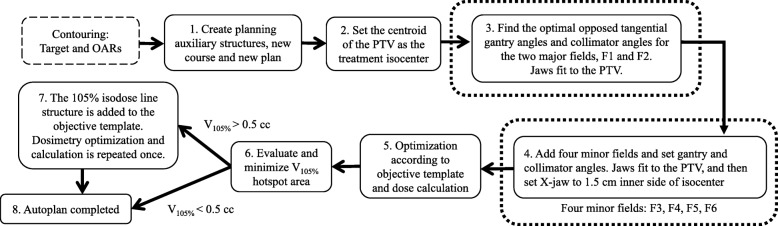
Methods: A cohort of 99 node-negative left-sided breast cancer patients completed hypofractionated whole-breast irradiation with six-field IMRT for 42.56 Gy in 16 daily fractions from year 2016 to 2018 at a tertiary center were re-planned with an in-house-developed algorithm. The automated plan-generating C#-based program is developed in a Varian ESAPI research mode. The dose-volume histogram (DVH) and other dosimetric parameters of the automated and manual plans were directly compared.
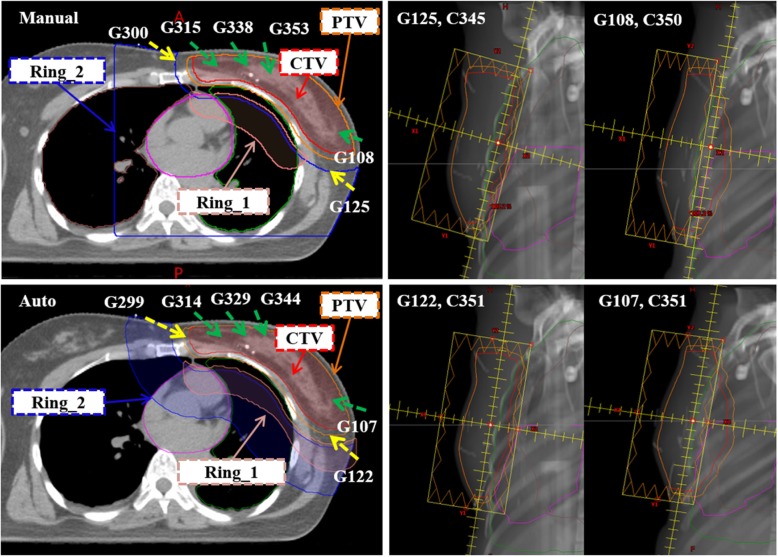
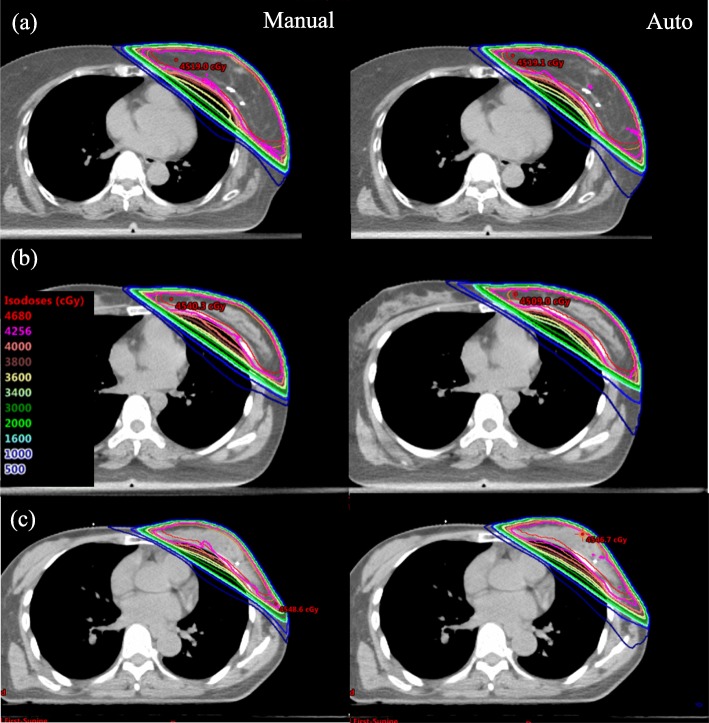
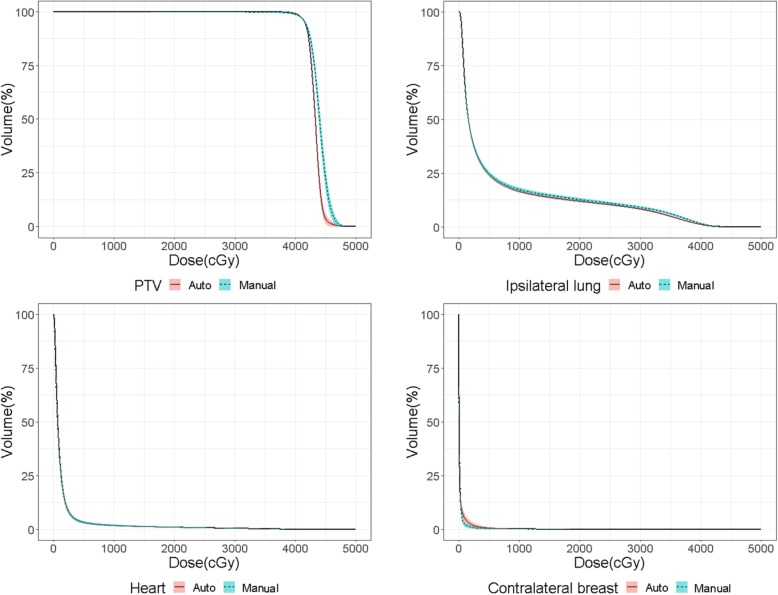
Results: The average time for generating an autoplan was 5 to 6 min, while the manual planning time ranged from 1 to 1.5 h. There was only a small difference in both the gantry angles and the collimator angles between the autoplans and the manual plans (ranging from 2.2 to 5.3 degrees). Autoplans and manual plans performed similarly well in hotspot volume and PTV coverage, with the autoplans performing slightly better in the ipsilateral-lung-sparing dose parameters but were inferior in contralateral-breast-sparing. The autoplan dosimetric quality did not vary with different breast sizes, but for manual plans, there was worse ipsilateral-lung-sparing (V4Gy) in larger or medium-sized breasts than in smaller breasts. Autoplans were generally superior than manual plans in CI (1.24 ± 0.06 vs. 1.30 ± 0.09, p < 0.01) and MU (1010 ± 46 vs. 1205 ± 187, p < 0.01).
Conclusions: Our study presents a well-designed standardized fully automated planning algorithm for optimized whole-breast radiotherapy treatment plan generation. A large cohort of 99 patients were re-planned and retrospectively analyzed. The automated plans demonstrated similar or even better dosimetric quality and efficacy in comparison with the manual plans. Our result suggested that the autoplanning algorithm has great clinical applicability potential.
Keywords: Automation; Autoplanning; Early-stage; Hypofractionation; IMRT; Left-sided breast cancer; Treatment planning; Whole-breast irradiation.
Conflict of interest statement
The authors declare that they have no competing interests.
Figures
References
-
- Quantitative Analyses of Normal Tissue Effects in the Clinic (QUANTEC): An Introduction to the Scientific Issues - International Journal of Radiation Oncology • Biology • Physics. Available at: https://www.redjournal.org/article/S0360-3016(09)03300-8/fulltext. Accessed 11 May 2019. - PMC - PubMed
MeSH terms
Grants and funding
LinkOut - more resources
Full Text Sources
Medical
Research Materials
