Association between Chinese or South Asian ethnicity and end-of-life care in Ontario, Canada
- PMID: 32179535
- PMCID: PMC7083548
- DOI: 10.1503/cmaj.190655
Association between Chinese or South Asian ethnicity and end-of-life care in Ontario, Canada
Abstract
Background: Ethnicity may be associated with important aspects of end-of-life care, such as what treatments are received, access to palliative care and where people die. However, most studies have focused on end-of-life care of white, Hispanic and black patients. We sought to compare end-of-life care delivered to people of Chinese and South Asian ethnicity with that delivered to others from the general population, in Ontario, Canada.
Methods: In this population-based cohort study, we included all people who died in Ontario, Canada, between Apr. 1, 2004, and Mar. 31, 2015. People were identified as having Chinese or South Asian ethnicity on the basis of a validated surname algorithm. We used modified Poisson regression analyses to assess location of death and care received in the last 6 months of life.
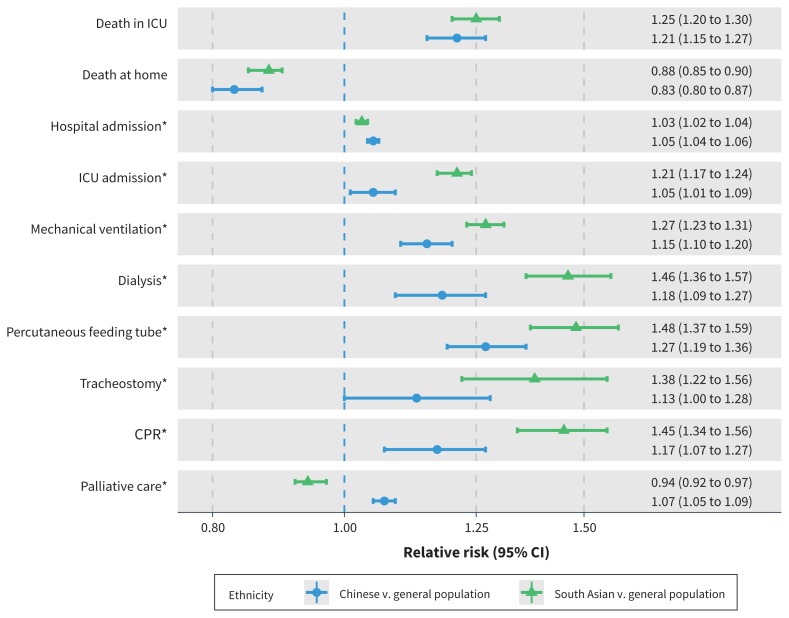
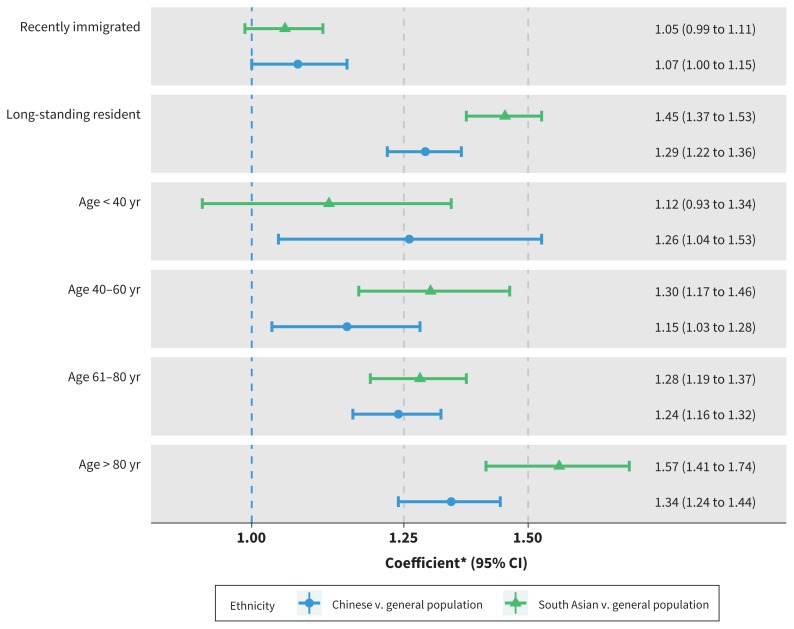
Results: We analyzed 967 339 decedents, including 18 959 (2.0%) of Chinese and 11 406 (1.2%) of South Asian ethnicity. Chinese (13.6%) and South Asian (18.5%) decedents were more likely than decedents from the general population (10.1%) to die in the intensive care unit (ICU). The adjusted relative risk of dying in intensive care was 1.21 (95% confidence interval [CI] 1.15 to 1.27) for Chinese and 1.25 (95% CI 1.20 to 1.30) for South Asian decedents. In their last 6 months of life, decedents of Chinese and South Asian ethnicity experienced significantly more ICU admission, hospital admission, mechanical ventilation, dialysis, percutaneous feeding tube placement, tracheostomy and cardiopulmonary resuscitation than the general population.
Interpretation: Decedents of Chinese and South Asian ethnicity in Ontario were more likely than decedents from the general population to receive aggressive care and to die in an ICU. These findings may be due to communication difficulties between patients and clinicians, differences in preferences about end-of-life care or differences in access to palliative care services.
© 2020 Joule Inc. or its licensors.
Conflict of interest statement
Competing interests: None declared.
Figures
Comment in
-
Ethnicity and "aggressive" end-of-life care.CMAJ. 2020 Mar 16;192(11):E287-E288. doi: 10.1503/cmaj.200201. CMAJ. 2020. PMID: 32179539 Free PMC article. No abstract available.
References
-
- Fraser J. Palliative and end-of-life care provincial roundtable report: a report from parliamentary assistant John Fraser to the minister of health and long-term care. Toronto: Queen’s Printer for Ontario; 2016. Available: www.health.gov.on.ca/en/public/programs/palliative/pdf/palliative_report... (accessed 2018 July 9).
-
- Steinhauser KE, Christakis NA, Clipp EC, et al. Factors considered important at the end of life by patients, family, physicians, and other care providers. JAMA 2000;284:2476–82. - PubMed
-
- Kwak J, Haley WE. Current research findings on end-of-life decision making among racially or ethnically diverse groups. Gerontologist 2005;45:634–41. - PubMed
Publication types
MeSH terms
LinkOut - more resources
Full Text Sources
Miscellaneous