. 2020 Mar 16;10(1):4823.
doi: 10.1038/s41598-020-61844-z.

Right-lateralized fronto-parietal network and phasic alertness in healthy aging

Affiliations

Right-lateralized fronto-parietal network and phasic alertness in healthy aging

Marleen Haupt et al. Sci Rep. .

Abstract

Phasic alerting cues temporarily increase the brain's arousal state. In younger and older participants, visual processing speed in a whole report task, estimated based on the theory of visual attention, is higher in cue than no-cue conditions. The present study assessed whether older participants' ability to profit from warning cues is related to intrinsic functional connectivity (iFC) in the cingulo-opercular and/or right fronto-parietal network. We acquired resting-state functional magnetic resonance imaging data from 31 older participants. By combining an independent component analysis and dual regression, we investigated iFC in both networks. A voxel-wise multiple regression in older participants yielded that higher phasic alerting effects on visual processing speed were significantly related to lower right fronto-parietal network iFC. This result supports a particular role of the right fronto-parietal network in maintaining phasic alerting capabilities in aging. We then compared healthy older participants to a previously reported sample of healthy younger participants to assess whether behaviour-iFC relationships are age group specific. The comparison revealed that the association between phasic alerting and cingulo-opercular network iFC is significantly lower in older than in younger adults.


Conflict of interest statement

The authors declare no competing interests.

Figures
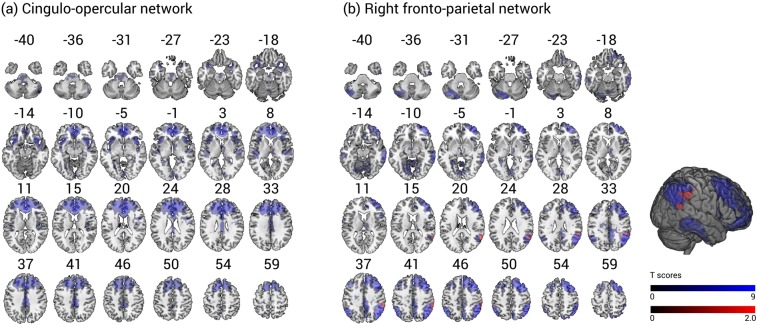
Figure 1
Figure 1
IFC in the cingulo-opercular network (a) and right fronto-parietal network (b) in older healthy participants. The clusters significantly related to phasic alerting effects (red) are overlaid on intra-network iFC (blue). The spatial maps are obtained by a combined independent component analysis dual regression approach. Behaviour-iFC associations were tested using a voxel-wise multiple regression, controlling for age, sex, head motion, and education (p < 0.05 FWE corrected at cluster level). The results are presented on a standard anatomical MNI152 template using MRIcroGL (https://www.mccauslandcenter.sc.edu/mricrogl/source); slice numbers in transverse plane are indicated.
Figure 2
Figure 2
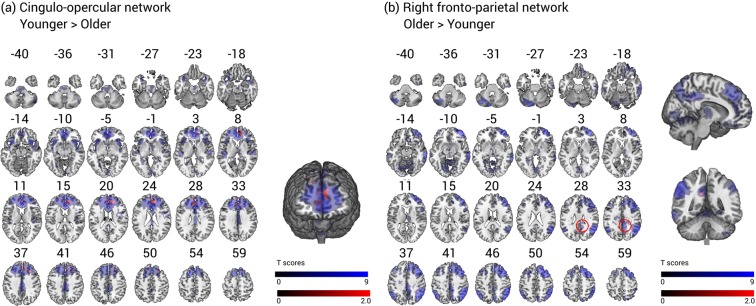
Age group differences of associations between phasic alerting effect on visual processing speed and iFC in the cingulo-opercular (a) and right fronto-parietal network (b). Panel a illustrates that the association between phasic alerting effects on visual processing speed and iFC in the cingulo-opercular network is significantly lower in older than in younger adults (p < 0.05 FWE corrected at cluster level, significant cluster in red). Panel b represents an exploratory analysis (p < 0.05 uncorrrected at cluster level) in the right fronto-parietal network. The spatial maps (blue) are obtained by a combined independent component analysis dual regression approach. Behaviour-iFC associations were tested using a voxel-wise multiple regression, controlling for age, sex, head motion, and education. The results are presented on a standard anatomical MNI152 template using MRIcroGL (https://www.mccauslandcenter.sc.edu/mricrogl/source); slice numbers in transverse plane are indicated.
Figure 3
Figure 3
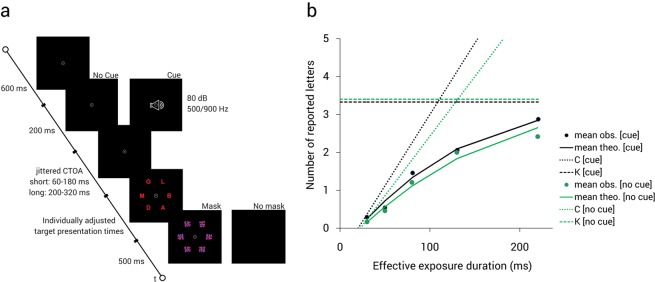
Exemplary trial sequence of the presented TVA-based whole report task (a) and summary of performance in cue and no-cue conditions for a representative healthy older participant (b). Solid curves (mean theo.) depict the best TVA-based fit to acquired data points (mean obs). The dashed line represents the model-based estimate of vSTM storage capacity K; the dotted line represents the model-based estimate of visual processing speed C.

References

    1. Sturm W, Willmes K. On the functional neuroanatomy of intrinsic and phasic alertness. Neuroimage. 2001;14:S76–84. doi: 10.1006/nimg.2001.0839. - DOI - PubMed
    1. Bundesen C. A theory of visual attention. Psychol. Rev. 1990;97:523–547. doi: 10.1037/0033-295X.97.4.523. - DOI - PubMed
    1. Matthias E, et al. The influence of alertness on spatial and nonspatial components of visual attention. J. Exp. Psychol. Hum. Percept. Perform. 2010;36:38–56. doi: 10.1037/a0017602. - DOI - PubMed
    1. Petersen A, Petersen AH, Bundesen C, Vangkilde S, Habekost T. The effect of phasic auditory alerting on visual perception. Cognition. 2017;165:73–81. doi: 10.1016/j.cognition.2017.04.004. - DOI - PubMed
    1. Haupt, M., Sorg, C., Napiórkowski, N. & Finke, K. Phasic alertness cues modulate visual processing speed in healthy aging. Neurobiol. Aging70, 30–39 (2018). - PubMed

Publication types