


Late-stage oxidative C(sp3)-H methylation
- PMID: 32179876
- PMCID: PMC8006464
- DOI: 10.1038/s41586-020-2137-8
Late-stage oxidative C(sp3)-H methylation
Abstract
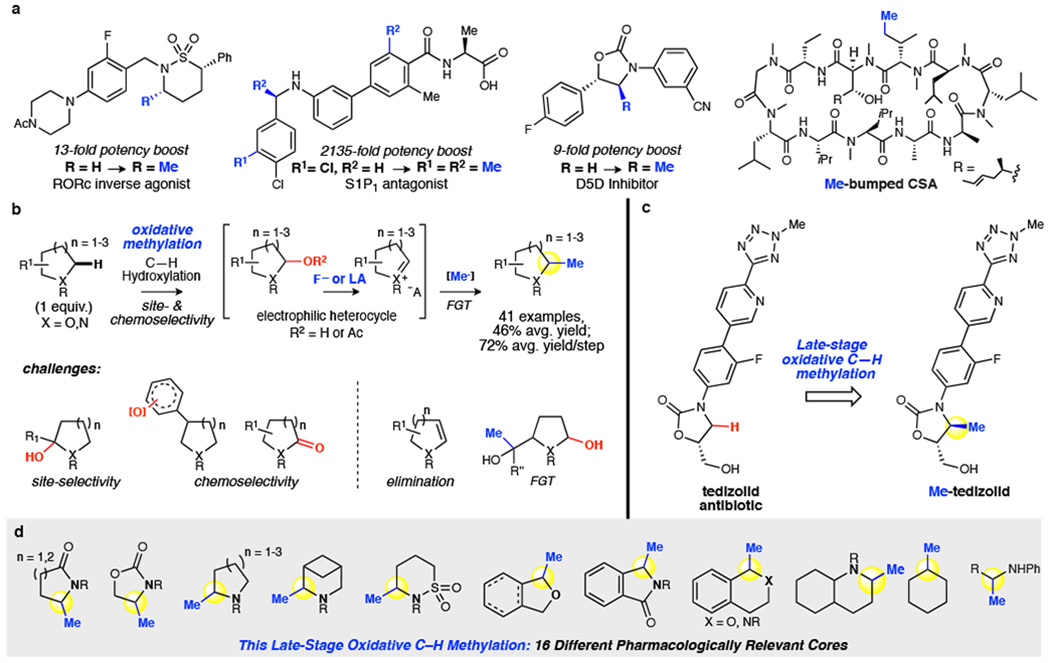
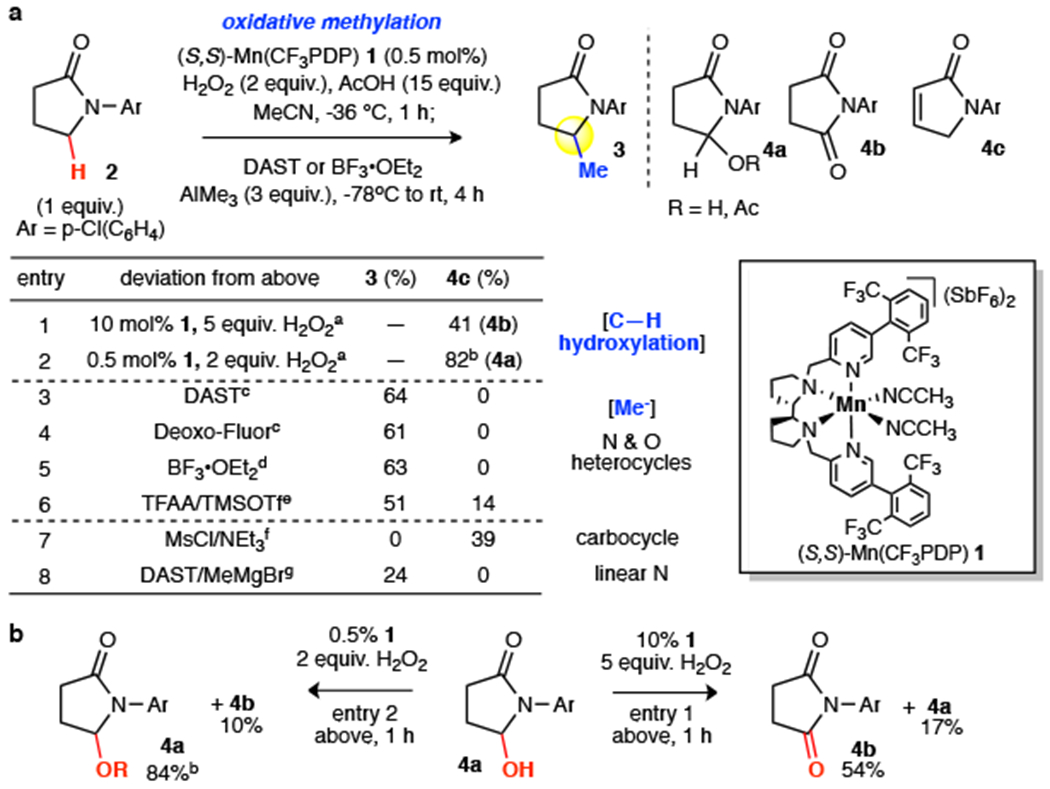
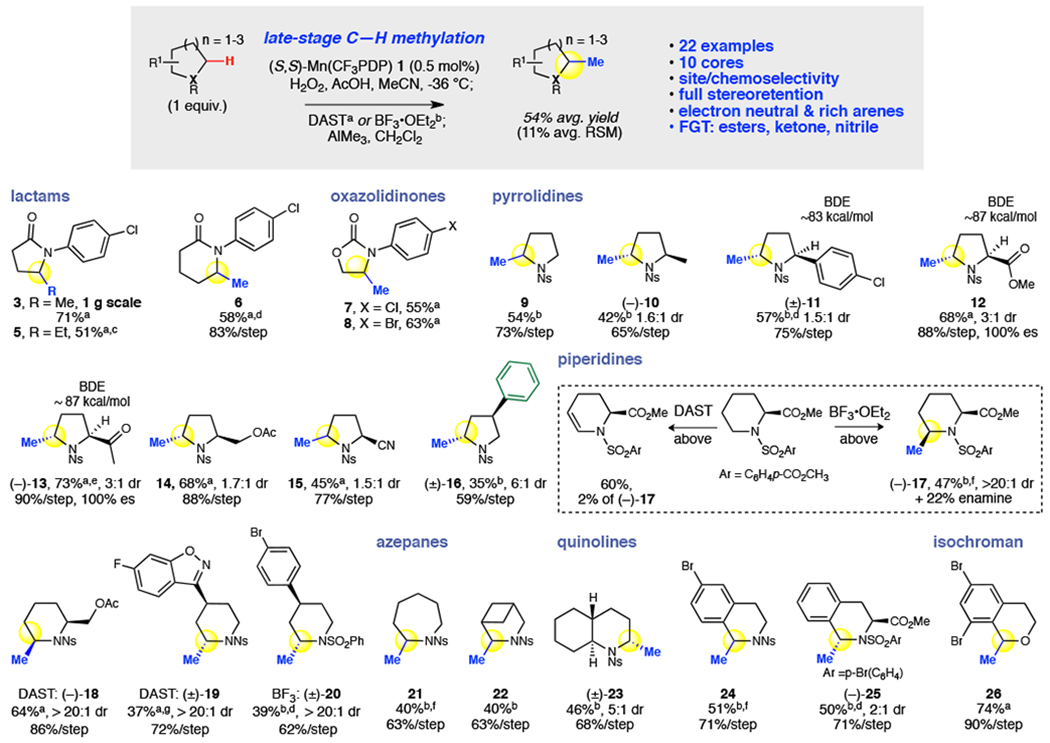
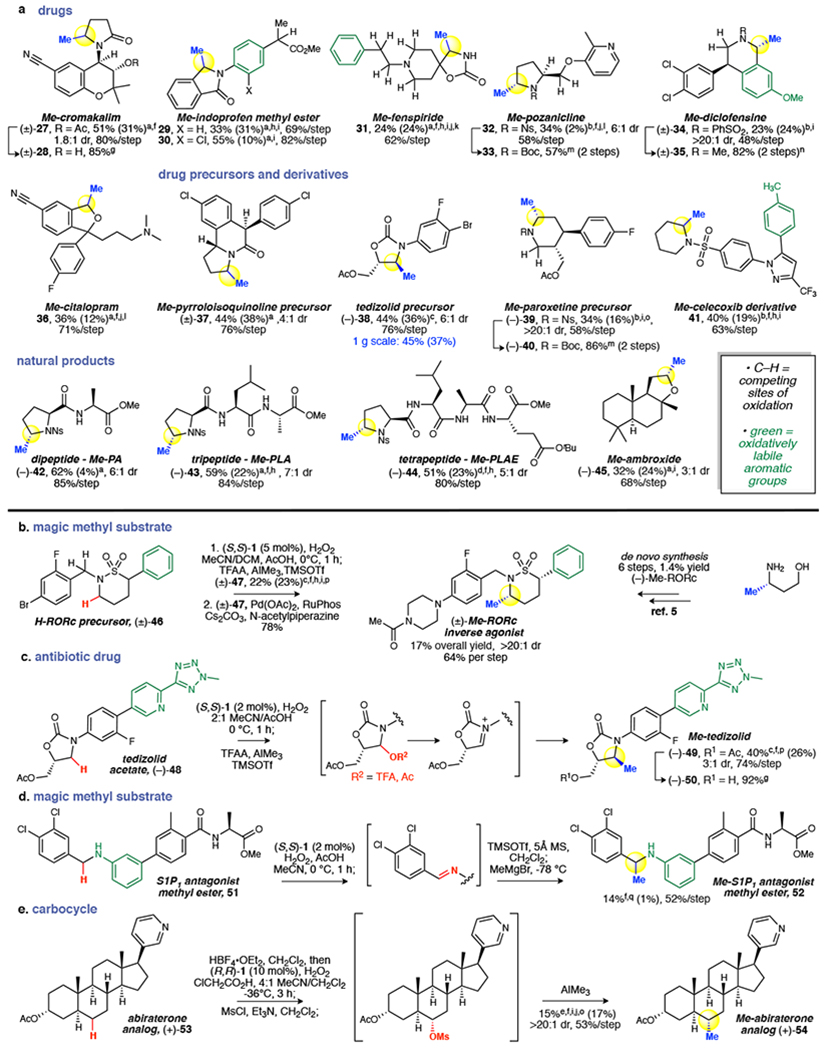
Frequently referred to as the 'magic methyl effect', the installation of methyl groups-especially adjacent (α) to heteroatoms-has been shown to dramatically increase the potency of biologically active molecules1-3. However, existing methylation methods show limited scope and have not been demonstrated in complex settings1. Here we report a regioselective and chemoselective oxidative C(sp3)-H methylation method that is compatible with late-stage functionalization of drug scaffolds and natural products. This combines a highly site-selective and chemoselective C-H hydroxylation with a mild, functional-group-tolerant methylation. Using a small-molecule manganese catalyst, Mn(CF3PDP), at low loading (at a substrate/catalyst ratio of 200) affords targeted C-H hydroxylation on heterocyclic cores, while preserving electron-neutral and electron-rich aryls. Fluorine- or Lewis-acid-assisted formation of reactive iminium or oxonium intermediates enables the use of a mildly nucleophilic organoaluminium methylating reagent that preserves other electrophilic functionalities on the substrate. We show this late-stage C(sp3)-H methylation on 41 substrates housing 16 different medicinally important cores that include electron-rich aryls, heterocycles, carbonyls and amines. Eighteen pharmacologically relevant molecules with competing sites-including drugs (for example, tedizolid) and natural products-are methylated site-selectively at the most electron rich, least sterically hindered position. We demonstrate the syntheses of two magic methyl substrates-an inverse agonist for the nuclear receptor RORc and an antagonist of the sphingosine-1-phosphate receptor-1-via late-stage methylation from the drug or its advanced precursor. We also show a remote methylation of the B-ring carbocycle of an abiraterone analogue. The ability to methylate such complex molecules at late stages will reduce synthetic effort and thereby expedite broader exploration of the magic methyl effect in pursuit of new small-molecule therapeutics and chemical probes.
Conflict of interest statement
Figures
Comment in
-
Manganese catalyst enables exploration of the magic methyl effect.Nature. 2020 Apr;580(7805):592-593. doi: 10.1038/d41586-020-01167-1. Nature. 2020. PMID: 32350473 No abstract available.
References
-
- Schönherr H & Cernak T Profound methyl effects in drug discovery and a call for new C–H methylation reactions. Angew. Chem. Int. Ed 52, 12256–12267 (2013). - PubMed
-
- Cernak T, Dykstra KD, Tyagarajan S, Vachal P & Krska SW The medicinal chemist’s toolbox for late stage functionalization of drug-like molecules. Chem. Soc. Rev 45, 546–576 (2016). - PubMed
-
- Barreiro EJ, Kümmerle AE & Fraga CAM The methylation effect in medicinal chemistry. Chem. Rev, 111, 5215–5246 (2011). - PubMed
-
- Fauber BP et al. Discovery of 1-{4-[3-Fluoro-4-((3S,6R)-3-methyl-1,1-dioxo-6-phenyl-[1,2]thiazinan-2-ylmethyl)-phenyl]-piperazin-1-yl}-ethanone (GNE-3500): a potent, selective, and orally bioavailable retinoic acid receptor-related orphan receptor c (RORc or RORγ) inverse agonist. J. Med. Chem 58, 5308–5322 (2015). - PubMed
Publication types
MeSH terms
Substances
Grants and funding
LinkOut - more resources
Full Text Sources
Other Literature Sources
Medical
