Review
. 2020 Feb 28:7:66.
doi: 10.3389/fvets.2020.00066. eCollection 2020.

Expanding Diversity of Susceptible Hosts in Peste Des Petits Ruminants Virus Infection and Its Potential Mechanism Beyond

Affiliations
Review

Expanding Diversity of Susceptible Hosts in Peste Des Petits Ruminants Virus Infection and Its Potential Mechanism Beyond

Yongxi Dou et al. Front Vet Sci. .

Abstract

Peste des petits ruminants (PPR) is a severe respiratory and digestive tract disease of domestic small ruminants caused by PPR virus (PPRV) of the genus Morbillivirus. Although the primary hosts of PPRV are goats and sheep, the host range of PPRV has been continuously expanding and reported to infect various animal hosts over the last decades, which could bring a potential challenge to effectively control and eradicate PPR globally. In this review, we focused on current knowledge about host expansion and interspecies infection of PPRV and discussed the potential mechanisms involved.

Keywords: Morbillivirus; expanding; peste des petits ruminants; peste des petits ruminants virus; potential mechanism; susceptible hosts.


Figures

Figure 1
Figure 1
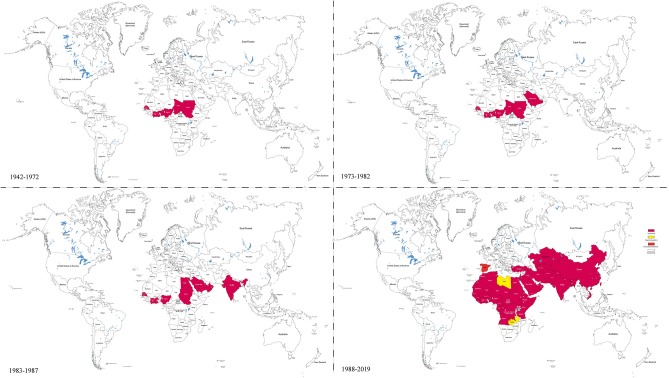
Global distribution of PPRV at different time periods. This figure is drawn according to the relevant reports of PPR and the Table 1 references by Illustrator CS6 software. It shows that the PPRV spread from west to east and the infection is rapidly expanding.
Figure 2
Figure 2
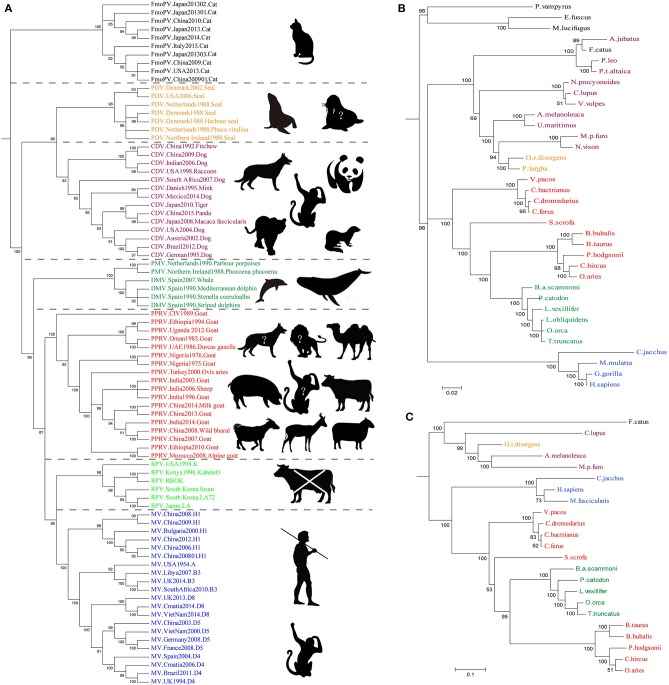
The Bayesian Phylogenetic tree was constructed based on Morbillivirus Hemagglutinin and its receptors SLAM and Nectin-4 gene. (A) The genetic relationship of MV and PPRV was the closest of morbilliviruses, and PDV and CDV were located on the same evolutionary branch. The genetic relationship of FmoPV and the other morbilliviruses was highly distant. In the right side of the tree, the host or suspicious host exhibits a broad host range of the viruses. The animals tagged with “?” represent potentially infected hosts. (B,C) Phylogenetic tree of SLAM and Nectin-4. The evolutionary tree shows that the evolution of the H seems to be strongly associated with the evolution of the SLAM and Nectin-4 receptor, especially in the Nectin-4. The sequences which are used to construct the Bayesian Phylogenetic tree GenBank accession numbers are listed in Table 2.
Figure 3
Figure 3
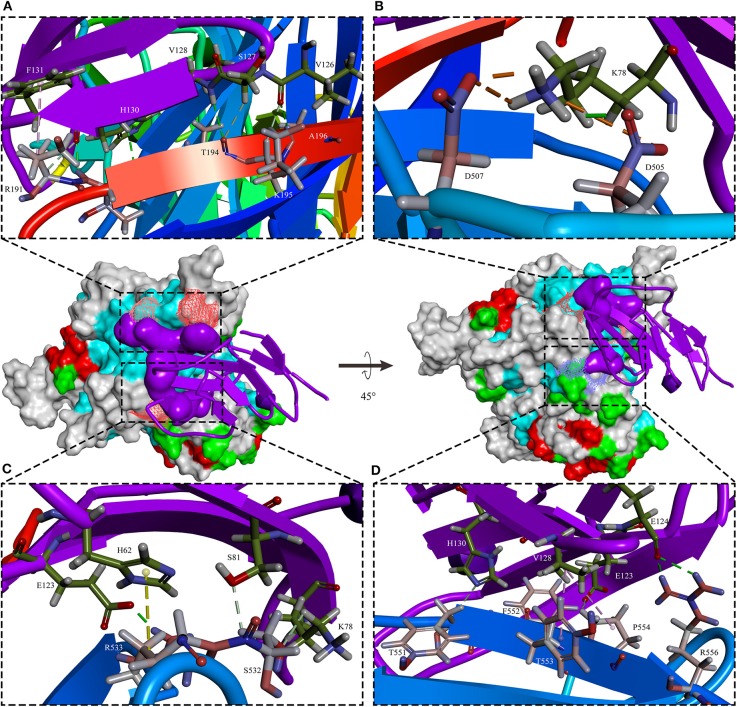
The sSLAM receptor-binding sites with PPRV HNw. The typical β-sandwich structure with BED and AGFCC′ β-sheets of the sheep SLAM (purple) bound to the β4–β6 hydrophobic groove governs in PPRV HNw head domain six-bladed β-propeller head (rainbow colors). In addition to the presence of a large number of hydrogen bonding interactions, D507 on PPRV HNw made an intermolecular salt bridge with K78 on sSLAM-V and also had Pi interactions with PPRV HN residues R191, R533, Y553, and SLAM residues F132, H63, K129. (A–D) showed four small segments of the binding interface in PPRV HNw-shSLAM complex.
Figure 4
Figure 4
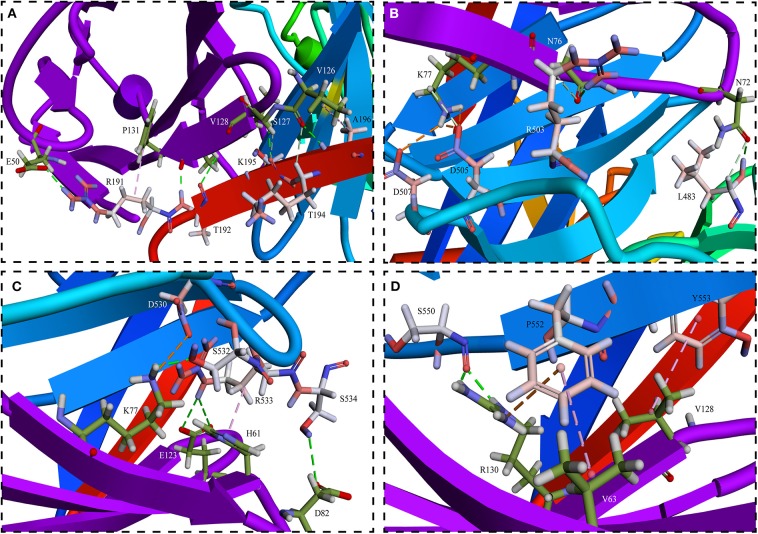
Detailed views of (A–D) in the interface between PPRV HNw and hSLAM. (A) The interface of PPRV HNw–hSLAM complex, the successional interaction comprised of β-sheet R191-K196 on the PPRV HNw β6 sheets and K126-P131 on the hSLAM G β-sheets made the complex in a more stable state. And R191 of PPRV HNw made the intermolecular Pi interaction with P131 of hSLAM, which might play an important role in stabilizing the PPRV HNw-hSLAM complex. (B) The residues D505 and D507 on PPRV HNw made the strong salt bridge with K77 on hSLAM might also play an important role in stabilizing the PPRV HNw–hSLAM complex. (C) Key residues D530 and R533 of PPRV HNw made hydrogen bonds and Pi interaction with the residues of hSLAM. (D) The strong Pi interaction comprised of residues F552 on PPRV HNw and K64 and R131 on hSLAM. Other residues L483, R503, S532, S534, S550 also made a large number of hydrogen bonds with the SLAM.

References

    1. Couacy-Hymann E, Bodjo C, Danho T, Libeau G, Diallo A. Surveillance of wildlife as a tool for monitoring rinderpest and peste des petits ruminants in West Africa. Rev Sci Tech. (2005) 24:869–77. 10.20506/rst.24.3.1615 - DOI - PubMed
    1. Khan HA, Siddique M, Sajjad ur R, Abubakar M, Ashraf M. The detection of antibody against peste des petits ruminants virus in sheep, goats, cattle and buffaloes. Trop Anim Health Prod. (2008) 40:521–7. 10.1007/s11250-008-9129-2 - DOI - PubMed
    1. Abubakar M, Mahapatra M, Muniraju M, Arshed MJ, Khan EH, Banyard AC, et al. Serological detection of antibodies to peste des petits ruminants virus in large ruminants. Transbound Emerg Dis. (2017) 64:513–9. 10.1111/tbed.12392 - DOI - PMC - PubMed
    1. Govindarajan R, Koteeswaran A, Venugopalan AT, Shyam G, Shaouna S, Shaila MS, et al. Isolation of pestes des petits ruminants virus from an outbreak in Indian buffalo (Bubalus bubalis). Vet Rec. (1997) 141:573–4. 10.1136/vr.141.22.573 - DOI - PubMed
    1. Balamurugan V, Krishnamoorthy P, Veeregowda BM, Sen A, Rajak KK, Bhanuprakash V, et al. Seroprevalence of Peste des petits ruminants in cattle and buffaloes from Southern Peninsular India. Trop Anim Health Prod. (2012) 44:301–6. 10.1007/s11250-011-0020-1 - DOI - PubMed

LinkOut - more resources