


Diagnostic utility of clinical laboratory data determinations for patients with the severe COVID-19
- PMID: 32181911
- PMCID: PMC7228247
- DOI: 10.1002/jmv.25770
Diagnostic utility of clinical laboratory data determinations for patients with the severe COVID-19
Abstract
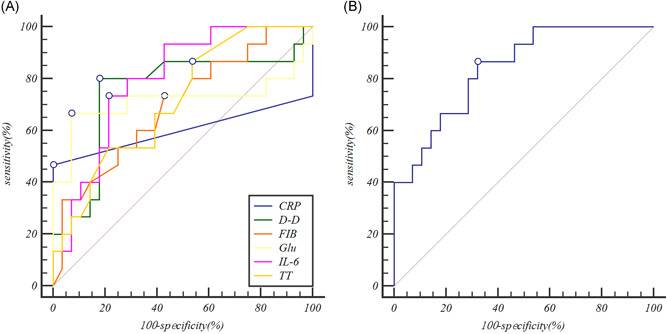
The role of clinical laboratory data in the differential diagnosis of the severe forms of COVID-19 has not been definitely established. The aim of this study was to look for the warning index in severe COVID-19 patients. We investigated 43 adult patients with COVID-19. The patients were classified into mild group (28 patients) and severe group (15 patients). A comparison of the hematological parameters between the mild and severe groups showed significant differences in interleukin-6 (IL-6), d-dimer (d-D), glucose, thrombin time, fibrinogen, and C-reactive protein (P < .05). The optimal threshold and area under the receiver operator characteristic curve (ROC) of IL-6 were 24.3 and 0.795 µg/L, respectively, while those of d-D were 0.28 and 0.750 µg/L, respectively. The area under the ROC curve of IL-6 combined with d-D was 0.840. The specificity of predicting the severity of COVID-19 during IL-6 and d-D tandem testing was up to 93.3%, while the sensitivity of IL-6 and d-D by parallel test in the severe COVID-19 was 96.4%. IL-6 and d-D were closely related to the occurrence of severe COVID-19 in the adult patients, and their combined detection had the highest specificity and sensitivity for early prediction of the severity of COVID-19 patients, which has important clinical value.
Keywords: IL-6; d-dimer; diagnostic utility; the severe COVID-19.
© 2020 Wiley Periodicals, Inc.
Conflict of interest statement
The authors declare that there are no conflict of interests.
Figures

References
-
- World Health Organization . Coronavirus disease 2019 (COVID‐19) Situation Report‐23. 2020.
-
- Wan SYQ, Fan S, Lv J, et al. Characteristics of lymphocyte subsets and cytokines in peripheral blood of 123 hospitalized patients with 2019 novel coronavirus pneumonia (NCP). medRxiv. 2020.
Publication types
MeSH terms
Substances
Grants and funding
LinkOut - more resources
Full Text Sources
Other Literature Sources
Medical
Molecular Biology Databases
Research Materials
