Comparison of Effects of Abdominal Draw-In Lumbar Stabilization Exercises with and without Respiratory Resistance on Women with Low Back Pain: A Randomized Controlled Trial
- PMID: 32182226
- PMCID: PMC7100066
- DOI: 10.12659/MSM.921295
Comparison of Effects of Abdominal Draw-In Lumbar Stabilization Exercises with and without Respiratory Resistance on Women with Low Back Pain: A Randomized Controlled Trial
Abstract
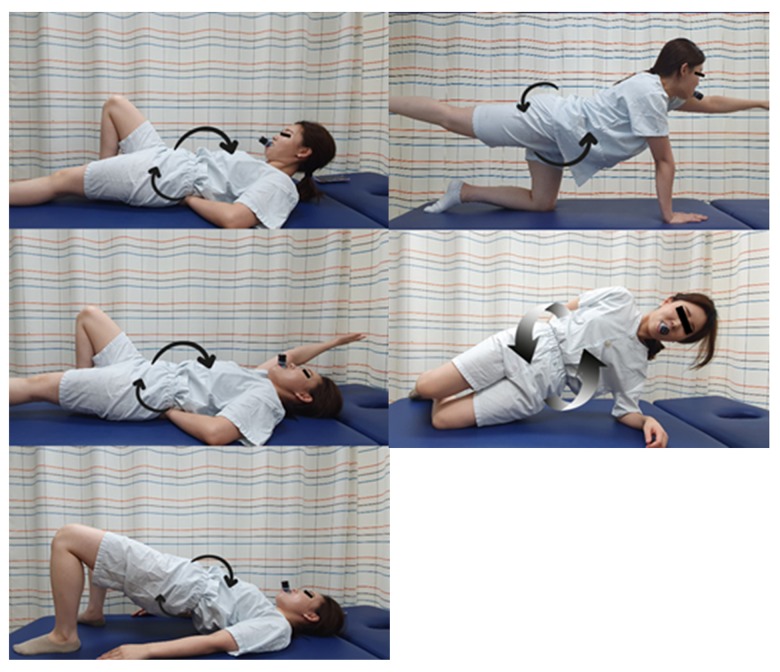
BACKGROUND This study examined the effects of abdominal draw-in lumbar stabilization exercises (ADIM) with respiratory resistance on women ages 40-49 years with low back pain. MATERIAL AND METHODS Forty-four women ages 40-49 years were screened for participation and were randomly assigned to either a respiratory with resistance exercise group (n=22) or a control group (n=22). Abdominal draw-in lumbar stabilization exercises were administered to both groups, but only the respiratory with resistance exercise group received the respiratory resistance training. The exercise training lasted 50 min per session, 3 sessions per week for 4 weeks. The assessment methods used were the quadruple visual analogue scale (QVAS), Oswestry disability index-Korean version (ODI-K), diaphragm thickness and contraction rate, and lung capacity test. RESULTS Both groups showed significant differences in the QVAS, ODI-K, maximum voluntary ventilation (MVV), and diaphragm thickness and contraction rate before and after the intervention (p<0.05). In the respiratory resistance exercise group, the ODI-K, forced vital capacity (FVC), forced expiratory volume in one second (FEV1), MVV, and diaphragm thickness and contraction rate showed significantly better improvement than the control group (p<0.05). CONCLUSIONS A lumbar stabilization exercise program consisting of ADIM and respiratory resistance resulted in decreased pain, reduced dysfunctions, and increased muscle thickness in contraction, contraction rate, and pulmonary function. Strong contraction of the diaphragm and deep abdominal muscles through breathing resistance increased the pressure in the abdominal cavity. Therefore, this may be an effective clinical exercise method for patients with lumbar instability.
Figures

References
-
- Rubin DI. Epidemiology and risk factors for spine pain. Neurol Clin. 2007;25:353–71. - PubMed
-
- Edmondston S, Singer K. Thoracic spine: Anatomical and biomechanical considerations for manual therapy. Man Ther. 1997;2:132–43. - PubMed
-
- Lee H-O. Activation of trunk muscles during stabilization exercises in four-point kneeling. The Journal of Korean Physical Therapy. 2010;22:33–38.
-
- Comerford MJ, Mottram SL. Movement and stability dysfunction – contemporary developments. Man Ther. 2001;6:15–26. - PubMed
-
- Mcconnell J. Recalcitrant chronic low back and leg pain – a new theory and different approach to management. Man Ther. 2002;7:183–92. - PubMed
Publication types
MeSH terms
LinkOut - more resources
Full Text Sources
Medical