. 2020 Mar 8;12(3):718.
doi: 10.3390/nu12030718.

Determinants of Sweetness Preference: A Scoping Review of Human Studies

Affiliations

Determinants of Sweetness Preference: A Scoping Review of Human Studies

Carolina Venditti et al. Nutrients. .

Abstract

Factors associated with sweetness preference are multi-faceted and incredibly complex. A scoping review was undertaken to identify determinants of sweetness preference in humans. Using an online search tool, ProQuest ™, a total of 99 publications were identified and subsequently grouped into the following categories of determinants: Age, dietary factors, reproductive hormonal factors, body weight status, heritable, weight loss, sound, personality, ethnicity and lifestyle, previous exposure, disease, and 'other' determinants. Methodologies amongst studies were heterogenous in nature (e.g., there was variability across studies in the sweetness concentrations tested, the number of different sweetness concentrations used to assess sweetness preference, and the methods utilized to measure sweetness preference), rendering interpretation of overall findings challenging; however, for certain determinants, the evidence appeared to support predictive capacity of greater sweetness preference, such as age during certain life-stages (i.e., young and old), being in a hungry versus satiated state, and heritable factors (e.g., similar sweetness preferences amongst family members). Recommendations for the design of future studies on sweetness preference determinants are provided herein, including an "investigator checklist" of criteria to consider.

Keywords: liking; preference; sweet; sweetness.


Conflict of interest statement

The authors declare no conflicts of interest. The funders had no role in the design of the study; in the collection, analyses, or interpretation of data. The funders (American Beverage Association; M.J.) provided support in writing and editing the manuscript.

Figures
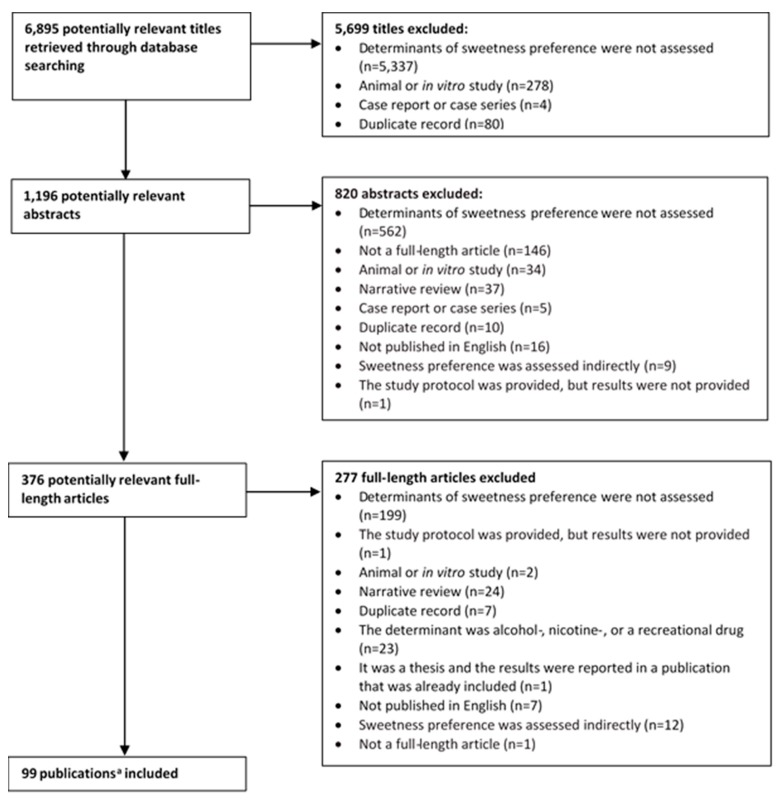
Figure 1
Figure 1
Flowchart of the literature search process. a Two of the publications [23,24] were considered “kin studies” (i.e., the studies were conducted using the same population of individuals, and outcomes were assessed at the same time point, but different outcomes were published in different manuscripts). Therefore, 98 unique studies (99 publications) are included.
Figure 2
Figure 2
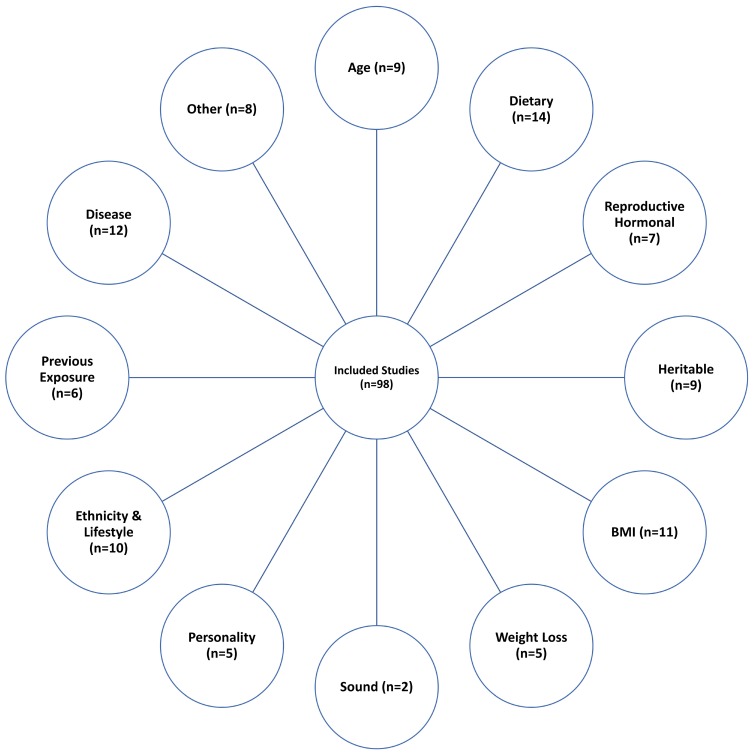
Sweetness preference distinct determinants.
Figure 3
Figure 3
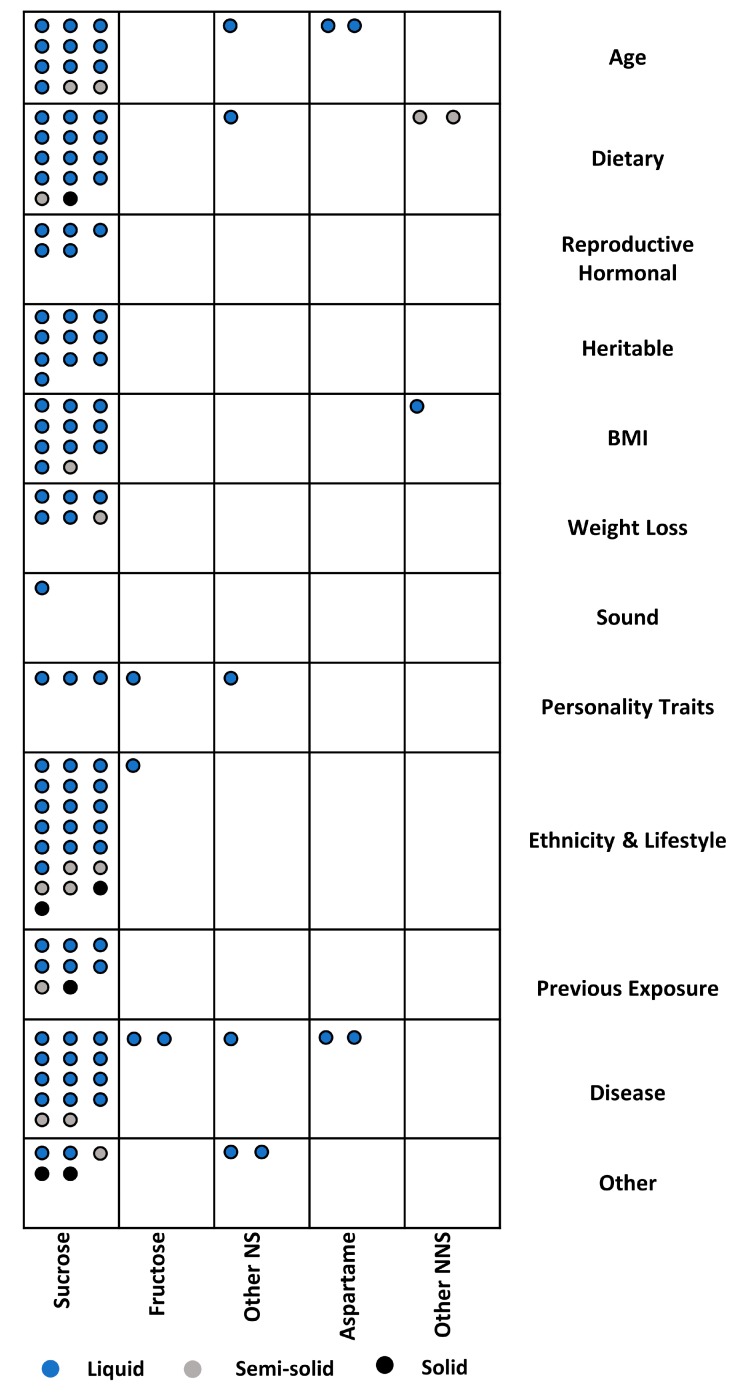
Sweeteners and physical states of sweetness delivery vehicles in sweetness reference studies. Each circle represents a different food/beverage set within the 98 studies evaluated, where a “set” is defined as one or more variations of the same food or beverage, tested in the same study population, sweetened with the same sweetener (i.e., NS or NNS), but differing only in the level of sweetness. There are a total of 128 food/beverage sets. In several studies, assessments of sweetness preference were completed for multiple “sets”. NS = nutritive sweetener; NNS = non-nutritive sweetener.
Figure 4
Figure 4
Sweetness levels (sucrose concentration equivalents) tested across studies. Each study’s reported sweetness level (i.e., a single sweet food/beverage set tested) or range (i.e., more than one sweetness level assessed for a food/beverage set) is represented by vertical bars, as sucrose equivalents, for each distinct determinant.
Figure 5
Figure 5
Summary of the scoring parameters from the “investigator checklist”. The percentage of studies in which adequate consideration of the identified parameter in the investigator checklist is provided. The “investigator checklist” is available in Table S2-1 of Supplementary File S2; an abbreviated version of the checklist is available in Table 1.

References

    1. Ventura A.K., Mennella J.A. Innate and learned preferences for sweet taste during childhood. Curr. Opin. Clin. Nutr. Metab. Care. 2011;14:379–384. doi: 10.1097/MCO.0b013e328346df65. - DOI - PubMed
    1. Beauchamp G.K. Why do we like sweet taste: A bitter tale? Physiol. Behav. 2016;164:432–437. doi: 10.1016/j.physbeh.2016.05.007. - DOI - PMC - PubMed
    1. Shrayyef M.Z., Gerich J.E. Normal glucose homeostasis. In: Poretsky L., editor. Principles of Diabetes Mellitus. Springer; Basel, Switzerland: New York, NY, USA: 2010. pp. 19–35.
    1. Lee A.A., Owyang C. Sugars, sweet taste receptors, and brain responses. Nutrients. 2017;9:653. doi: 10.3390/nu9070653. - DOI - PMC - PubMed
    1. Bachmanov A.A., Beauchamp G.K. Taste receptor genes. Annu. Rev. Nutr. 2007;27:389–414. doi: 10.1146/annurev.nutr.26.061505.111329. - DOI - PMC - PubMed

Publication types

LinkOut - more resources