Review
. 2020 Mar 9;9(3):740.
doi: 10.3390/jcm9030740.

The Role of Mitochondria in Inflammation: From Cancer to Neurodegenerative Disorders

Affiliations
Review

The Role of Mitochondria in Inflammation: From Cancer to Neurodegenerative Disorders

Sonia Missiroli et al. J Clin Med. .

Abstract

The main features that are commonly attributed to mitochondria consist of the regulation of cell proliferation, ATP generation, cell death and metabolism. However, recent scientific advances reveal that the intrinsic dynamicity of the mitochondrial compartment also plays a central role in proinflammatory signaling, identifying these organelles as a central platform for the control of innate immunity and the inflammatory response. Thus, mitochondrial dysfunctions have been related to severe chronic inflammatory disorders. Strategies aimed at reestablishing normal mitochondrial physiology could represent both preventive and therapeutic interventions for various pathologies related to exacerbated inflammation. Here, we explore the current understanding of the intricate interplay between mitochondria and the innate immune response in specific inflammatory diseases, such as neurological disorders and cancer.

Keywords: cancer; inflammation; mitochondria; neurodegenerative diseases.


Conflict of interest statement

The authors declare no conflicts of interest.

Figures
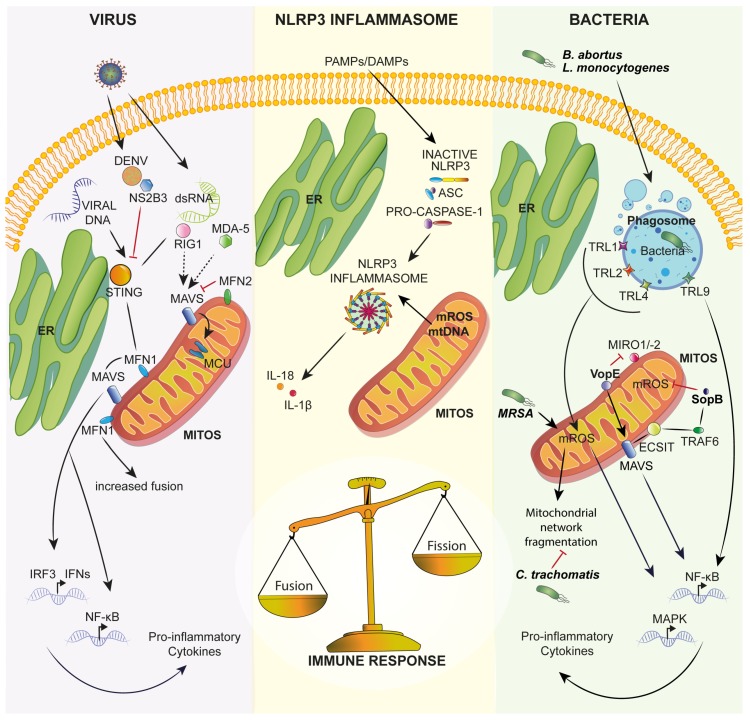
Figure 1
Figure 1
Schematic representation of the role of mitochondria in innate immunity. Viral infection, exposure to PAMPs/DAMPs or exposure to bacteria can activate the immune response, altering mitochondrial dynamics and functions. Upon viral infection, MAVS plays a key role in activation of the innate immune response, activating NF-kB and IRF-3 (interferon regulatory factor 3) signaling and inducing proinflammatory cytokine and type I interferon release. Moreover, mitochondria are a key source of DAMPs that are able to activate the NLRP3 inflammasome, leading to proinflammatory cytokine release such as IL-1β and IL-18. Several bacteria manipulate mitochondria during infection. See text for further details. DAMPs: damage-associated molecular patterns; DENV: dengue virus; ER: endoplasmic reticulum; NLRP3: NOD-, LRR- and pyrin domain-containing 3; MCU: mitochondrial calcium uniporter; MDA-5: melanoma differentiation-associated gene 5; MFN: mitofusin; mROS: mitochondrial reactive oxygen species; PAMPs: pathogen-associated molecular patterns; RIG-1: retinoic acid-inducible gene I; TLRs: Toll-like receptors; TRAF6: tumor necrosis factor receptor associated factor 6.
Figure 2
Figure 2
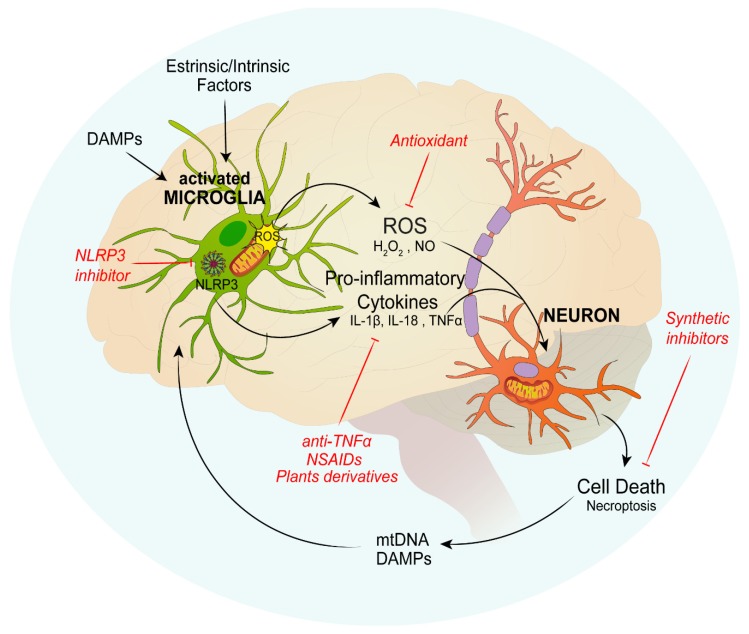
Involvement of mitochondrial dysfunction and neuroinflammation in the development of neurodegenerative diseases. DAMPs or extrinsic/intrinsic factors activate microglia that lead to ROS production and proinflammatory cytokines release that in turn alter neuronal functions and induce cell death. This creates a vicious cycle that favors mtDNA and DAMP production, activating the NLRP3 inflammasome. Selective NLRP3 inhibitors, antioxidants, specific inhibitors that block the necroptotic pathway, anti-TNFα, NSAIDs and plant derivatives can prevent this mechanism. DAMPs: damage-associated molecular patterns; NLRP3: NOD-, LRR- and pyrin domain-containing 3; NSAID: nonsteroidal anti-inflammatory drugs; mtDNA: mitochondrial DNA; ROS: reactive oxygen species.
Figure 3
Figure 3
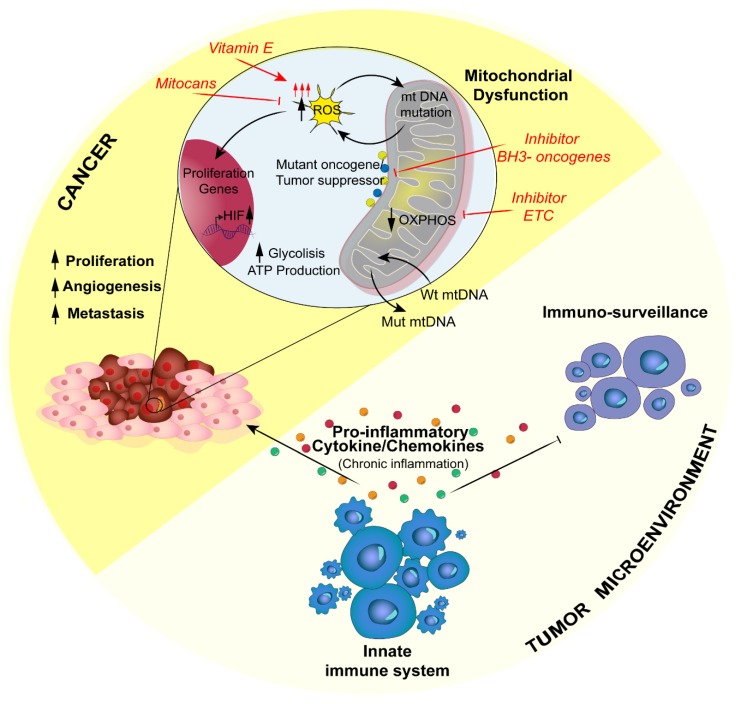
Schematic representation of how mitochondrial dysfunctions, which alter the inflammatory response, can promote cancer. In cancer, mitochondrial dysfunctions lead to increased ROS production, which can have a dual role that is either dangerous or prosurvival. On the one hand, mitochondrial ROS (mROS) can accumulate DNA mutations; on the other hand, mROS can increase cytokine inflammatory release from the innate immune system. A strategy that cancer cells can adopt to survive the increased rate of mutations is represented by the horizontal transfer of wild-type mtDNA molecules from surrounding healthy cells. The inflammatory response by the innate immune system can sustain cell tumor growth instead of counteracting it, altering the immune-surveillance and STING pathways (see text for further details). The main clinical strategy could be the selective inhibition of mROS production. ETC: electron transport chain; MOMP: mitochondrial outer membrane permeabilization; mtDNA: mitochondrial DNA; OXPHOS: mitochondrial oxidative phosphorylation; PKM2: pyruvate kinase M2; ROS: reactive oxygen species.

References

    1. Giorgi C., Marchi S., Pinton P. The machineries, regulation and cellular functions of mitochondrial calcium. Nat. Rev. Mol. Cell Biol. 2018;19:713–730. doi: 10.1038/s41580-018-0052-8. - DOI - PubMed
    1. Marchi S., Giorgi C., Suski J.M., Agnoletto C., Bononi A., Bonora M., De Marchi E., Missiroli S., Patergnani S., Poletti F., et al. Mitochondria-ros crosstalk in the control of cell death and aging. J. Signal Transduct. 2012;2012:329635. doi: 10.1155/2012/329635. - DOI - PMC - PubMed
    1. Mohanty A., Tiwari-Pandey R., Pandey N.R. Mitochondria: The indispensable players in innate immunity and guardians of the inflammatory response. J. Cell Commun. Signal. 2019;13:303–318. doi: 10.1007/s12079-019-00507-9. - DOI - PMC - PubMed
    1. Pearce E.L., Pearce E.J. Metabolic pathways in immune cell activation and quiescence. Immunity. 2013;38:633–643. doi: 10.1016/j.immuni.2013.04.005. - DOI - PMC - PubMed
    1. Sandhir R., Halder A., Sunkaria A. Mitochondria as a centrally positioned hub in the innate immune response. Biochim. Biophys. Acta Mol. Basis Dis. 2017;1863:1090–1097. doi: 10.1016/j.bbadis.2016.10.020. - DOI - PubMed

LinkOut - more resources