


New Resin-Based Bulk-Fill Composites: in vitro Evaluation of Micro-Hardness and Depth of Cure as Infection Risk Indexes
- PMID: 32183115
- PMCID: PMC7143874
- DOI: 10.3390/ma13061308
New Resin-Based Bulk-Fill Composites: in vitro Evaluation of Micro-Hardness and Depth of Cure as Infection Risk Indexes
Abstract
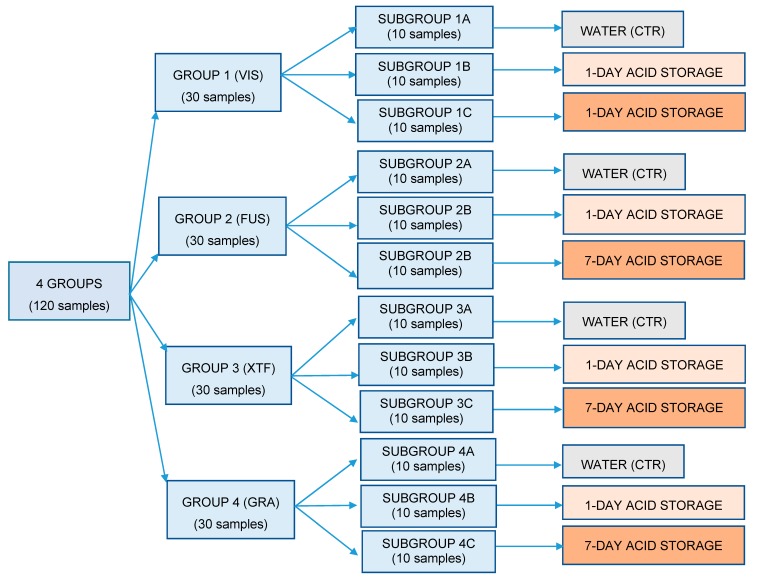
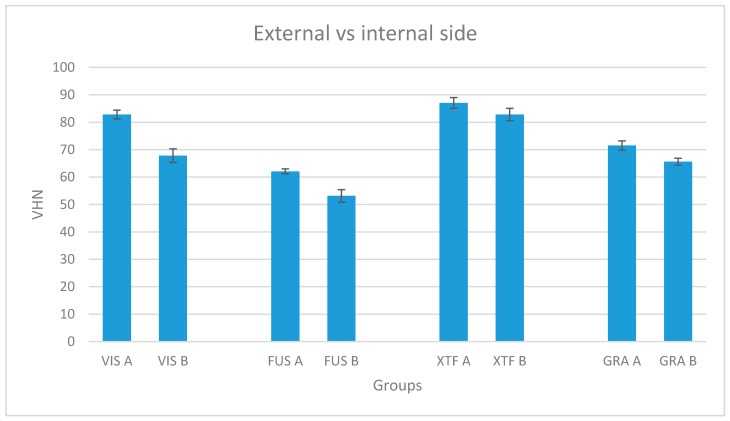
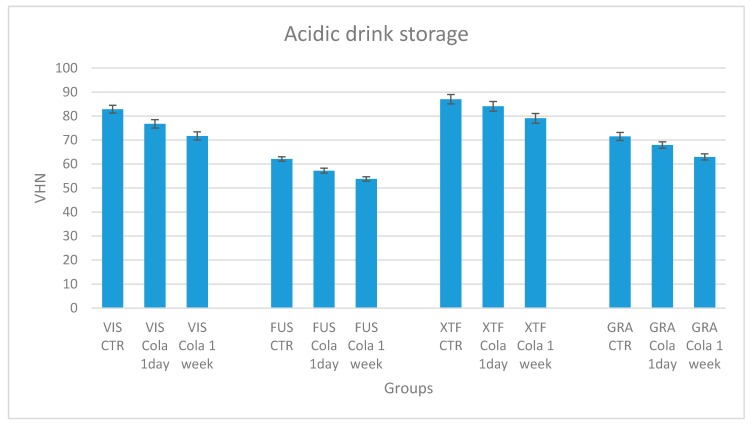
The current in vitro study evaluated the Vickers hardness number (VHN) and hardness ratio of four bulk-fill composites (VisCalor bulk; Admira Fusion x-tra; x-tra fil; and GrandioSO x-tra-Voco, Cuxhaven, Germany) to assess the risk of bacterial colonization in comparison with standard composite materials. Thirty samples were prepared for each group. The VHN of both the external (top) and internal surface (bottom) was determined with a micro-hardness tester (200 g load for 15 s), and the hardness ratio was also calculated for each sample. Subsequently, storage in an acidic soft drink (Coca-Cola, Coca-Cola Company, Milano, Italy) was performed; for each group, 10 samples were stored for 1 day, while another 10 were stored for 7 days and the remaining 10 were kept in water as controls. A significant reduction in VHN was shown for all the groups when comparing the external versus internal side (P < 0.05), although the hardness ratio was greater than 0.80, resulting in an adequate polymerization. Regarding the acid storage, all the groups showed a significant decrease of VHN when compared with the controls, both after 1 day (P < 0.05) and after 7 days (P < 0.001). All the products showed adequate depth of cure without further risk of bacterial colonization. However, acid exposure negatively affected micro-hardness values, which might promote subsequent colonization.
Keywords: acid exposure; bacterial colonization; bulk-fill composites; depth of cure; hardness ratio; infection; micro-hardness.
Conflict of interest statement
The authors of this study have no conflict of interest to disclose.
Figures
References
-
- Devoto W., Saracinelli M., Manauta J. Composite in everyday practice: How to choose the right material and simplify application techniques in the anterior teeth. Eur. J. Esthet. Dent. 2010;5:102–124. - PubMed
LinkOut - more resources
Full Text Sources
