


Exploring Mediation Roles of Child Screen-Viewing between Parental Factors and Child Overweight in Taiwan
- PMID: 32183186
- PMCID: PMC7143561
- DOI: 10.3390/ijerph17061878
Exploring Mediation Roles of Child Screen-Viewing between Parental Factors and Child Overweight in Taiwan
Abstract
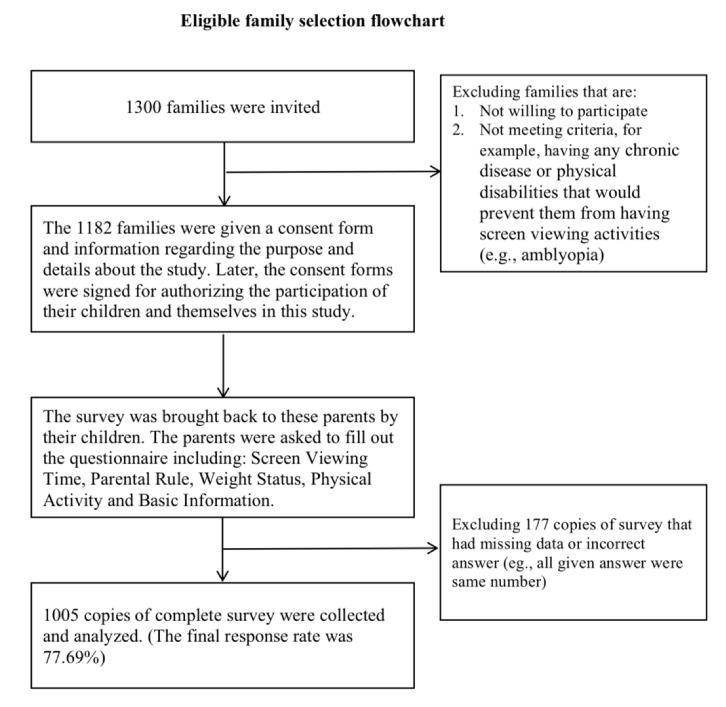
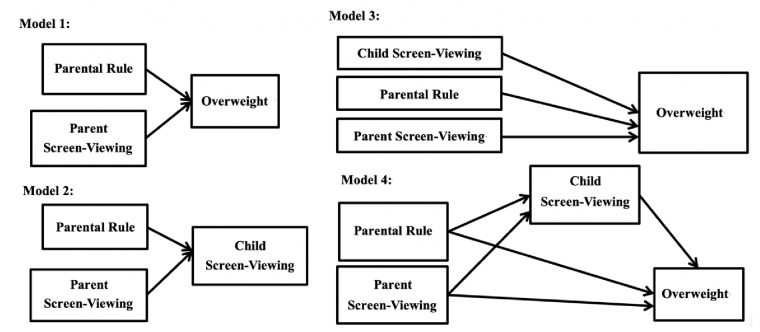
Children's screen-viewing behavior is influenced by parents' own screen-viewing hours and the parental rules set for screen-viewing time. However, whether childhood obesity is associated with these three factors has not been widely investigated in Chinese populations. We examined the relationships between parental rules, parental screen-viewing, child screen-viewing and child overweight. Questionnaires were distributed to 1300 parents who had children studying in two elementary schools in an eastern Taiwanese City (Yi-Lan). We collected the data (the final response rate was 77.7%) on children's health states, the length of screen-viewing time, and whether parental rules of screen-viewing time have been set (n = 1005). Models using structural equation modeling, with controlling of age, gender, and physical activity of the participants, were carried out, to examine the mediated effect of child screen-viewing. The results of model testing showed that child screen-viewing could be a mediator in the associations between parental rule and child overweight (parental rule: coefficient = -0.18, p < 0.001); and between parent screen-viewing and child overweight (parent screen-viewing: coefficient = 0.072, p < 0.001). These findings suggested that parental factors (rules and little screen viewing time) effectively decreased the level of children's screen-viewing time, and the child screen-viewing time could mediate the association between parental factors and child overweight in the Chinese population.
Keywords: child; obesity; parent behavior; parental rule; screen-viewing.
Conflict of interest statement
The authors declare no conflict of interest.
Figures
References
-
- Gebremariam M.K., Totland T.H., Andersen L.F., Bergh I.H., Bjelland M., Grydeland M., Ommundsen Y., Lien N. Stability and change in screen-based sedentary behaviours and associated factors among Norwegian children in the transition between childhood and adolescence. BMC Public Health. 2012;12:104–112. doi: 10.1186/1471-2458-12-104. - DOI - PMC - PubMed
MeSH terms
LinkOut - more resources
Full Text Sources
