


Biofeedback Systems for Gait Rehabilitation of Individuals with Lower-Limb Amputation: A Systematic Review
- PMID: 32183338
- PMCID: PMC7146745
- DOI: 10.3390/s20061628
Biofeedback Systems for Gait Rehabilitation of Individuals with Lower-Limb Amputation: A Systematic Review
Abstract
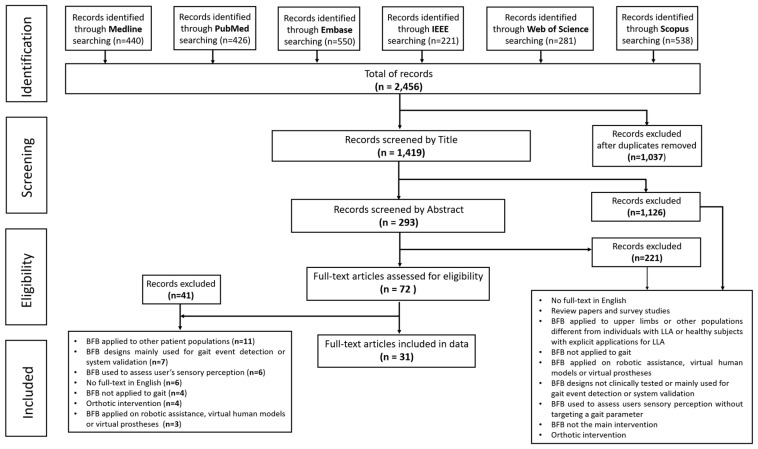
Individuals with lower-limb amputation often have gait deficits and diminished mobility function. Biofeedback systems have the potential to improve gait rehabilitation outcomes. Research on biofeedback has steadily increased in recent decades, representing the growing interest toward this topic. This systematic review highlights the methodological designs, main technical and clinical challenges, and evidence relating to the effectiveness of biofeedback systems for gait rehabilitation. This review provides insights for developing an effective, robust, and user-friendly wearable biofeedback system. The literature search was conducted on six databases and 31 full-text articles were included in this review. Most studies found biofeedback to be effective in improving gait. Biofeedback was most commonly concurrently provided and related to limb loading and symmetry ratios for stance or step time. Visual feedback was the most used modality, followed by auditory and haptic. Biofeedback must not be obtrusive and ideally provide a level of enjoyment to the user. Biofeedback appears to be most effective during the early stages of rehabilitation but presents some usability challenges when applied to the elderly. More research is needed on younger populations and higher amputation levels, understanding retention as well as the relationship between training intensity and performance.
Keywords: amputee; biofeedback; gait; locomotion; lower-limb amputation; prosthesis; real-time feedback; rehabilitation; sensory feedback; wearable systems.
Conflict of interest statement
The authors declare no conflict of interest. The funders had no role in the design of the study; in the collection, analyses, or interpretation of data; in the writing of the manuscript, or in the decision to publish the results.
Figures
References
-
- Adams J.A., Dickinson J. Proprioceptive Control of Human Movement. Am. J. Psychol. 1977;90:336. doi: 10.2307/1422062. - DOI
-
- Geurts A.C.H., Mulder T.W. Reorganisation of Postural Control Following Lower Limb Amputation: Theoretical Considerations and Implications for Rehabilitation. Physiother. Theory Pr. 1992;8:145–157. doi: 10.3109/09593989209108094. - DOI
Publication types
MeSH terms
Grants and funding
LinkOut - more resources
Full Text Sources
