


Inherited DNA Repair Gene Mutations in Men with Lethal Prostate Cancer
- PMID: 32183364
- PMCID: PMC7140841
- DOI: 10.3390/genes11030314
Inherited DNA Repair Gene Mutations in Men with Lethal Prostate Cancer
Abstract
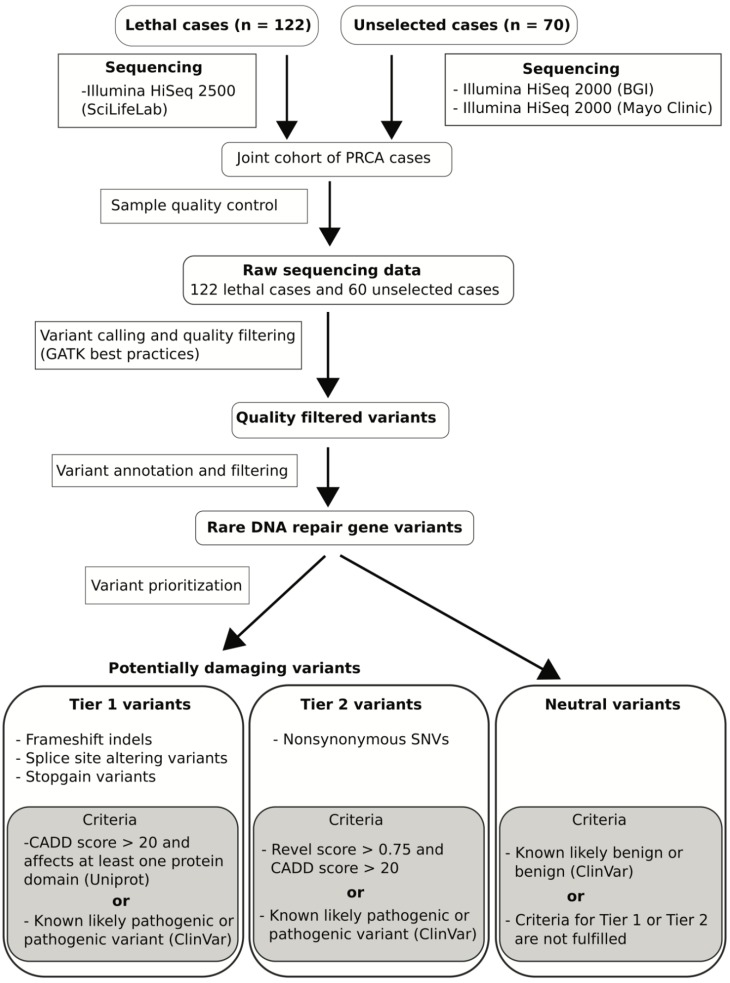
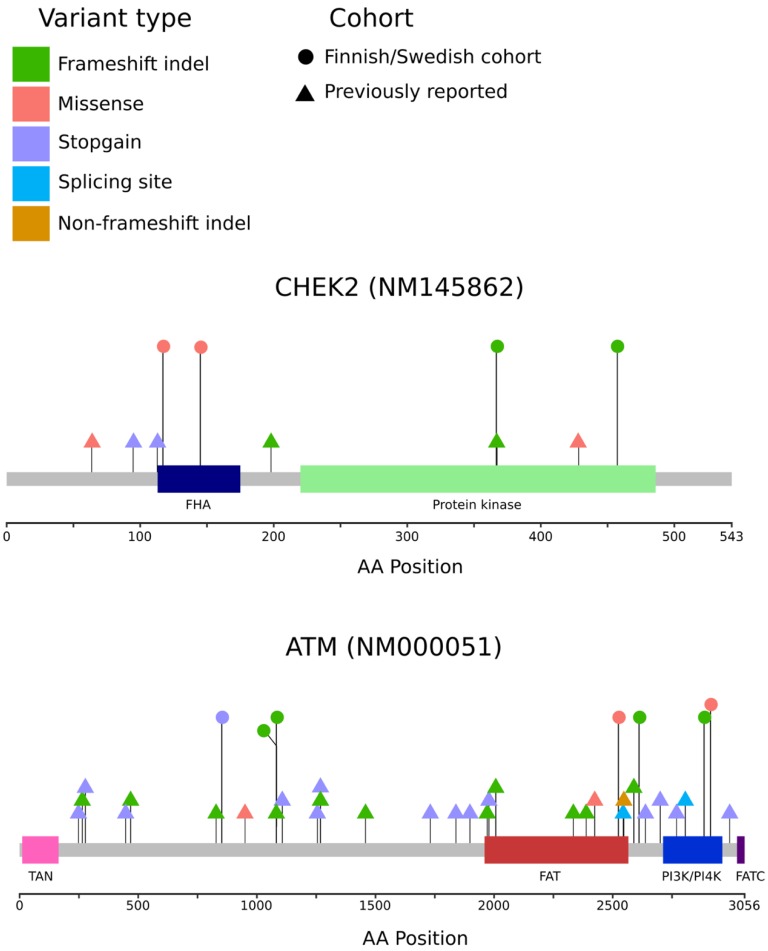
Germline variants in DNA repair genes are associated with aggressive prostate cancer (PrCa). The aim of this study was to characterize germline variants in DNA repair genes associated with lethal PrCa in Finnish and Swedish populations. Whole-exome sequencing was performed for 122 lethal and 60 unselected PrCa cases. Among the lethal cases, a total of 16 potentially damaging protein-truncating variants in DNA repair genes were identified in 15 men (12.3%). Mutations were found in six genes with CHEK2 (4.1%) and ATM (3.3%) being most frequently mutated. Overall, the carrier rate of truncating variants in DNA repair genes among men with lethal PrCa significantly exceeded the carrier rate of 0% in 60 unselected PrCa cases (p = 0.030), and the prevalence of 1.6% (p < 0.001) and 5.4% (p = 0.040) in Swedish and Finnish population controls from the Exome Aggregation Consortium. No significant difference in carrier rate of potentially damaging nonsynonymous single nucleotide variants between lethal and unselected PrCa cases was observed (p = 0.123). We confirm that DNA repair genes are strongly associated with lethal PrCa in Sweden and Finland and highlight the importance of population-specific assessment of variants contributing to PrCa aggressiveness.
Keywords: DNA repair genes; lethal cancer; prostate cancer.
Conflict of interest statement
The authors declare no conflict of interest.
Figures
References
-
- Schumacher F.R., Al Olama A.A., Berndt S.I., Benlloch S., Ahmed M., Saunders E.J., Dadaev T., Leongamornlert D., Anokian E., Cieza-Borrella C., et al. Association analyses of more than 140,000 men identify 63 new prostate cancer susceptibility loci. Nat. Genet. 2018;50:928–936. doi: 10.1038/s41588-018-0142-8. - DOI - PMC - PubMed
-
- Szulkin R., Karlsson R., Whitington T., Aly M., Gronberg H., Eeles R.A., Easton D.F., Kote-Jarai Z., Al Olama A.A., Benlloch S., et al. Genome-wide association study of prostate cancer-specific survival. Cancer Epidemiol. Biomarkers Prev. 2015;24:1796–1800. doi: 10.1158/1055-9965.EPI-15-0543. - DOI - PMC - PubMed
Publication types
MeSH terms
Grants and funding
LinkOut - more resources
Full Text Sources
Medical
Research Materials
Miscellaneous
