


Micronutrient Deficiencies Following Minimally Invasive Esophagectomy for Cancer
- PMID: 32183492
- PMCID: PMC7146612
- DOI: 10.3390/nu12030778
Micronutrient Deficiencies Following Minimally Invasive Esophagectomy for Cancer
Abstract
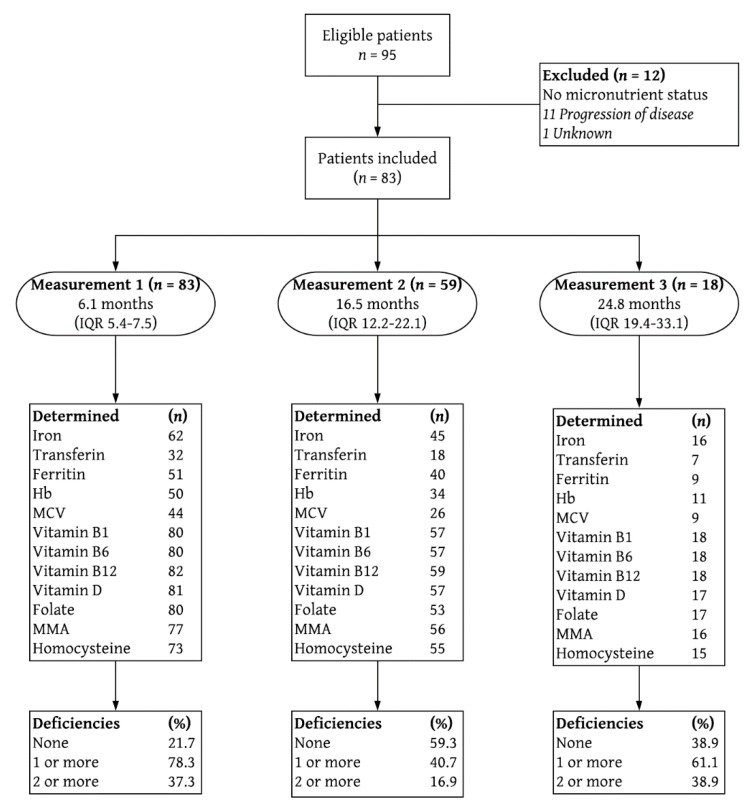
Over the past decades, survival rates for patients with resectable esophageal cancer have improved significantly. Consequently, the sequelae of having a gastric conduit, such as development of micronutrient deficiencies, become increasingly apparent. This study investigated postoperative micronutrient trends in the follow-up of patients following a minimally invasive esophagectomy (MIE) for cancer. Patients were included if they had at least one postoperative evaluation of iron, ferritin, vitamins B1, B6, B12, D, folate or methylmalonic acid. Data were available in 83 of 95 patients. Of these, 78.3% (65/83) had at least one and 37.3% (31/83) had more than one micronutrient deficiency at a median of 6.1 months (interquartile range (IQR) 5.4-7.5) of follow-up. Similar to the results found in previous studies, most common deficiencies identified were: iron, vitamin B12 and vitamin D. In addition, folate deficiency and anemia were detected in a substantial amount of patients in this cohort. At 24.8 months (IQR 19.4-33.1) of follow-up, micronutrient deficiencies were still common, however, most deficiencies normalized following supplementation on indication. In conclusion, patients undergoing a MIE are at risk of developing micronutrient deficiencies as early as 6 up to 24 months after surgery and should therefore be routinely checked and supplemented when needed.
Keywords: esophageal cancer; esophagectomy; micronutrient deficiencies; vitamin deficiencies.
Conflict of interest statement
The authors declare no conflict of interest.
Figures
References
-
- Faiz Z., Lemmens V.E., Siersema P.D., Nieuwenhuijzen G.A., Wouters M.W., Rozema T., Coebergh J.W., Wijnhoven B.P. Increased resection rates and survival among patients aged 75 years and older with esophageal cancer: A Dutch nationwide population-based study. World J. Surg. 2012;36:2872–2878. doi: 10.1007/s00268-012-1762-2. - DOI - PubMed
-
- Kumagai K., Rouvelas I., Tsai J.A., Mariosa D., Lind P.A., Lindblad M., Ye W., Lundell L., Schuhmacher C., Mauer M., et al. Survival benefit and additional value of preoperative chemoradiotherapy in resectable gastric and gastro-oesophageal junction cancer: A direct and adjusted indirect comparison meta-analysis. Eur. J. Surg. Oncol. 2015;41:282–294. doi: 10.1016/j.ejso.2014.11.039. - DOI - PubMed
-
- Straatman J., van der Wielen N., Cuesta M.A., Daams F., Roig Garcia J., Bonavina L., Rosman C., van Berge Henegouwen M.I., Gisbertz S.S., van der Peet D.L. Minimally Invasive Versus Open Esophageal Resection: Three-year Follow-up of the Previously Reported Randomized Controlled Trial: The TIME Trial. Ann. Surg. 2017;266:232–236. doi: 10.1097/SLA.0000000000002171. - DOI - PubMed
Publication types
MeSH terms
Substances
LinkOut - more resources
Full Text Sources
Medical
Miscellaneous
