


Early warning signals of malaria resurgence in Kericho, Kenya
- PMID: 32183637
- PMCID: PMC7115183
- DOI: 10.1098/rsbl.2019.0713
Early warning signals of malaria resurgence in Kericho, Kenya
Abstract
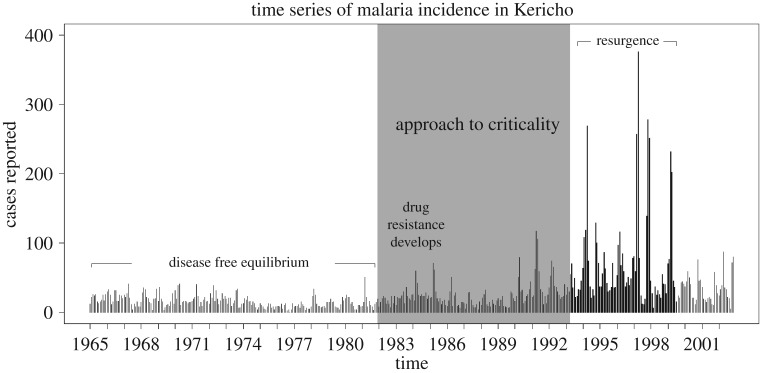
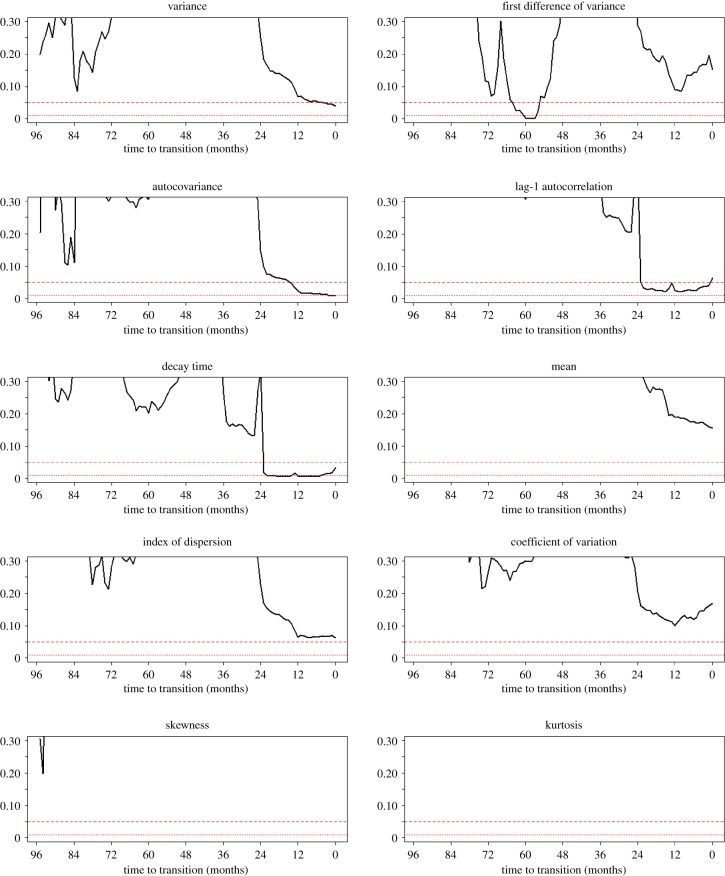
Campaigns to eliminate infectious diseases could be greatly aided by methods for providing early warning signals of resurgence. Theory predicts that as a disease transmission system undergoes a transition from stability at the disease-free equilibrium to sustained transmission, it will exhibit characteristic behaviours known as critical slowing down, referring to the speed at which fluctuations in the number of cases are dampened, for instance the extinction of a local transmission chain after infection from an imported case. These phenomena include increases in several summary statistics, including lag-1 autocorrelation, variance and the first difference of variance. Here, we report the first empirical test of this prediction during the resurgence of malaria in Kericho, Kenya. For 10 summary statistics, we measured the approach to criticality in a rolling window to quantify the size of effect and directions. Nine of the statistics increased as predicted and variance, the first difference of variance, autocovariance, lag-1 autocorrelation and decay time returned early warning signals of critical slowing down based on permutation tests. These results show that time series of disease incidence collected through ordinary surveillance activities may exhibit characteristic signatures prior to an outbreak, a phenomenon that may be quite general among infectious disease systems.
Keywords: forecasting; infectious disease; malaria; resurgence; statistics.
Conflict of interest statement
We declare we have no competing interests.
Figures
References
Publication types
MeSH terms
Associated data
Grants and funding
LinkOut - more resources
Full Text Sources
Other Literature Sources
Medical
