


Development and upgrading of public primary healthcare facilities with essential surgical services infrastructure: a strategy towards achieving universal health coverage in Tanzania
- PMID: 32183797
- PMCID: PMC7076948
- DOI: 10.1186/s12913-020-5057-2
Development and upgrading of public primary healthcare facilities with essential surgical services infrastructure: a strategy towards achieving universal health coverage in Tanzania
Abstract
Background: Infrastructure development and upgrading to support safe surgical services in primary health care facilities is an important step in the journey towards achieving Universal Health Coverage (UHC). Quality health service provision together with equitable geographic access and service delivery are important components that constitute UHC. Tanzania has been investing in infrastructure development to offer essential safe surgery close to communities at affordable costs while ensuring better outcomes. This study aimed to understand the public sector's efforts to improve the infrastructure of primary health facilities between 2005 and 2019. We assessed the construction rates, geographic coverage, and physical status of each facility, surgical safety and services rendered in public primary health facilities.
Methods: Data was collected from existing policy reports, the Services Availability and Readiness Assessment (SARA) tool (physical status), the Health Facility Registry (HFR), implementation reports on infrastructure development from the 26 regions and 185 district councils across the country (covering assessment of physical infrastructure, waste management systems and inventories for ambulances) and Comprehensive Emergence Obstetric Care (CEMONC) signal functions assessment tool. Data was descriptively analyzed so as to understand the distribution of primary health care facilities and their status (old, new, upgraded, under construction, renovated and equipped), and the service provided, including essential surgical services.
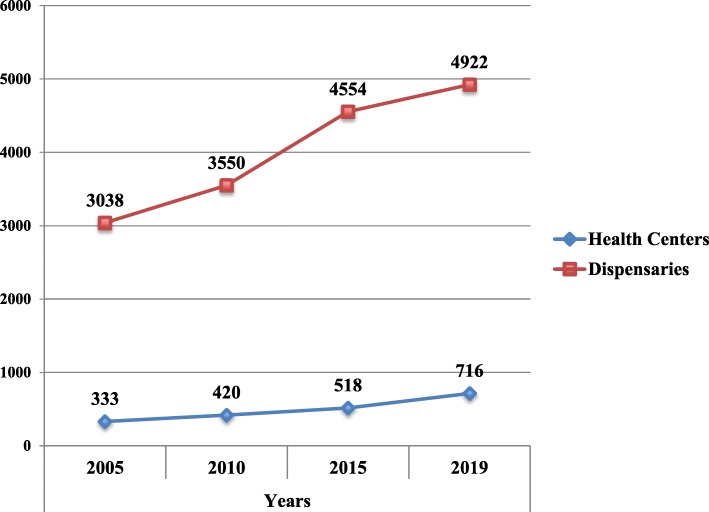
Results: Of 5072 (518 are Health Centers and 4554 are Dispensaries) existing public primary health care facilities, the majority (46%) had a physical status of A (good state), 33% (1693) had physical status of B (minor renovation needed) and the remaining facilities had physical status of C up to F (needing major renovation). About 33% (1673) of all health facilities had piped water and 5.1% had landline telecommunication system. Between 2015 and August 2019, a total of 419 (8.3%) health facilities (Consisting of 350 health centers and 69 District Council Hospitals) were either renovated or constructed and equipped to offer safe surgery services. Of all Health Centers only 115 (22.2%) were offering the CEMONC services. Of these 115 health facilities, only 20 (17.4%) were offering the CEMONC services with all 9 - signal functions and only 17.4% had facilities that are offering safe blood transfusion services.
Conclusion: This study indicates that between 2015 and 2019 there has been improvement in physical status of primary health facilities as a result constructions, upgrading and equipping the facilities to offer safe surgery and related diagnostic services. Despite the achievements, still there is a high demand for good physical statuses and functioning of primary health facilities with capacity to offer essential and safe surgical services in the country also as an important strategy towards achieving UHC. This is also inline with the National Surgical, Obstetrics and Anesthesia plan (NSOAP).
Keywords: Infrastructure; Primary health facilities; Safe surgery; Universal health coverage.
Conflict of interest statement
SA and AK declare that they have no competing interests. However, NAK, JTK, YS and DG work at the President’s Office – Regional Administration and Local Government and JGM declares that he receives funding from GE Foundation as part of the SS2020 Program.
Figures

References
-
- World Health Organization (WHO) Together on the road to universal health coverage A CALL TO ACTION. 2017.
-
- The world health report (2013): research for Universal Health Coverage. https://apps.who.int/medicinedocs/documents/s20294en/s20294en.pdf. Accessed Nov 2019.
MeSH terms
Grants and funding
LinkOut - more resources
Full Text Sources
