


Free-living amoebae and their relationship to air quality in hospital environments: characterization of Acanthamoeba spp. obtained from air-conditioning systems
- PMID: 32183918
- PMCID: PMC10318258
- DOI: 10.1017/S0031182020000487
Free-living amoebae and their relationship to air quality in hospital environments: characterization of Acanthamoeba spp. obtained from air-conditioning systems
Abstract
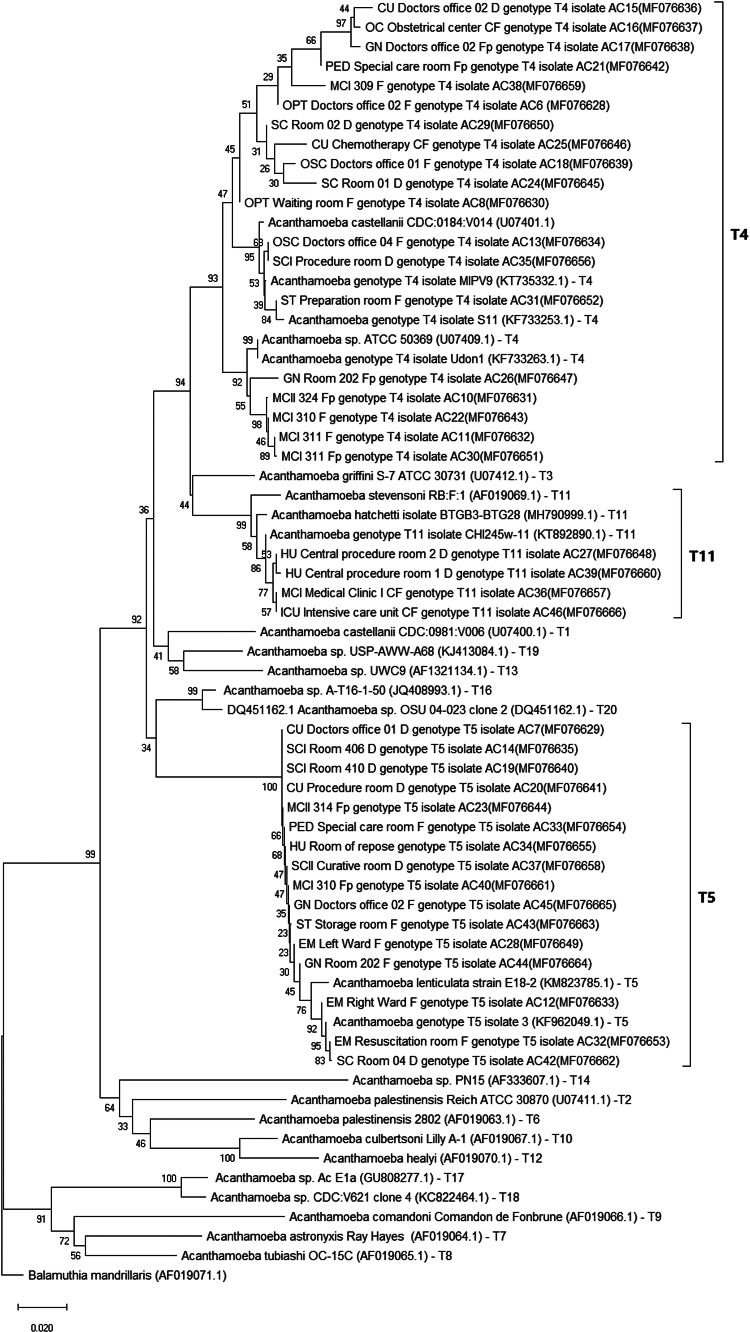
Free-living amoebae (FLA) are widely dispersed in the environment, can cause opportunistic and non-opportunistic infections in humans and other animals. The aim of the present study was characterize FLA obtained from air-conditioners of a public hospital in the city of Florianópolis, SC, Brazil. Fifty-four dust samples were collected of air conditioners, and were inoculated on 1.5% non-nutrient agar, overlaid with layers of Escherichia coli. Subsequently the isolates were axenised in PYG growth medium. The morphological and molecular characterization of the isolates was performed, as well as the tolerance (physiological) assays were used to evaluate the pathogenic potential. The results revealed the presence of FLA in 42 (77.8%) of the collected samples. Of these, 39 (92.9%) axenic isolates of FLA were obtained for morphological and genotypic studies. All the isolates characterized belong to the genus Acanthamoeba. Nineteen (48.7%) isolates belong to the genotype T4, 16 (41.0%) to the T5 genotype and 4 (10.3%) to genotype T11. Seven (18.0%) isolates were considered potentially pathogenic in tolerance assays. These findings require attention, considering the isolation environment and immunocompromised characteristics of many hospitalized patients.
Keywords: Acanthamoeba; air-conditioners; free-living amoebae; hospital.
Figures

References
-
- Afonso MSM, Tripple AFV, Souza ACS, Prado MA and Anders PS (2004) A qualidade do ar em ambientes hospitalares climatizados e sua influência na ocorrência de infecções. Revista Eletrônica de Enfermagem 6, 181–188.
-
- Alves DSMM, Moraes AS, Nitz N, Oliveira MGC, Hecht MM, Gurguel-Gonçalves R and Cuba CAC (2012) Occurrence and characterization of Acanthamoeba similar to genotypes T4, T5, and T2/T6 isolated from environmental sources in Brasília, Federal District, Brazil. Experimental Parasitology 131, 239–244. - PubMed
-
- Astorga B, Lorenzo-Morales J, Martín-Navarro CM, Alarcón V, Moreno J, González AC, Navarrete E, Piñero JE and Valladares B (2011) Acanthamoeba belonging to T3, T4, and T11: genotypes isolated from air-conditioning units in Santiago, Chile. Journal of Eukaryotic Microbiology 58, 542–544. - PubMed
Publication types
MeSH terms
LinkOut - more resources
Full Text Sources
Medical
Miscellaneous
