


Psychological Stress-Induced Immune Response and Risk of Alzheimer's Disease in Veterans from Operation Enduring Freedom and Operation Iraqi Freedom
- PMID: 32184013
- PMCID: PMC7308186
- DOI: 10.1016/j.clinthera.2020.02.018
Psychological Stress-Induced Immune Response and Risk of Alzheimer's Disease in Veterans from Operation Enduring Freedom and Operation Iraqi Freedom
Abstract
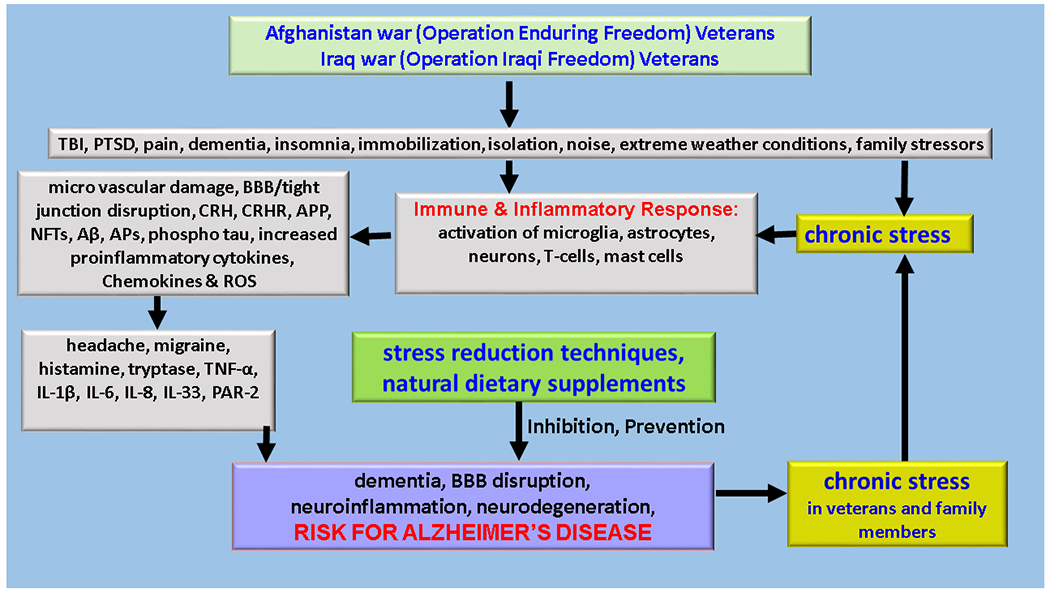
Purpose: Psychological stress is a significant health problem in veterans and their family members. Traumatic brain injury (TBI) and stress lead to the onset, progression, and worsening of several inflammatory and neurodegenerative diseases in veterans and civilians. Alzheimer's disease (AD) is a progressive, irreversible neuroinflammatory disease that causes problems with memory, thinking, and behavior. TBIs and chronic psychological stress cause and accelerate the pathology of neuroinflammatory diseases such as AD. However, the precise molecular and cellular mechanisms governing neuroinflammation and neurodegeneration are currently unknown, especially in veterans. The purpose of this review article was to advance the hypothesis that stress and TBI-mediated immune response substantially contribute and accelerate the pathogenesis of AD in veterans and their close family members and civilians.
Methods: The information in this article was collected and interpreted from published articles in PubMed between 1985 and 2020 using the key words stress, psychological stress, Afghanistan war, Operation Enduring Freedom (OEF), Iraq War, Operation Iraqi Freedom (OIF), Operation New Dawn (OND), traumatic brain injury, mast cell and stress, stress and neuroimmune response, stress and Alzheimer's disease, traumatic brain injury, and Alzheimer's disease.
Findings: Chronic psychological stress and brain injury induce the generation and accumulation of beta-amyloid peptide, amyloid plaques, neurofibrillary tangles, and phosphorylation of tau in the brain, thereby contributing to AD pathogenesis. Active military personnel and veterans are under enormous psychological stress due to various war-related activities, including TBIs, disabilities, fear, new environmental conditions, lack of normal life activities, insufficient communications, explosions, military-related noise, and health hazards. Brain injury, stress, mast cell, and other immune cell activation can induce headache, migraine, dementia, and upregulate neuroinflammation and neurodegeneration in veterans of Operation Enduring Freedom, Operation Iraqi Freedom, and Operation New Dawn. TBIs, posttraumatic stress disorder, psychological stress, pain, glial activation, and dementia in active military personnel, veterans, or their family members can cause AD several years later in their lives. We suggest that there are increasing numbers of veterans with TBIs and stress and that these veterans may develop AD late in life if no appropriate therapeutic intervention is available.
Implications: Per these published reports, the fact that TBIs and psychological stress can accelerate the pathogenesis of AD should be recognized. Active military personnel, veterans, and their close family members should be evaluated regularly for stress symptoms to prevent the pathogenesis of neurodegenerative diseases, including AD.
Keywords: afghanistan war; alzheimer's disease; amyloid plaque; iraq war; psychological stress; traumatic brain injury.
Copyright © 2020 Elsevier Inc. All rights reserved.
Conflict of interest statement
CONFLICTS OF INTERESTS
The authors have indicated that they have no conflicts of interest regarding the content of this article.
Declarations of Interest
None
Figures
References
-
- Slatore CG, Falvo MJ, Nugent S, Carlson K: Afghanistan and Iraq War Veterans: Mental Health Diagnoses are Associated with Respiratory Disease Diagnoses. Mil Med 2018, 183:e249–e257. - PubMed
-
- Ciarleglio MM, Aslan M, Proctor SP, Concato J, Ko J, Kaiser AP, Vasterling JJ: Associations of Stress Exposures and Social Support With Long-Term Mental Health Outcomes Among U.S. Iraq War Veterans. Behav Ther 2018, 49:653–667. - PubMed
-
- Georgopoulos AP, James LM, Carpenter AF, Engdahl BE, Leuthold AC, Lewis SM: Gulf War illness (GWI) as a neuroimmune disease. Exp Brain Res 2017, 235:3217–3225. - PubMed
-
- Hasoon J: Blast-associated traumatic brain injury in the military as a potential trigger for dementia and chronic traumatic encephalopathy. US Army Med Dep J 2017:102–105. - PubMed
Publication types
MeSH terms
Grants and funding
LinkOut - more resources
Full Text Sources
Medical
