


Observational retrospective study of UK national success, risks and costs for 319,105 IVF/ICSI and 30,669 IUI treatment cycles
- PMID: 32184314
- PMCID: PMC7076239
- DOI: 10.1136/bmjopen-2019-034566
Observational retrospective study of UK national success, risks and costs for 319,105 IVF/ICSI and 30,669 IUI treatment cycles
Abstract
Objective: To compare success rates, associated risks and cost-effectiveness between intrauterine insemination (IUI) and in vitro fertilisation (IVF).
Design: Retrospective observational study.
Setting: The UK from 2012 to 2016.
Participants: Data from Human Fertilisation and Embryology Authority's freedom of information request for 2012-2016 for IVF/ICSI (intracytoplasmic sperm injection)and IUI as practiced in 319 105 IVF/ICSI and 30 669 IUI cycles. Direct-cost calculations for maternal and neonatal expenditure per live birth (LB) was constructed using the cost of multiple birth model, with inflation-adjusted Bank of England index-linked data. A second direct-cost analysis evaluating the incremental cost-effective ratio (ICER) was modelled using the 2016 national mean (baseline) IVF and IUI success rates.
Outcome measures: LB, risks from IVF and IUI, and costs to gain 1 LB.
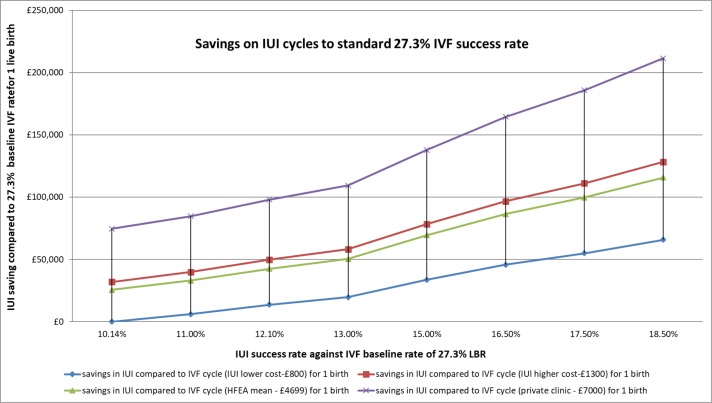
Results: This largest comprehensive analysis integrating success, risks and costs at a national level shows IUI is safer and more cost-effective than IVF treatment.IVF LB/cycle success was significantly better than IUI at 26.96% versus 11.49% (p<0.001) but the IUI success is much closer to IVF at 2.35:1, than previously considered. IVF remains a significant source of multiple gestation pregnancy (MGP) compared with IUI (RR (Relative Risk): 1.45 (1.31 to 1.60), p<0.001) as was the rate of twins (RR: 1.58, p<0.001).In 2016, IVF maternal and neonatal cost was £115 082 017 compared with £2 940 196 for IUI and this MGP-related perinatal cost is absorbed by the National Health Services. At baseline tariffs and success rates IUI was £42 558 cheaper than IVF to deliver 1LB with enhanced benefits with small improvements in IUI. Reliable levels of IVF-related MGP, OHSS (ovarian hyperstimulation syndrome), fetal reductions and terminations are revealed.
Conclusion: IUI success rates are much closer to IVF than previously reported, more cost-effective in delivering 1 LB, and associated with lower risk of complications for maternal and neonatal complications. It is prudent to offer IUI before IVF nationally.
Keywords: IUI; IVF; cost efficiency; risks; stakeholders; success.
© Author(s) (or their employer(s)) 2020. Re-use permitted under CC BY-NC. No commercial re-use. See rights and permissions. Published by BMJ.
Conflict of interest statement
Competing interests: None declared.
Figures

References
-
- HFEA Jan What’s the difference between IVF and IUI? 2019. Available: https://www.hfea.gov.uk/treatments/explore-all-treatments/intrauterine-i...
-
- NICE National Institute for Health and Care Excellence. Fertility problems: assessment and treatment. 2013. Clinical guideline [CG156] Published date: February 2013 Last updated: August 2016, 2013. Available: https://www.nice.org.uk/guidance/cg156
Publication types
MeSH terms
LinkOut - more resources
Full Text Sources
Miscellaneous
