


Current Knowledge and Attitudes Concerning Cost-Effectiveness in Glaucoma Pharmacotherapy: A Glaucoma Specialists Focus Group Study
- PMID: 32184559
- PMCID: PMC7064281
- DOI: 10.2147/OPTH.S236030
Current Knowledge and Attitudes Concerning Cost-Effectiveness in Glaucoma Pharmacotherapy: A Glaucoma Specialists Focus Group Study
Abstract
Background: Rising healthcare costs motivate continued cost-reduction efforts. To help lower costs associated with open-angle glaucoma (OAG), a prevalent, progressive disease with substantial direct and indirect costs, clinicians need to understand the cost-effectiveness of intraocular pressure (IOP)-lowering pharmacotherapies. There is little published information on clinicians' knowledge and attitudes about cost-effectiveness in glaucoma treatment.
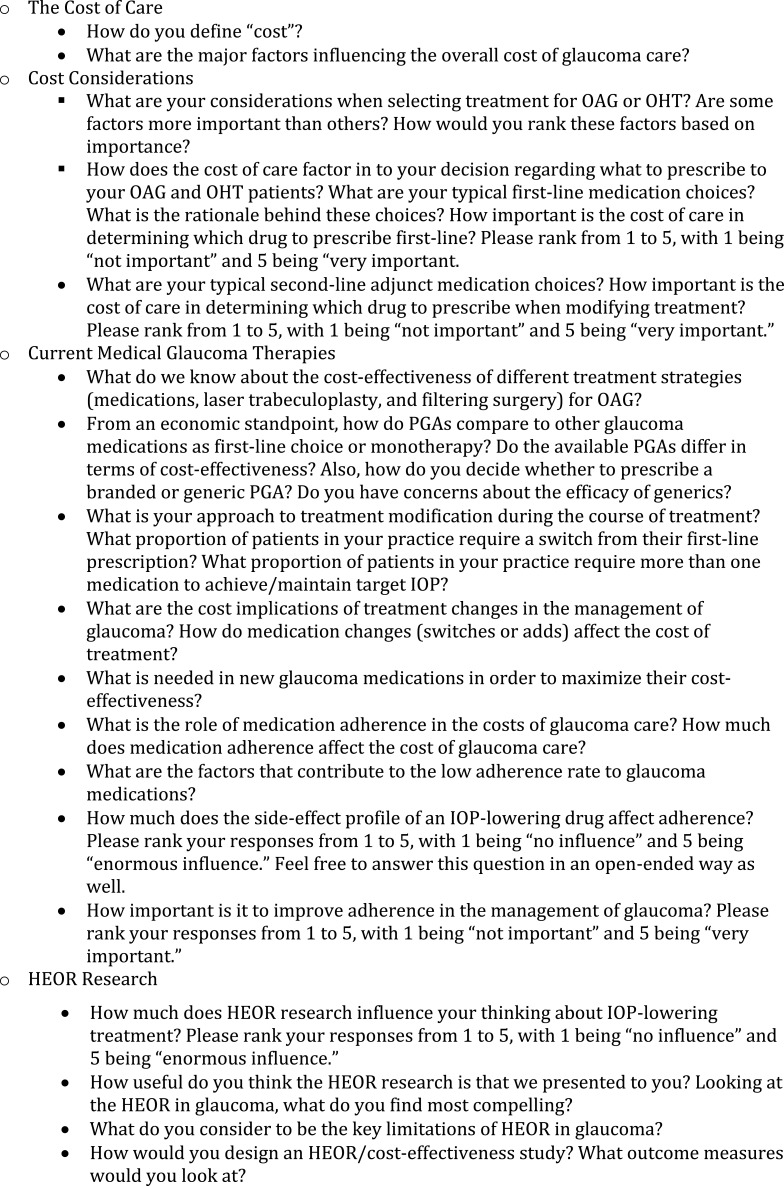
Purpose: This pilot focus group study aimed to explore clinician attitudes and perspectives around the costs and cost drivers of glaucoma therapy; the implementation of cost-effectiveness decisions; the clinical utility of cost-effectiveness studies; and the cost-effectiveness of available treatments.
Methods: Six US glaucoma specialists participated in two separate teleconferencing sessions (three participants each), managed by an independent, skilled moderator (also a glaucoma specialist) using a discussion guide. Participants reviewed recent publications (n=25) on health economics outcomes research in glaucoma prior to the sessions.
Results: Participants demonstrated a clear understanding of the economic burden of glaucoma therapy and identified medications, diagnostics, office visits, and treatment changes as key cost drivers. They considered cost-effectiveness an appropriate component of treatment decision-making but identified the need for additional data to inform these decisions. Participants indicated that there were only a few recent studies on health economics outcomes in glaucoma which evaluate parameters important to patient care, such as quality of life and medication adherence, and that longitudinal data were scant. In addition to efficacy, participants felt patient adherence and side-effect profile should be included in economic evaluations of glaucoma pharmacotherapy. Recently approved medications were evaluated in this context.
Conclusion: Clinicians deem treatment decisions based on cost-effectiveness data as clinically appropriate. Newer IOP-lowering therapies with potentially greater efficacy and favorable side-effect and adherence profiles may help optimize cost-effectiveness. Future studies should include: clinicians' perspectives; lack of commercial bias; analysis of long-term outcomes/costs; more comprehensive parameters; real-world (including quality-of-life) data; and a robust Markov model.
Keywords: clinician knowledge and attitudes; cost-effectiveness; focus group; ocular hypertension; open-angle glaucoma; prostaglandin analogs.
© 2020 Feldman et al.
Conflict of interest statement
Dr Robert N Weinreb reports grants and personal fees from Bausch Health US, LLC, personal fees from Aerie Pharmaceuticals, personal fees from Allergan, personal fees from Eyenovia, and personal fees from Novartis, outside the submitted work. Dr Robert M Feldman reports personal fees from Bausch Health US, LLC, personal fees from Alcon, and personal fees from Aerie, outside the submitted work. Dr. Jeffrey M Liebmann reports personal fees from Bausch Health US, LLC, personal fees from Aerie Pharmaceuticals, personal fees from Allergan, and personal fees from Novartis, outside the submitted work. The authors report no other conflicts of interest in this work.
Figures
References
-
- Flaxman SR, Bourne RRA, Resnikoff S, Vision Loss Expert Group of the Global Burden of Disease Study, et al. Global causes of blindness and distance vision impairment 1990–2020: a systematic review and meta-analysis. Lancet Glob Health. 2017;5(12):e1221–e1234. doi: 10.1016/S2214-109X(17)30393-5 - DOI - PubMed
