Observational Study
. 2020 Mar 2:15:461-470.
doi: 10.2147/COPD.S230323. eCollection 2020.

Reduced Serum Concentration of CC16 Is Associated with Severity of Chronic Obstructive Pulmonary Disease and Contributes to the Diagnosis and Assessment of the Disease

Affiliations
Observational Study

Reduced Serum Concentration of CC16 Is Associated with Severity of Chronic Obstructive Pulmonary Disease and Contributes to the Diagnosis and Assessment of the Disease

Biaoxue Rong et al. Int J Chron Obstruct Pulmon Dis. .

Abstract

Background: The aim of this study was to reveal the correlations between serum concentration of Clara cell secretory protein (CC16) and clinical parameters of stable chronic obstructive pulmonary disease (COPD).

Patients and methods: Serum concentration of CC16 was determined by enzyme-linked immunosorbent assay (ELISA). The correlations between serum concentration of CC16 and clinical parameters was performed by linear correlation analysis and multiple linear regression analysis. The sensitivity and specificity of serum CC16 for differential diagnosis of COPD were determined by receiver operator characteristic curve (ROC).

Results: The serum concentration of CC16 was down-regulated in stable COPD patients compared with healthy control group (p < 0.05). The decreased serum CC16 was negatively related to smoking (p < 0.05), GOLD grading (p < 0.005), mMRC score (p < 0.05) and medical history (p < 0.05) of patients, but positively correlated with pulmonary function (p < 0.05). The smoking, FEV1/FVC values, COPD grading and mMRC scores all affected the concentration of CC16 (p < 0.05). The decreased CC16 was an independent risk factor in the process of deterioration of lung function. The sensitivity and specificity of serum CC16 for identifying COPD reached to 65.3% and 75%.

Conclusion: Decreased serum concentration of CC16 correlated with the disease progression of COPD, suggesting that it can be used as an indicator contributing to the diagnosis and assessment of COPD.

Keywords: CC16; COPD; Clara cell secretory protein 16; chronic obstructive pulmonary disease.


Conflict of interest statement

The authors report no conflicts of interest in this work.

Figures
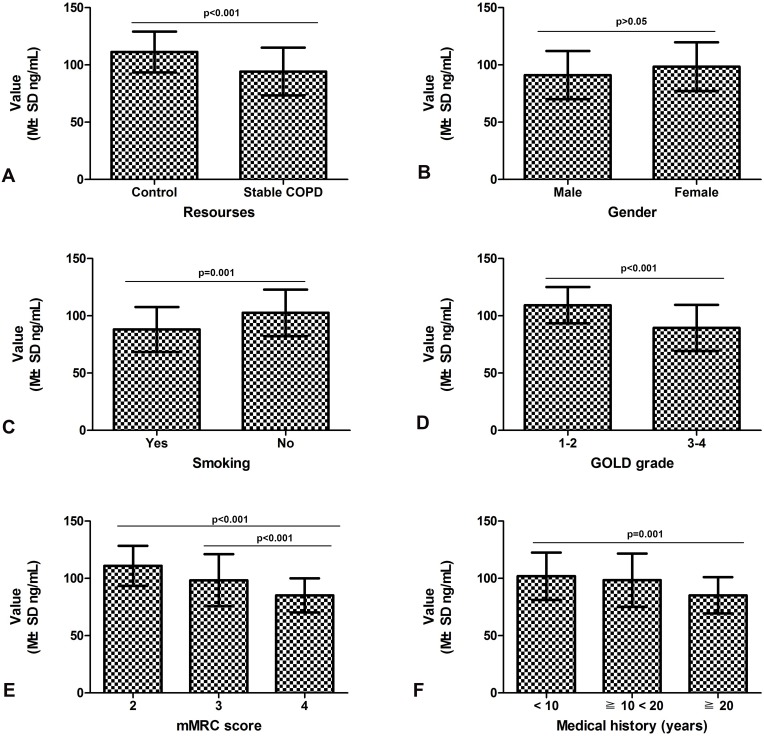
Figure 1
Figure 1
Relationship between clinical parameters and serum concentration of CC16 in stable COPD patients. Notes: (A) Serum concentration of CC16 was higher in stable COPD patients than that in healthy control group (p < 0.001). (B) Serum concentration of CC16 was not related to the patient’s gender (p > 0.05). (C) Stable COPD patients with smoking showed an increased serum concentration of CC16 compared to the patients without smoking (p = 0.001). (D) Serum concentration of CC16 of patients of GOLD-3 and 4 was decreased compared with that of GOLD-1 and 2 (p < 0.001). (E) The patients with 4 points of mMRC scores showed a low serum concentration of CC16 compared with those with 2 and 3 points (p < 0.001). (F) Serum CC16 concentration in the patients with longer clinical history was decreased compared to those with short history (p = 0.001). Abbreviations: COPD, chronic obstructive pulmonary disease; CC16, Clara cell secretory protein 16; M±SD, mean ± standard deviation; GOLD, global initiative for chronic obstructive lung disease; mMRC, modified British Medical Research Council.
Figure 2
Figure 2
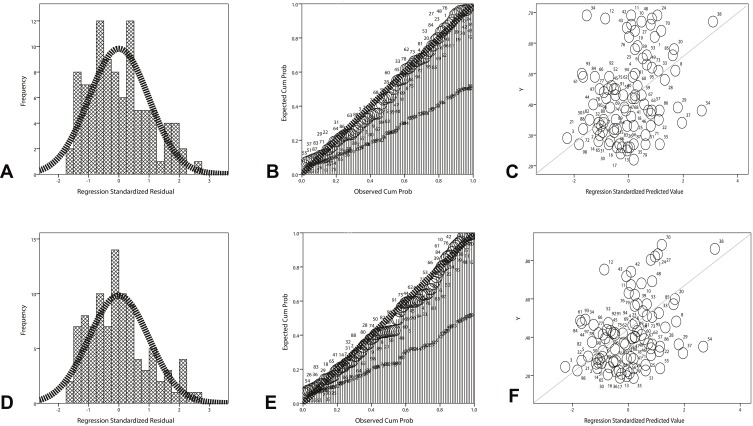
Linear regression analysis between serum concentration of CC16 and lung function test in stable COPD patients. Notes: (A) The histogram of normal curve showed that the normalized residuals are normal distributions (p > 0.05). (B) The dependent variable is approximately linear with the standardized predictive value, indicating that CC16 concentration and FEV1/FVC have a linear correlation (p > 0.05). (C) The cumulative probability plot of the observations suggested that the two variables have a feature of normal distribution (p < 0.05). (D) The histogram of normal curve showed that the normalized residuals are normal distributions (p > 0.05). (E) The dependent variable is approximately linear with the standardized predictive value, indicating that CC16 concentration and FEV1% predicted have a linear correlation (p > 0.05). (F) The cumulative probability plot of the observations suggested that the two variables have a feature of normal distribution (p < 0.05). Abbreviations: CC16, Clara cell secretory protein 16; FEV1, forced expiratory volume in one second; FVC, forced vital capacity.
Figure 3
Figure 3
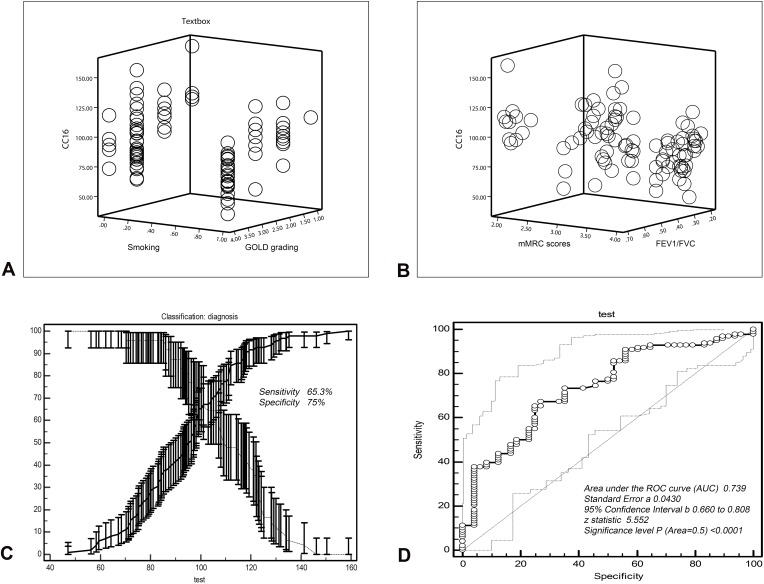
Analysis of factors influencing serum CC16 concentration in patients with COPD and diagnostic value analysis. Notes: (A) The patient’s status of smoking and COPD grading affected the serum CC16 concentration in patients with COPD (p < 0.05). (B) The patient’s mMRC score and FEV1/FVC affected the serum CC16 concentration in patients with COPD (p < 0.05) and FEV1/FVC has the most significant impact on CC16. (C) Selection of critical value (99.32 ng/mL) of serum CC16 concentration for discerning COPD patients from healthy individuals responded a sensitivity of 65.3% and specificity of 75.5%. (D) ROC curve of CC16 concentration for distinguishing COPD patients from healthy individuals (AUC=0.739). Abbreviations: GOLD, global initiative for chronic obstructive lung disease; mMRC, modified British Medical Research Council; FEV1, forced expiratory volume in one second; FVC, forced vital capacity; ROC, receiver operating characteristic curve; AUC, area under the curve.

References

    1. Biener AI, Decker SL, Rohde F. Prevalence and treatment of chronic obstructive pulmonary disease (COPD) in the United States. JAMA. 2019;322(7):602. doi:10.1001/jama.2019.10241 - DOI - PubMed
    1. Biaoxue R, Liu Y, Li M, Fu T, Gao W, Liu H. Correlation of serum levels of HIF-1alpha and IL-19 with the disease progression of COPD: a retrospective study. Int J Chron Obstruct Pulmon Dis. 2018;13:3791–3803. doi:10.2147/COPD.S177034 - DOI - PMC - PubMed
    1. Broeckaert F, Clippe A, Knoops B, Hermans C, Bernard A. Clara cell secretory protein (CC16): features as a peripheral lung biomarker. Ann N Y Acad Sci. 2000;923:68–77. doi:10.1111/j.1749-6632.2000.tb05520.x - DOI - PubMed
    1. Kropski JA, Fremont RD, Calfee CS, Ware LB. Clara cell protein (CC16), a marker of lung epithelial injury, is decreased in plasma and pulmonary edema fluid from patients with acute lung injury. Chest. 2009;135(6):1440–1447. doi:10.1378/chest.08-2465 - DOI - PMC - PubMed
    1. Montes de Oca M, Lopez Varela MV, Laucho-Contreras ME, et al. Classification of patients with chronic obstructive pulmonary disease according to the Latin American Thoracic Association (ALAT) staging systems and the global initiative for chronic obstructive pulmonary disease (GOLD). Arch Bronconeumol. 2017;53(3):98–106. doi:10.1016/j.arbres.2016.08.015 - DOI - PubMed

Publication types