


Spatial and temporal variation in prey color patterns for background matching across a continuous heterogeneous environment
- PMID: 32184983
- PMCID: PMC7069320
- DOI: 10.1002/ece3.6024
Spatial and temporal variation in prey color patterns for background matching across a continuous heterogeneous environment
Abstract
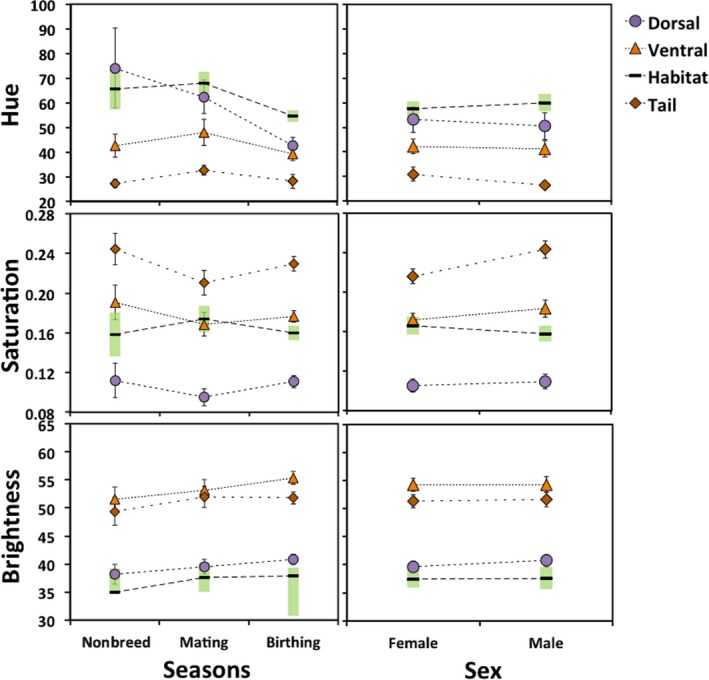
In heterogeneous habitats, camouflage via background matching can be challenging because visual characteristics can vary dramatically across small spatial scales. Additionally, temporal variation in signaling functions of coloration can affect crypsis, especially when animals use coloration seasonally for intraspecific signaling (e.g., mate selection). We currently have a poor understanding of how wild prey optimize background matching within continuously heterogeneous habitats, and whether this is affected by requirements of intraspecific signaling across biological seasons. Here, we quantified color patterns of a wild population of shore skink (Oligosoma smithi), a variably colored lizard endemic to New Zealand, to (a) investigate whether background matching varies across a vegetation gradient; (b) assess potential signaling functions of color; and (c) to determine whether there is a trade-off between requirements for crypsis and intraspecific signaling in coloration across seasons. Although all pattern types occurred throughout the vegetation gradient, we found evidence for background matching in skinks across the vegetation gradient, where dorsal brightness and pattern complexity corresponded with the proportion of vegetation cover. There was also a significant disparity between ventral color (saturation) of juveniles and adults, and also between sexes, suggestive of sex recognition. However, there was little indication that color was condition-dependent in adults. Despite some evidence for a potential role in signaling, crypsis did not greatly differ across seasons. Our study suggests that selection favors a mix of generalist and specialist background matching strategies across continuously heterogeneous habitats.
Keywords: camouflage; crypsis; intraspecific signaling; temporal variation.
© 2020 The Authors. Ecology and Evolution published by John Wiley & Sons Ltd.
Conflict of interest statement
We have no competing interests.
Figures
References
-
- Baling, M. (2017). Functional significance of highly variable colouration in the shore skink (Oligosoma smithi). PhD Thesis. (145 pp.). Auckland, New Zealand: Massey University.
-
- Baling, M. , Stuart‐Fox, D. , Brunton, D. H. , & Dale, J. (2016). Habitat suitability for conservation translocation: The importance of considering camouflage in cryptic species. Biological Conservation, 203, 298–305. 10.1016/j.biocon.2016.10.002 - DOI
-
- Bond, A. B. (2007). The evolution of color polymorphism: Crypticity, searching images, and apostatic selection. Annual Review of Ecology, Evolution, and Systematics, 8, 489–514. 10.1146/annurev.ecolsys.38.091206.095728 - DOI
-
- Caro, T. , Sherratt, T. N. , & Stevens, M. (2016). The ecology of multiple colour defences. Evolutionary Ecology, 30(5), 797–809. 10.1007/s10682-016-9854-3 - DOI
Associated data
LinkOut - more resources
Full Text Sources
