Effects of resistance training with controlled versus self-selected repetition duration on muscle mass and strength in untrained men
- PMID: 32185108
- PMCID: PMC7061915
- DOI: 10.7717/peerj.8697
Effects of resistance training with controlled versus self-selected repetition duration on muscle mass and strength in untrained men
Abstract
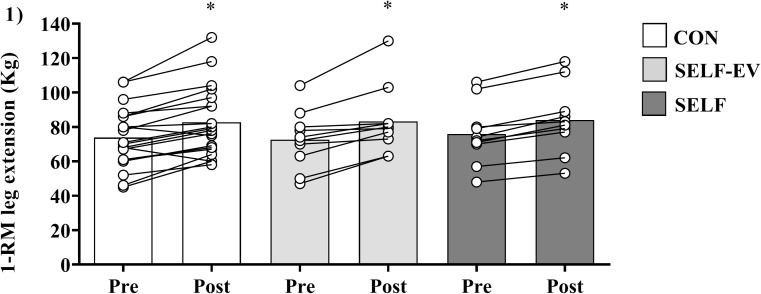
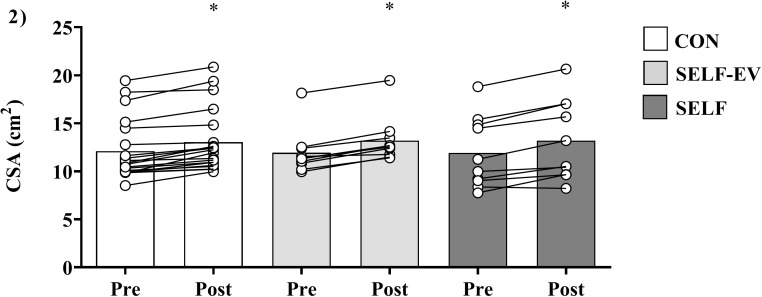
The aim of this study was to compare the effect of self-selected repetition duration (SELF), with and without volume load (VL) equalized with controlled repetition duration (CON) on muscle strength and hypertrophy in untrained males. We used a within-subjects design in which 20 volunteers (age: 24.7 ± 2.9 years) had one leg randomly assigned to CON (i.e., 2 s concentric, 2 s eccentric) and the other to SELF or to self-selected repetition duration with equalized volume load (SELF-EV). One repetition maximum (1-RM) and muscle cross-sectional area (CSA) were measured at baseline (Pre) and after (Post) resistance training (RT; 2×/wk for 8 weeks). For the main study variables (1-RM and muscle CSA), a mixed-model analysis was performed, assuming repetition duration (SELF, SELF-EV and CON), and time (Pre and Post) as fixed factors and the subjects as random factor for each dependent variable (1-RM and CSA). All RT protocols showed significant increases in values of 1-RM from Pre (CON: 73.7 ± 17.6 kg; SELF: 75.9 ± 17.7 kg; and SELF-EV: 72.6 ± 16.9 kg) to Post (CON: 83.4 ± 19.9 kg, effect size (ES): 0.47; SELF: 84 ± 19.1 kg, ES: 0.43; and SELF-EV: 83.2 ± 19.9 kg, ES: 0.57, P < 0.0001). Muscle CSA values increased for all protocols from Pre (CON: 12.09 ± 3.14 cm2; SELF: 11.91 ± 3.71 cm2; and SELF-EV: 11.93 ± 2.32 cm2) to Post (CON: 13.03 ± 3.25 cm2, ES: 0.29; SELF: 13.2 ± 4.16 cm2, ES: 0.32; and SELF-EV: 13.2 ± 2.35 cm2, ES: 0.53, P < 0.0001). No significant differences between protocols were found for both 1-RM and CSA (P > 0.05). Performing RT with SELF, regardless of VL, was equally effective in inducing increases in muscle strength and hypertrophy compared to CON in untrained men.
Keywords: Cadence; Muscle hypertrophy; Muscle strength; Repetition velocity; Strength training.
© 2020 Chaves et al.
Conflict of interest statement
The authors declare that they have no competing interests.
Figures
References
-
- Ahtiainen JP, Pakarinen A, Alen M, Kraemer WJ, Hakkinen K. Short vs. long rest period between the sets in hypertrophic resistance training: influence on muscle strength, size, and hormonal adaptations in trained men. Journal of Strength and Conditioning Research. 2005;19(3):572–582. doi: 10.1519/15604.1. - DOI - PubMed
-
- Ahtiainen JP, Walker S, Peltonen H, Holviala J, Sillanpaa E, Karavirta L, Sallinen J, Mikkola J, Valkeinen H, Mero A, Hulmi JJ, Hakkinen K. Heterogeneity in resistance training-induced muscle strength and mass responses in men and women of different ages. AGE. 2016;38(1):10. doi: 10.1007/s11357-015-9870-1. - DOI - PMC - PubMed
-
- Angleri V, Ugrinowitsch C, Libardi CA. Crescent pyramid and drop-set systems do not promote greater strength gains, muscle hypertrophy, and changes on muscle architecture compared with traditional resistance training in well-trained men. European Journal of Applied Physiology. 2017;117(2):359–369. doi: 10.1007/s00421-016-3529-1. - DOI - PubMed
LinkOut - more resources
Full Text Sources