


Multiparametric autoantibody profiling of patients with systemic sclerosis in Greece
- PMID: 32185313
- PMCID: PMC7046048
- DOI: 10.31138/mjr.29.3.120
Multiparametric autoantibody profiling of patients with systemic sclerosis in Greece
Abstract
Background: Systemic sclerosis (SSc) is an autoimmune rheumatic disease characterized by a wide range of disease-specific and disease-related autoantibodies (autoAbs). Profile assays have been developed and are currently in use to meet the demand for better characterization of all autoAbs found in SSc patients.
Aim: To assess the clinical relevance of SSc-related autoantibodies in 158 patients with SSc, all from Central Greece, taking advantage of a multiparametric SSc autoantibody line immunoassay.
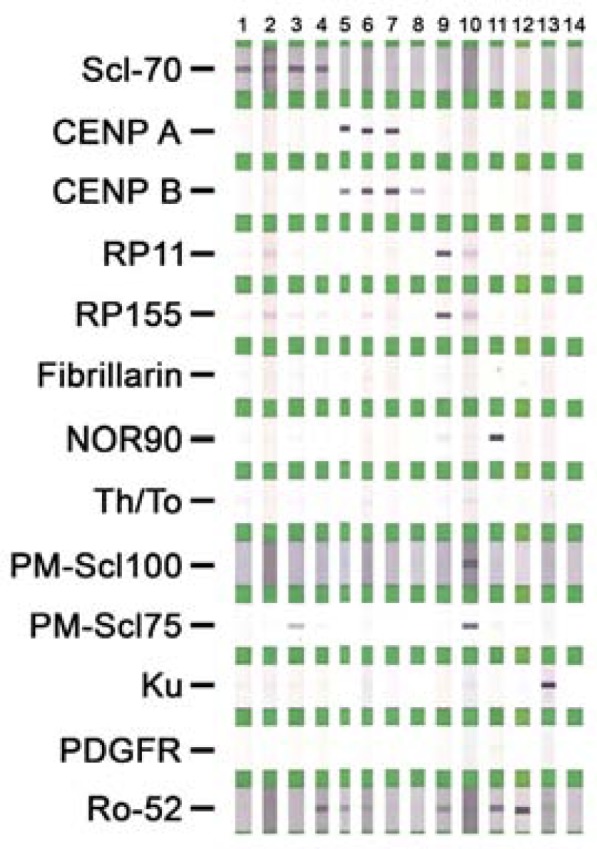
Material and methods: 158 consecutive patients with SSc (137 females, mean age 53.2 ± 10 years; 63 patients with dcSSc and 95 with lcSSc) from central Greece were included in the study. Eighteen patients with morphea were also included. Serum samples were analyzed by a profile SSc nucleoli line assay (Euroimmun) to detect Abs against 13 autoantigens: Scl-70, Centromere (A, B), RNA polymerase III (subunits 11 & 155), fibrillarin, NOR90, Th/To, PM/Scl 100, PM/Scl75, Ku, PDGFR and Ro52. Antinuclear autoAbs (ANAs) were detected by indirect immunofluorescence.
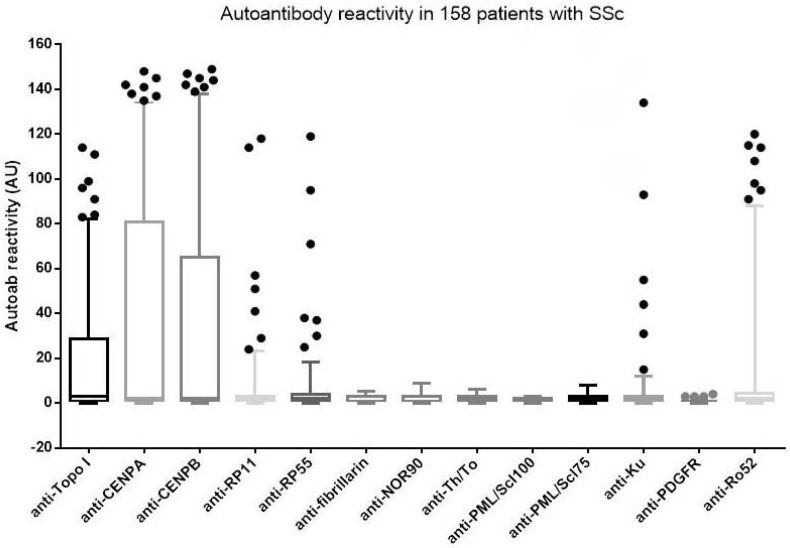
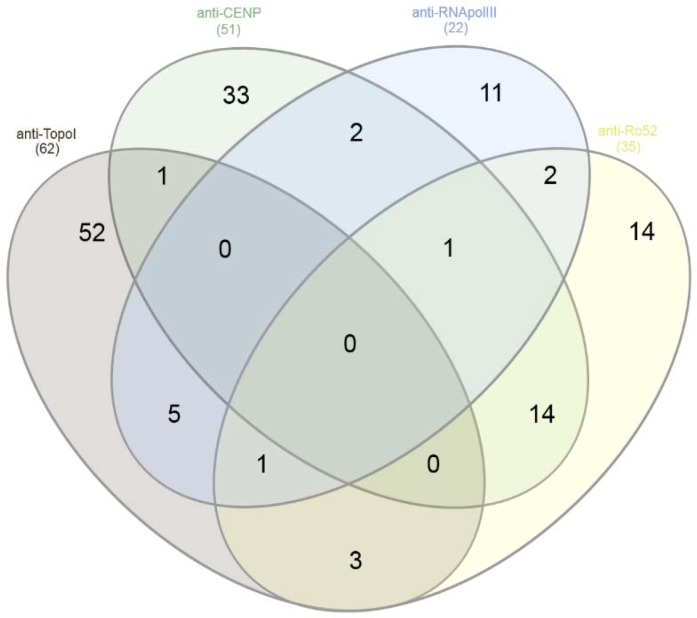
Results: ANAs were detected in 97.5% of SSc patients. Reactivities to specific autoantigens were as follows: Topo I, 40.5%; CENP, 32.9%; Ro52, 21.5%; RP11, 8.9%; RP155, 13.3%; NOR 90, 4.4%; Ku 3.8%; PM-Scl75, 3.2%; PM-Scl100, 1.3%; Th/To, 1.3%; Fibrillarin, 1.3%; PDGFR 0%; Ro52 21.5%. Twenty-one of SSc did not have any of the main autoAbs, namely anti-Topo I, anti-CENP, anti-RNA pol III Abs.
Conclusions: Multiparametric autoAb test provides positive SSc-associated autoAb reactivities in SSc patients negative for the three main autoAbs and this may prove of significance in early disease diagnosis.
Keywords: autoantibodies; autoimmune disease; diagnostics; scleroderma.
© 2018 The Mediterranean Journal of Rheumatology (MJR).
Figures
References
-
- Sakkas LI, Xu B, Artlett CM, et al. Oligoclonal T cell expansion in the skin of patients with systemic sclerosis. J Immunol 2002;168:3649–59. [PMID: ] - PubMed
LinkOut - more resources
Full Text Sources
Research Materials
Miscellaneous