


Mammalian membrane trafficking as seen through the lens of bacterial toxins
- PMID: 32185902
- PMCID: PMC7154709
- DOI: 10.1111/cmi.13167
Mammalian membrane trafficking as seen through the lens of bacterial toxins
Abstract
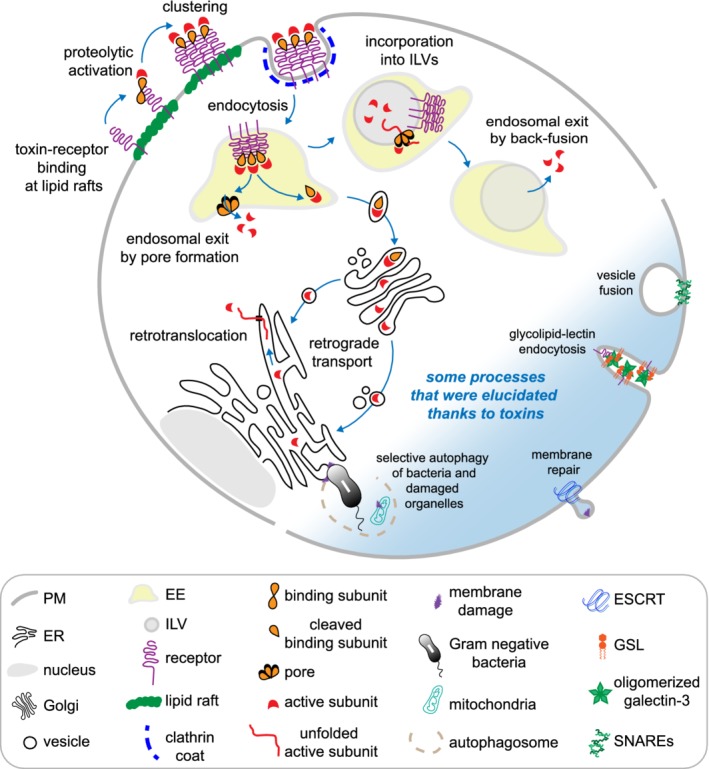
A fundamental question of eukaryotic cell biology is how membrane organelles are organised and interact with each other. Cell biologists address these questions by characterising the structural features of membrane compartments and the mechanisms that coordinate their exchange. To do so, they must rely on variety of cargo molecules and treatments that enable targeted perturbation, localisation, and labelling of specific compartments. In this context, bacterial toxins emerged in cell biology as paradigm shifting molecules that enabled scientists to not only study them from the side of bacterial infection but also from the side of the mammalian host. Their selectivity, potency, and versatility made them exquisite tools for uncovering much of our current understanding of membrane trafficking mechanisms. Here, we will follow the steps that lead toxins until their intracellular targets, highlighting how specific events helped us comprehend membrane trafficking and establish the fundamentals of various cellular organelles and processes. Bacterial toxins will continue to guide us in answering crucial questions in cellular biology while also acting as probes for new technologies and applications.
Keywords: cell membrane; mechanism of action; toxins; trafficking.
© 2020 The Authors. Cellular Microbiology published by John Wiley & Sons Ltd.
Conflict of interest statement
The authors declare no conflicts of interest.
Figures
References
-
- Abrami, L. , Fivaz, M. , Decroly, E. , Seidah, N. G. , Jean, F. , Thomas, G. , … van der Goot, F. G. (1998a). The pore‐forming toxin proaerolysin is activated by furin. The Journal of Biological Chemistry, 273, 32656–32661. - PubMed
-
- Abrami, L. , Fivaz, M. , & van der Goot, F. G. (2000). Surface dynamics of aerolysin on the plasma membrane of living cells. International Journal of Medical Microbiology, 290, 363–367. - PubMed
Publication types
MeSH terms
Substances
LinkOut - more resources
Full Text Sources
