. 2020 Aug;17(8):1196-1213.
doi: 10.1080/15476286.2020.1737442. Epub 2020 Mar 18.

Emerging roles of novel small non-coding regulatory RNAs in immunity and cancer

Affiliations

Emerging roles of novel small non-coding regulatory RNAs in immunity and cancer

Domenico Rosace et al. RNA Biol. 2020 Aug.

Abstract

The term small non-coding RNAs (ncRNAs) refers to all those RNAs that even without encoding for a protein, can play important functional roles. Transfer RNA and ribosomal RNA-derived fragments (tRFs and rRFs, respectively) are an emerging class of ncRNAs originally considered as simple degradation products, which though play important roles in stress responses, signalling, or gene expression. They control all levels of gene expression regulating transcription and translation and affecting RNA processing and maturation. They have been linked to pivotal cellular processes such as self-renewal, differentiation, and proliferation. For this reason, mis-regulation of this novel class of ncRNAs can lead to various pathological processes such as neurodegenerative and development diseases, metabolism and immune system disorders, and cancer. In this review, we summarise the classification, biogenesis, and functions of tRFs and rRFs with a special focus on their role in immunity and cancer.

Keywords: Transfer RNA fragments; cancer; immune system; rRFs; ribosomal RNA fragments; stress-induced tRNA cleavage; tRFs; tRNA cleavage; translation initiation.


Conflict of interest statement

The authors declare no conflict of interest.

Figures
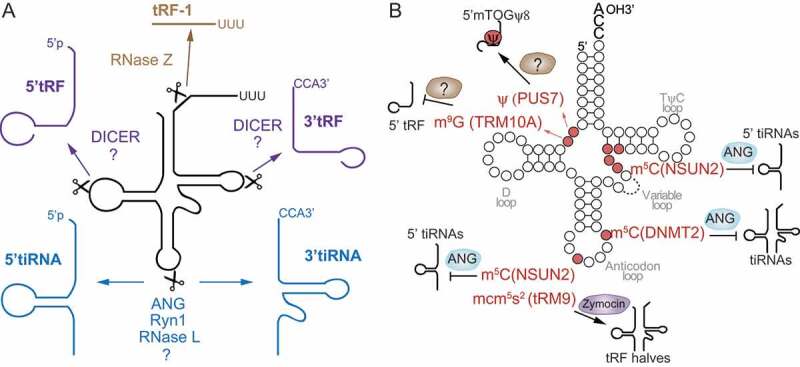
Figure 1.
Figure 1.
Biogenesis and diversity of transfer RNA-derived fragments (tRFs). A) Different types of tRFs are produced from pre-tRNAs or mature tRNAs. RNase Z removes the 3ʹ trailer of pre-tRNAs and produces tRF-1 (brown). Several tRFs are produced by endonucleolytic cleavage of the mature tRNAs. 3ʹtRF (or tRF-3s and 5ʹtRFs (or tRF-5s) (purple) are produced by DICER and other unknown endonucleases (?) cleaving at the D- and T-loop of mature tRNAs. 5ʹ and 3ʹtRNA halves or tiRNAs (light blue) are produced by endonucleolytic cleavage mediated by ANG and RNase L (in vertebrates), Ryn1 (yeast), and other unknown enzymes (?). B) The mature tRNA contains multiple modified nucleosides which regulate its cleavage into tRNA fragments. Modifications that affect tRNA cleavage are indicated in red as well as the modifying enzyme (in brackets) and the enzyme responsible for cleavage (when known) and the tRNA fragment that is produced by the modification (indicated by –>) or inhibited (indicated by –l).
Figure 2.
Figure 2.
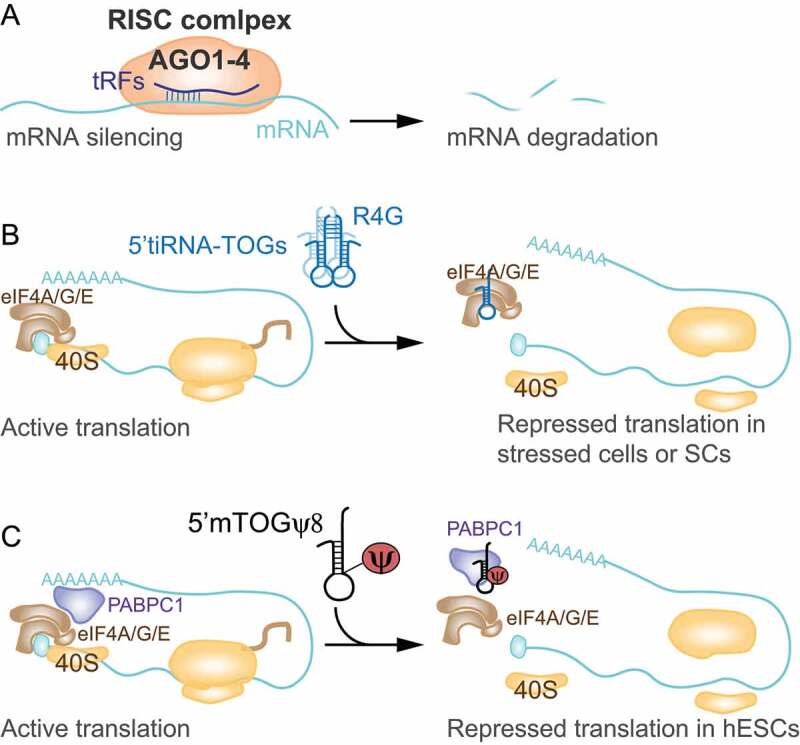
Mechanisms of tRFs-mediated sequence-specific gene silencing or repression of translation initiation. A) tRF-5s and tRF-3s associate with AGO proteins and sequence-specifically silence mRNAs. Target sites are found typically at the 3ʹ UTR, but also distributed all over the respective mRNAs. B) 5′tiRNAs with a 5′ TOG motif form an R4G structure that is required to displace the translation initiation complex eIF4A/G/E from capped mRNAs repressing translation initiation in cells under stress or in stem cells (SCs). C) In human embryonic stem cells (hESCs), 5′tiRNAs with a 5′ TOG and Ψ at position 8 displace PABPC1 from the translation initiation complex repressing translation of capped mRNAs.
Figure 3.
Figure 3.
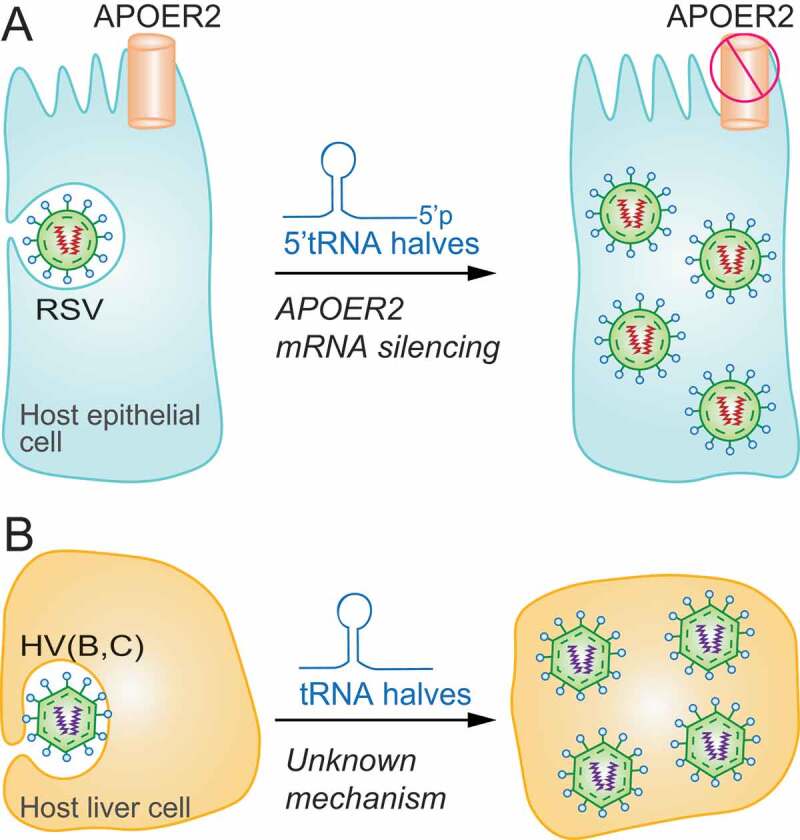
tRFs facilitate viral infections. A) 5ʹtRNA half biogenesis increases upon respiratory syncytial virus (RSV) infection to silence the expression of host genes (APOER2) and facilitate viral replication in epithelial cells. B) Hepatitis B and C virus (HV (B, C)) trigger tRNA half biogenesis which in turn facilitate viral replication via an unknown molecular mechanism in hepatocytes.
Figure 4.
Figure 4.
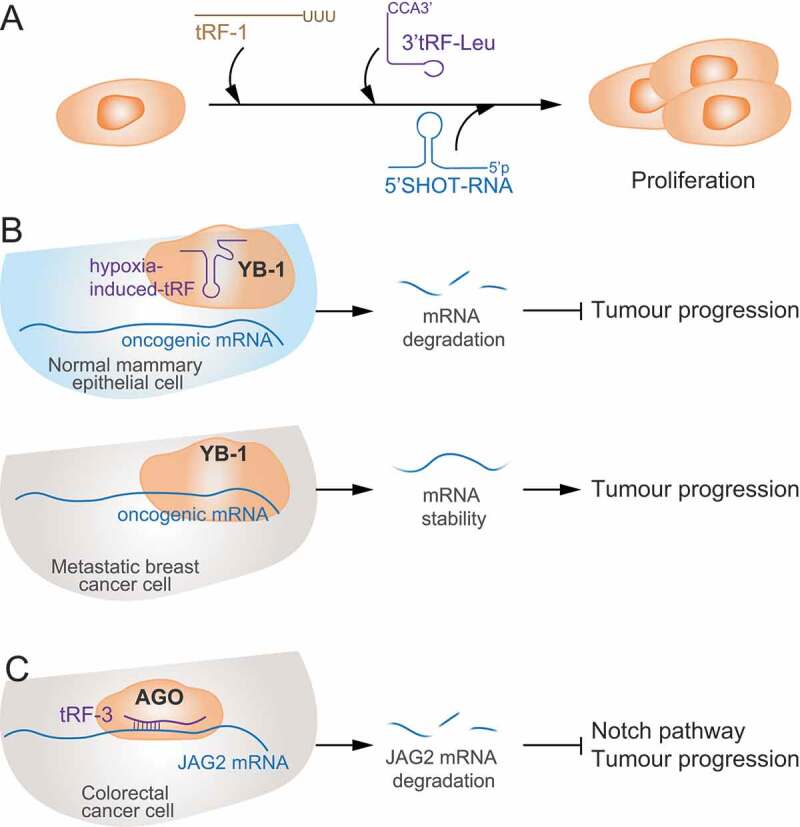
Association of tRFs with cancer initiation and progression. A) tRFs and tRNA halves can foster cancer cell proliferation. B) tRNA fragments mapping to the anticodon loop of tRNAs are induced upon hypoxic stress in normal mammary epithelial and breast cancer cells to sequester YB-1 from oncogenic transcripts and induce their degradation suppressing cancer progression. As metastatic breast cancer cells inhibit generation of these tRNA fragments, YB-1 binds and stabilizes tumour-promoting mRNAs (lower panel). C) In colon cancer cells, tRF-3s promote JAG2 mRNA degradation inactivating the cancer-promoting Notch signalling pathway.
Figure 5.
Figure 5.
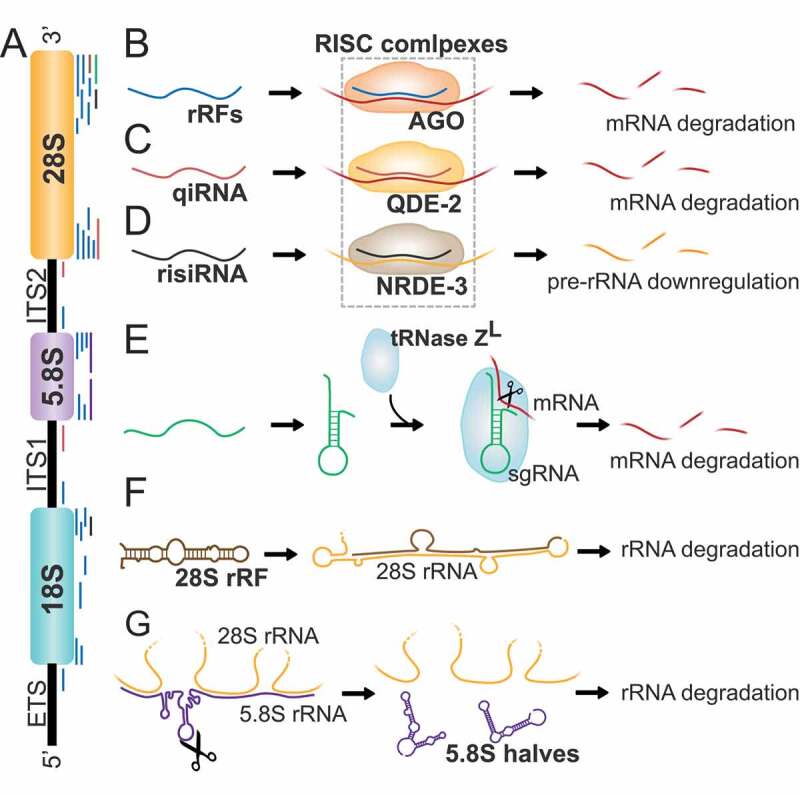
Ribosomal RNA-derived fragments. A) Eukaryotic ribosomes are constituted by four different rRNAs: 5S, 5.8S, 18S, and 28S (higher eukaryotes). Ribosome production is initiated in the nucleolus, where a single rRNA precursor (47S rRNA) containing 5.8S, 18S, and 28S rRNAs and spacer regions known as external and internal transcribed spacers (EST, ITS1, and ITS2), is transcribed. B) rRFs derived from rRNAs and transcribed spacers in humans, flies, and mice interact with AGO proteins and downregulate several mRNAs by sequence complementary. C) qiRNAs derived from 3ʹ ends of 28S rRNA and spacers ITS1 and ITS2 interact with AGO protein QDE-2 to contribute to mRNA degradation in N. Crassa. D) risiRNAs derive from 28S and 18S rRNA and act through the RNAi pathway by association with the AGO protein NRDE-3 to downregulate pre-rRNA in C. elegans. E) Some 28S rRNA-related fragments may function as small guide RNAs (sgRNA) to guide the endonuclease tRNase ZL in human cells to downregulate the levels of specific mRNAs. F) rRFs derived from the 3ʹ end of 28S rRNA can reverse complement a mature 28S rRNA molecule and induce its degradation. G) Mature 5.8S and 28S rRNAs interact in 3 regions by sequence complementarity. The cleavage of 5.8S rRNA in halves leads to the formation of strong stem loop structures between 28S rRNA and 5.8S rRNA halves preventing the interaction with 5.8S mature rRNA and thus participating in rRNA separation during ribosome degradation.

References

    1. Mattick JS, Makunin IV.. Non-coding RNA. Hum Mol Genet. 2006;15(Spec No 1):R17–29. - PubMed
    1. Phizicky EM, Hopper AK. tRNA biology charges to the front. Genes Dev. 2010;24:1832–1860. - PMC - PubMed
    1. Lee RC, Feinbaum RL, Ambros V. The C. elegans heterochronic gene lin-4 encodes small RNAs with antisense complementarity to lin-14. Cell. 1993;75:843–854. - PubMed
    1. Cech TR, Steitz JA. The noncoding RNA revolution-trashing old rules to forge new ones. Cell. 2014;157:77–94. - PubMed
    1. Borek E, Baliga BS, Gehrke CW, et al. High turnover rate of transfer RNA in tumor tissue. Cancer Res. 1977;37:3362–3366. - PubMed

Publication types