An Extended Swedish National Adoption Study of Bipolar Disorder Illness and Cross-Generational Familial Association With Schizophrenia and Major Depression
- PMID: 32186664
- PMCID: PMC7081154
- DOI: 10.1001/jamapsychiatry.2020.0223
An Extended Swedish National Adoption Study of Bipolar Disorder Illness and Cross-Generational Familial Association With Schizophrenia and Major Depression
Abstract
Importance: Information about how risk for bipolar disorder is transmitted across generations and how parental risk for bipolar disorder relates to their children's risk for schizophrenia and major depression is limited.
Objective: To evaluate the sources of parent-offspring transmission of bipolar disorder and its familial cross-generational association with schizophrenia and major depression.
Design, setting, and participants: Parents and offspring (born 1960-1990) from 4 family types were ascertained from Swedish national samples: intact (offspring, n = 2 175 259), not-lived-with biological father (n = 152 436), lived-with stepfather (n = 73 785), and adoptive (n = 15 624). Data analysis was conducted from October 28, 2019, to January 8, 2020.
Exposures: Three sources of parent-offspring resemblance: genes plus rearing, genes only, and rearing only.
Main outcomes and measures: Diagnosis of bipolar disorder, broad schizophrenia (ie, schizophrenia as a 3-level variable: unaffected, nonaffective psychosis, and schizophrenia) and major depression obtained from Swedish national registries. Parent-offspring resemblance was assessed primarily by tetrachoric correlation (ie, correlation of liability) and for key results, odds ratios (ORs) from logistic regression. Cross-generational associations of bipolar disorder with broad schizophrenia and major depression were assessed by their transmission from bipolar disorder in parents and transmission to bipolar disorder in offspring.
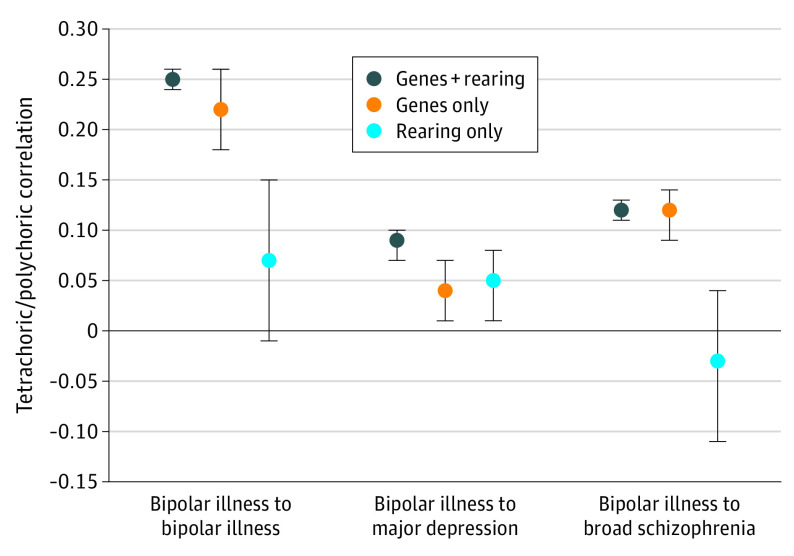
Results: The study population included 2 417 104 individuals of 4 family types (51.8% male and 48.2% female; median age, 41 [range, 25-60] years). For bipolar disorder to bipolar disorder transmission, tetrachoric correlations for 3 types of parent-offspring relationships were statistically homogeneous across family type and mothers and fathers for genes plus rearing (0.25; 95% CI, 0.24-0.26), genes only (0.22; 95% CI, 0.18-0.26), and rearing only (0.07; 95% CI, -0.01 to 0.15). Parallel ORs were 5.20 (95% CI, 4.91-5.50), 3.66 (95% CI, 2.97-4.51), and 1.63 (95% CI, 0.96-2.78). Best-estimate, cross-disorder tetrachoric correlations for 3 types of parent-offspring relationships for bipolar disorder and broad schizophrenia were 0.12 (95% CI, 0.11-0.13) for genes plus rearing, 0.12 (95% CI, 0.09-0.14) for genes only, and -0.03 (95% CI, -0.11 to 0.04) for rearing only, with parallel ORs of 1.95 (95% CI, 1.93-1.97), 2.04 (95% CI, 1.75-2.38), and 0.76 (95% CI, 0.43-1.35). For bipolar disorder and major depression, the parallel tetrachoric correlations were 0.09 (95% CI, 0.07-0.10) for genes plus rearing, 0.04 (95% CI, 0.01-0.07) for genes only, and 0.05 (95% CI, 0.01-0.08) for rearing only; parallel ORs were 1.53 (95% CI, 1.50-1.57), 1.23 (95% CI, 1.13-1.34), and 1.25 (95% CI, 1.09-1.42). Heritability for bipolar disorder was estimated at 0.44 (95% CI, 0.36-0.48). Genetic correlations were estimated at 0.572 (95% CI, 0.560-0.589) between bipolar disorder and broad schizophrenia and 0.302 (95% CI, 0.001-0.523) between bipolar disorder and major depression.
Conclusions and relevance: The findings of this study suggest that genes are largely responsible for bipolar disorder transmission across generations, although modest rearing effects are also likely present. Cross-generational transmission between bipolar disorder and broad schizophrenia appears to be entirely genetic with a moderate genetic correlation; for bipolar disorder and major depression, transmission appears to result equally from genes and rearing with a modest genetic correlation.
Conflict of interest statement
Figures
References
-
- Burton R. The Anatomy of Melancholy—What It Is: With All Kinds, Cases, Symptomes, Prognostickes, and Severall Cures of it. John Lichfield and James Short for Henry Cripps; 1621.
-
- López Beltrán C. The Medical Origins of Heredity In: Müller-Wille S, Rheinberger H-J, eds. Heredity Produced: At the Crossroad of Biology, Politics, and Culture, 1500-1870. MIT Press; 2007:105-132.
-
- Tsuang MT, Faraone SV. The Genetics of Mood Disorders. The Johns Hopkins University Press; 1990.