


Are environmental area characteristics at birth associated with overweight and obesity in school-aged children? Findings from the SLOPE (Studying Lifecourse Obesity PrEdictors) population-based cohort in the south of England
- PMID: 32188454
- PMCID: PMC7081603
- DOI: 10.1186/s12916-020-01513-0
Are environmental area characteristics at birth associated with overweight and obesity in school-aged children? Findings from the SLOPE (Studying Lifecourse Obesity PrEdictors) population-based cohort in the south of England
Abstract
Background: Geographical inequalities in overweight and obesity prevalence among children are well established in cross-sectional research. We aimed to examine how environmental area characteristics at birth are related to these outcomes in childhood.
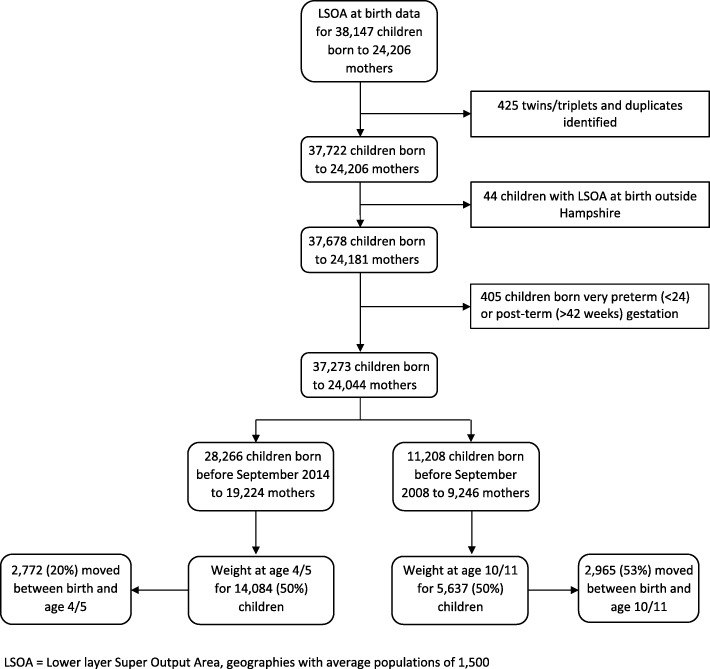
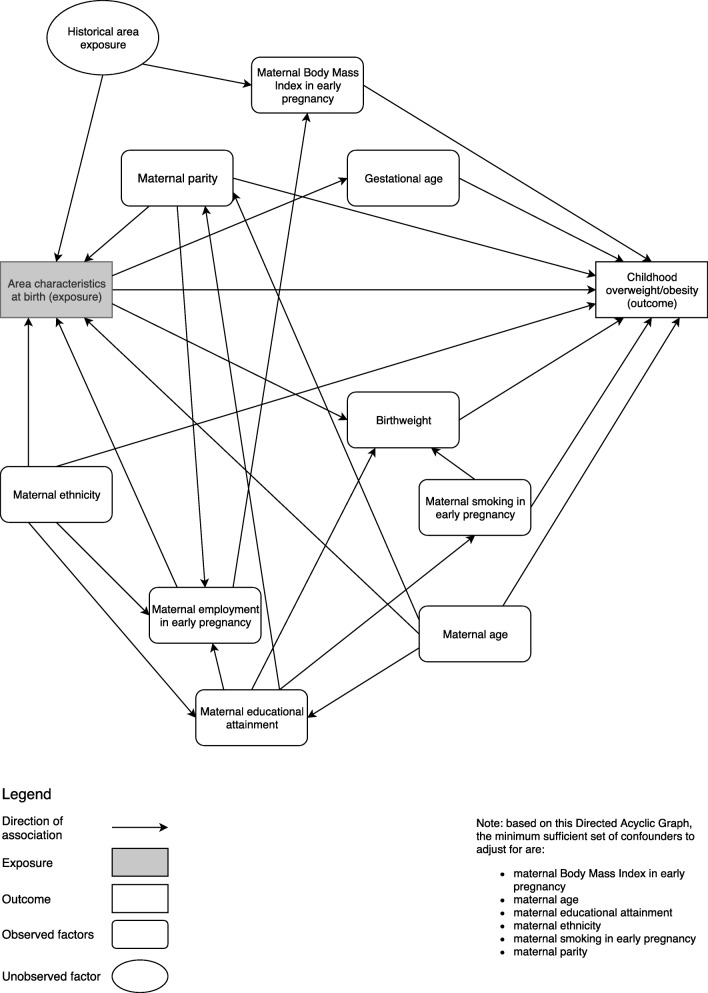
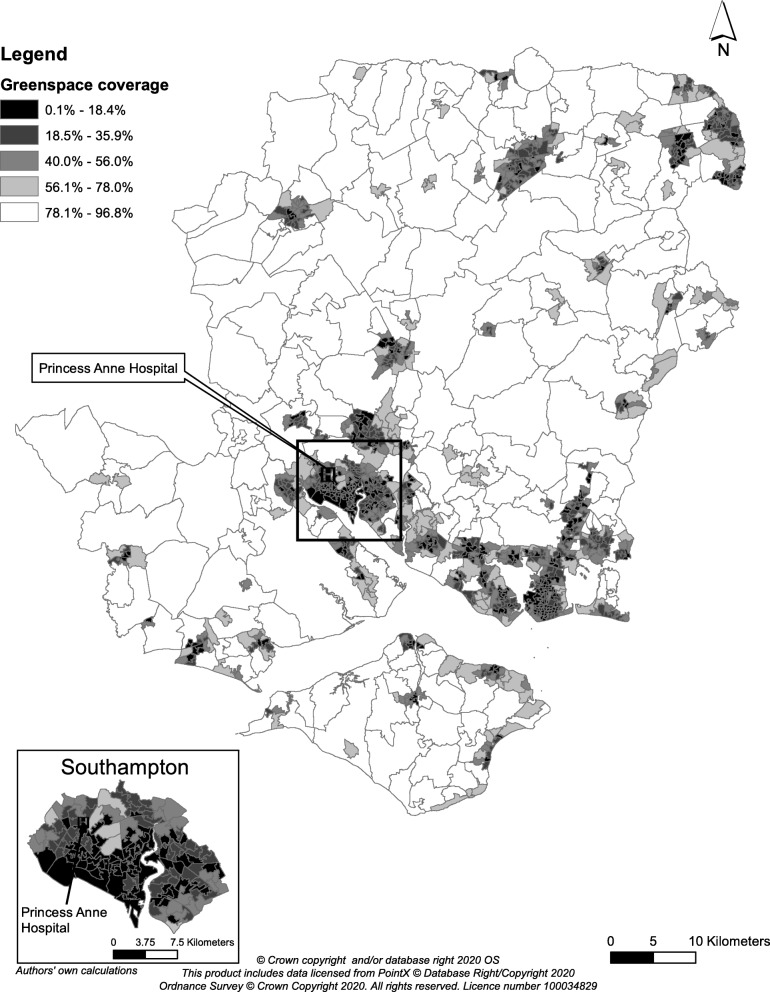
Methods: Anonymised antenatal and birth data recorded by University Hospital Southampton linked to school-measured weight and height data for children within Southampton, UK, were utilised (14,084 children at ages 4-5 and 5637 at ages 10-11). Children's home address at birth was analysed at the Lower and Middle layer Super Output Area (LSOA/MSOA) levels (areas with average populations of 1500 and 7000, respectively). Area-level indices (walkability, relative density of unhealthy food outlets, spaces for social interaction), natural greenspace coverage, supermarket density and measures of air pollution (PM2.5, PM10 and NOx) were constructed using ArcGIS Network Analyst. Overweight/obesity was defined as a body mass index (BMI; kg/m2) greater than the 85th centile for sex and age. Population-average generalised estimating equations estimated the risk of being overweight/obese for children at both time points. Confounders included maternal BMI and smoking in early pregnancy, education, ethnicity and parity. We also examined associations for a subgroup of children who moved residence between birth and outcome measurement.
Results: There were mixed results between area characteristics at birth and overweight/obesity at later ages. MSOA relative density of unhealthy food outlets and PM10 were positively associated with overweight/obesity, but not among children who moved. LSOA greenspace coverage was negatively associated with the risk of being overweight/obese at ages 10-11 in all children (relative risk ratio 0.997, 95% confidence interval 0.995-0.999, p = 0.02) and among children who moved.
Conclusions: Local access to natural greenspaces at the time of birth was inversely associated with becoming overweight or obese by age 10-11, regardless of migration. Increased access/protection of greenspace may have a role in the early prevention of childhood obesity.
Keywords: Area indices; Childhood overweight; Greenspace; Obesity.
Conflict of interest statement
The authors declare that they have no competing interests.
Figures
Comment in
-
Obesogenic environments and obesity: a comment on 'Are environmental area characteristics at birth associated with overweight and obesity in school-aged children? Findings from the SLOPE (Studying Lifecourse Obesity PrEdictors) population-based cohort in the south of England'.BMC Med. 2020 Mar 18;18(1):59. doi: 10.1186/s12916-020-01538-5. BMC Med. 2020. PMID: 32183849 Free PMC article. No abstract available.
References
-
- World Health Organization. Ending childhood obesity. Geneva; 2016. Available from: https://apps.who.int/iris/bitstream/handle/10665/204176/9789241510066_en.... Accessed 12 Feb 2020.
-
- Wilkins E, Radley D, Morris M, Hobbs M, Christensen A, Marwa WL, et al. A systematic review employing the GeoFERN framework to examine methods, reporting quality and associations between the retail food environment and obesity. Health Place. 2019;57:186–199. doi: 10.1016/j.healthplace.2019.02.007. - DOI - PubMed
Publication types
MeSH terms
Grants and funding
LinkOut - more resources
Full Text Sources
Medical
