Review
. 2020 Mar 18;12(535):eaax2466.
doi: 10.1126/scitranslmed.aax2466.

Priorities for developing respiratory syncytial virus vaccines in different target populations

Affiliations
Review

Priorities for developing respiratory syncytial virus vaccines in different target populations

Simon B Drysdale et al. Sci Transl Med. .

Abstract

The development of an effective vaccine against respiratory syncytial virus (RSV) has been hampered by major difficulties that occurred in the 1960s when a formalin-inactivated vaccine led to increased severity of RSV disease after acquisition of the virus in the RSV season after vaccination. Recent renewed efforts to develop a vaccine have resulted in about 38 candidate vaccines and monoclonal antibodies now in clinical development. The target populations for effective vaccination are varied and include neonates, young children, pregnant women, and older adults. The reasons for susceptibility to infection in each of these groups may be different and, therefore, could require different vaccine types for induction of protective immune responses, adding a further challenge for vaccine development. Here, we review the current knowledge of RSV vaccine development for these target populations and propose a view and rationale for prioritizing RSV vaccine development.


Conflict of interest statement

Competing interests: A.J.P. chairs the UK Department of Health and Social Care’s Joint Committee on Vaccination and Immunisation (JCVI) and the European Medicines Agency Scientific Advisory Group on Vaccines and is a member of the World Health Organization’s Strategic Group of Experts. The views expressed in this manuscript do not necessarily reflect the views of these agencies. A.J.P. and C.S.R. are Jenner Institute investigators. S.B.D. has been an investigator on studies funded by Janssen and MedImmune; all funds have been paid to S.B.D.’s institution, and S.B.D. has received no personal payments. The other authors declare that they have no competing interests.

Figures

Fig. 1
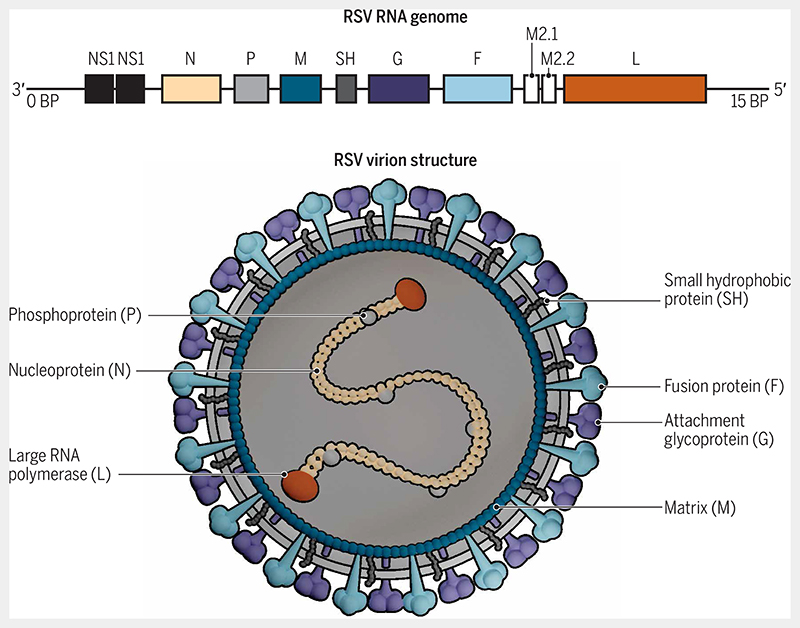
Fig. 1. Structure of RSV.
The RNA genome of RSV consists of 10 genes encoding 11 proteins. These proteins include two nonstructural proteins (NS1 and NS2); four envelope proteins: attachment glycoprotein (G), fusion protein (F), matrix protein (M), and small hydrophobic protein (SH); and five ribonucleocapsid proteins: nucleoprotein (N), phosphoprotein (P), large RNA polymerase (L), M2-1 (a zinc-binding transcription antiterminator), and M2-2 (a regulatory factor involved in the balance between RNA replication and transcription). In terms of vaccine development, the most important protein is the F protein. The F protein in the outer envelope of the RSV virion is highly conserved among RSV strains, making it an excellent potential vaccine target. The F protein has two forms, prefusion and postfusion, with the prefusion form being less stable but more immunogenic than the postfusion form [adapted from (132)].
Fig. 2
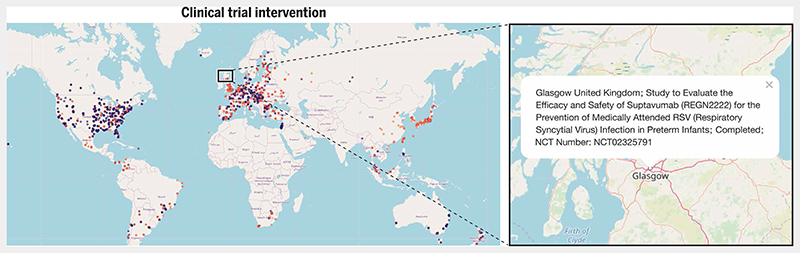
Fig. 2. Different interventions tested in RSV clinical trials worldwide.
The global map shows the distribution of all RSV vaccine and drug trials worldwide. The inset shows an expanded view of clinical trial sites in Scotland. Each dot on the global map represents a single clinical trial site and is color-coded according to the type of intervention tested. Dots are in translucent colors to prevent overlapping dots (depicting proximal trial sites) from obscuring each other. Blue dots represent biologicals (vaccines and monoclonal antibodies), red dots represent antiviral drugs, and yellow dots represent other study designs including observational studies. Clicking on the blue box connects to an interactive map (https://rsvclinicaltrials.org/interventions.html) where each clickable dot produces a popup box containing detailed information about a particular study site. Here, the popup box provides details of a clinical trial at a study site in Glasgow, UK, for evaluating the safety and efficacy of the antiviral drug suptavumab in preterm infants. Source data for this interactive map were downloaded from clinicaltrials.gov (in December 2019). The search term used in the “condition or disease” field was “Respiratory Syncytial Virus”. All clinical trials that fulfilled this search criterion were added to the source data file that was used to generate the maps.
Fig. 3
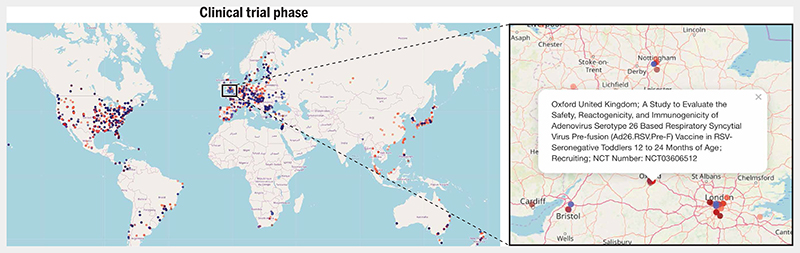
Fig. 3. Global distribution of RSV clinical trials at different phases.
Dots on the global map are color-coded according to the clinical trial phase: Phase 1 trials are shown in maroon, combined phase 1/2 trials are shown in dark red, and phase 2 trials are shown in light red. Combined phase 2/3 trials are shown in light blue and phase 3 trials are shown in dark blue. Purple dots indicate phase 4 trials. Dots are in translucent colors to prevent overlapping dots (depicting proximal trial sites) from obscuring each other. Clicking on the blue box connects to an interactive map (https://rsvclinicaltrials.org/phase.html) where each clickable dot produces a popup box containing detailed information about a particular study site. Here, the popup box provides details of a phase 1/2 trial of an adenovirus vector RSV vaccine in seronegative toddlers aged 12 to 24 months conducted at a trial site in Oxford, UK. Source data for this interactive map were downloaded from clinicaltrials.gov (in December 2019). The search term used in the “condition or disease” field was “Respiratory Syncytial Virus”. All clinical trials that fulfilled this search criterion were added to the source data file that was used to generate the maps.
Fig. 4
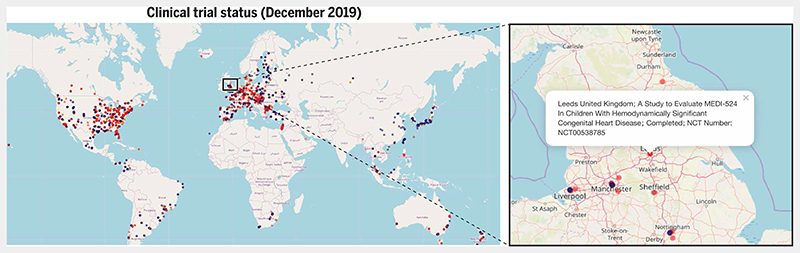
Fig. 4. Status of RSV clinical trials worldwide.
The recruitment status of different RSV vaccine and drug clinical trials as of December 2019 is shown. Yellow dots indicate trials that were active but had not yet started recruitment as of December 2019; red dots indicate completed trials. Green dots indicate inactive trials that had not yet begun recruitment as of December 2019; blue dots indicate trials that were actively recruiting in December 2019. Gray, purple, and black dots indicate trials that were terminated, of unknown status, or were halted, respectively. Dots are plotted in translucent colors to prevent overlapping dots (depicting proximal trial sites) from obscuring each other. Clicking on the blue box connects to an interactive map (https://rsvclinicaltrials.org/status.html) where each clickable dot produces a popup box containing detailed information about a particular study site. Here, the popup box provides details of a trial that evaluated an anti-RSV monoclonal antibody (MEDI-524) in children with congenital heart disease conducted at a trial site in Leeds, UK. Source data for this interactive map were downloaded from clinicaltrials.gov (in December 2019). The search term used in the “condition or disease”field was “Respiratory Syncytial Virus”. All clinical trials that fulfilled this search criterion were added to the source data file that was used to generate the maps.

References

    1. Shi T, McAllister DA, O’Brien KL, Simoes EAF, Madhi SA, Gessner BD, Polack FP, Balsells E, Acacio S, Aguayo C, Alassani I, et al. RSV Global Epidemiology Network, Global, regional, and national disease burden estimates of acute lower respiratory infections due to respiratory syncytial virus in young children in 2015: A systematic review and modelling study. Lancet. 2017;390:946–958. - PMC - PubMed
    1. Lee N, Lui GCY, Wong KT, Li TCM, Tse ECM, Chan JYC, Yu J, Wong SSM, Choi KW, Wong RYK, Ngai KLK, et al. High morbidity and mortality in adults hospitalized for respiratory syncytial virus infections. Clin Infect Dis. 2013;57:1069–1077. - PubMed
    1. Ackerson B, Tseng HF, Sy LS, Solano Z, Slezak J, Luo Y, Fischetti CA, Shinde V. Severe morbidity and mortality associated with respiratory syncytial virus versus Influenza infection in hospitalized older adults. Clin Infect Dis. 2019;69:197–203. - PMC - PubMed
    1. PATH RSV vaccine snapshot. [accessed 15 May 2019]. https://vaccineresources.org/files/RSV-snapshot-2019_04_05_April_High%20... .
    1. Crank MC, Ruckwardt TJ, Chen M, Morabito KM, Phung E, Costner PJ, Holman LSA, Hickman SP, Berkowitz NM, Gordon IJ, Yamshchikov GV, et al. VRC 317 Study Team, A proof of concept for structure-based vaccine design targeting RSV in humans. Science. 2019;365:505–509. - PubMed

Publication types

Substances