. 2020 Mar 13:11:37.
doi: 10.1186/s40104-020-00441-6. eCollection 2020.

A secondary bile acid from microbiota metabolism attenuates ileitis and bile acid reduction in subclinical necrotic enteritis in chickens

Affiliations

A secondary bile acid from microbiota metabolism attenuates ileitis and bile acid reduction in subclinical necrotic enteritis in chickens

Mohit Bansal et al. J Anim Sci Biotechnol. .

Abstract

Background: Clostridium perfringens-induced chicken necrotic enteritis (NE) is responsible for substantial economic losses worldwide annually. Recently, as a result of antibiotic growth promoter prohibition, the prevalence of NE in chickens has reemerged. This study was aimed to reduce NE through titrating dietary deoxycholic acid (DCA) as an effective antimicrobial alternative.

Materials and methods: Day-old broiler chicks were assigned to six groups and fed diets supplemented with 0 (basal diet), 0.8, 1.0 and 1.5 g/kg (on top of basal diet) DCA. The birds were challenged with Eimeria maxima (20,000 oocysts/bird) at d 18 and C. perfringens (109 CFU/bird per day) at d 23, 24, and 25 to induce NE. The birds were sacrificed at d 26 when ileal tissue and digesta were collected for analyzing histopathology, mRNA accumulation and C. perfringens colonization by real-time PCR, targeted metabolomics of bile acids, fluorescence in situ hybridization (FISH), or terminal deoxynucleotidyl transferase dUTP nick end labeling (TUNEL) assay.

Results: At the cellular level, birds infected with E. maxima and C. perfringens developed subclinical NE and showed shortening villi, crypt hyperplasia and immune cell infiltration in ileum. Dietary DCA alleviated the NE-induced ileal inflammation in a dose-dependent manner compared to NE control birds. Consistent with the increased histopathological scores, subclinical NE birds suffered body weight gain reduction compared to the uninfected birds, an effect attenuated with increased doses of dietary DCA. At the molecular level, the highest dose of DCA at 1.5 g/kg reduced C. perfringens luminal colonization compared to NE birds using PCR and FISH. Furthermore, the dietary DCA reduced subclinical NE-induced intestinal inflammatory gene expression and cell apoptosis using PCR and TUNEL assays. Upon further examining ileal bile acid pool through targeted metabolomics, subclinical NE reduced the total bile acid level in ileal digesta compared to uninfected birds. Notably, dietary DCA increased total bile acid and DCA levels in a dose-dependent manner compared to NE birds.

Conclusion: These results indicate that DCA attenuates NE-induced intestinal inflammation and bile acid reduction and could be an effective antimicrobial alternative against the intestinal disease.

Keywords: Bile acid; Chicken; Clostridium perfringens; Deoxycholic acid; Intestinal inflammation; Necrotic enteritis.


Conflict of interest statement

Competing interestsThe authors declare that they have no competing interests.

Figures
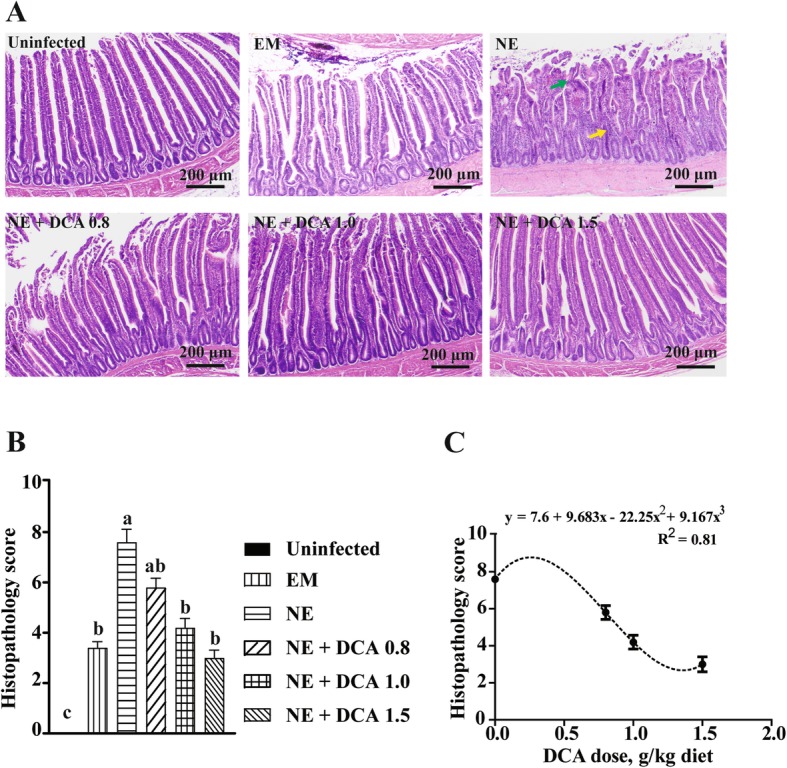
Fig. 1
Fig. 1
DCA prevented subclinical NE-induced ileal inflammation. Cohorts of 16 birds were fed diets supplemented with 0, 0.8, 1.0 and 1.5 g/kg DCA. Birds were challenged with E. maxima at d 18 and C. perfringens at d 23, 24, and 25. Randomly selected five birds from each treatment groups were sacrificed and ileal tissue samples were collected. a Representative images of H&E-stained ileal tissue sections showing immune cell infiltration (yellow arrow) and blunted villi (green arrow). b Histopathology score of ileal tissue. c Fitting curve for histopathology scores in response to different doses of DCA. All graphs showed mean ± SEM. Different letters of a, b and c mean P < 0.05. Results are representative of 3 independent experiments. Scale bar is 200 μm
Fig. 2
Fig. 2
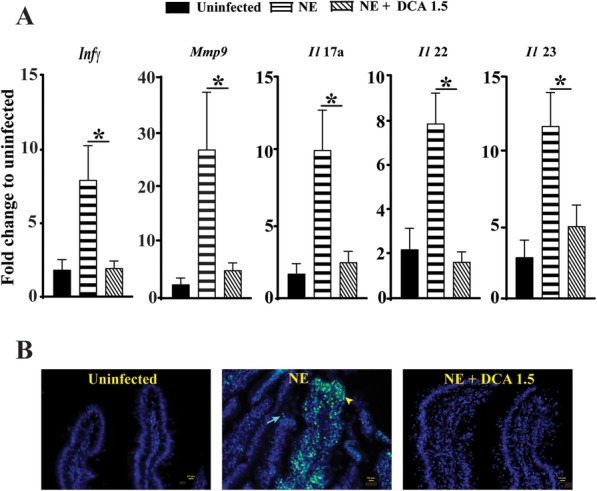
DCA reduced NE-induced host inflammatory response. Cohorts of broiler chickens were fed with different doses of DCA and infected as in Fig. 1. a Ileal Infγ, Mmp9, Il17A, Il22 and Il23 mRNA fold changes relative to uninfected birds and normalized to Gapdh.b Representative TUNNEL assay images showing epithelial (Arrow) and immune cell cell apoptosis (arrow head). Scale bar is 10 μm. All graphs depict mean ± SEM. * indicates P < 0.05. Results are representative of 3 independent experiments
Fig. 3
Fig. 3
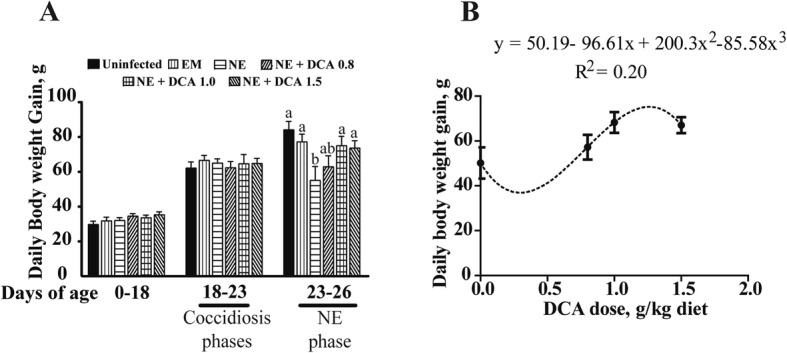
DCA prevented NE induced body weight gain loss. Cohorts of 16 broiler chicks were fed basal and DCA supplemented diets (0.8, 1.0 and 1.5 g/kg) and infected as in Fig. 1. a Bird body weight gain was measured at d 18, 23 and 26. Showed were periodic body weight gain at d 0 to 18, 18 to 23 and 23 to 26. b Fitting curve for daily body weight gain at d 23 to 26 in response to different doses of DCA. All graphs showed mean ± SEM. Different letters of a and b mean P < 0.05. Results are representative of 3 independent experiments
Fig. 4
Fig. 4
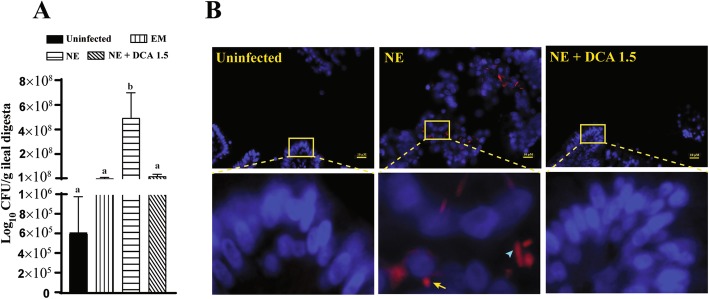
DCA reduced C. perfringens ileal colonization. Cohorts of broiler chickens were fed with different doses of DCA and infected as in Fig. 1. aC. perfringens was quantified in ileal digesta using PCR. bC. perfringens was visualized in ileal tissue using FISH. All graphs showed mean ± SEM. Different letters of a and b mean P < 0.05. Results are representative of 3 independent experiments. Scale bar is 10 μm
Fig. 5
Fig. 5
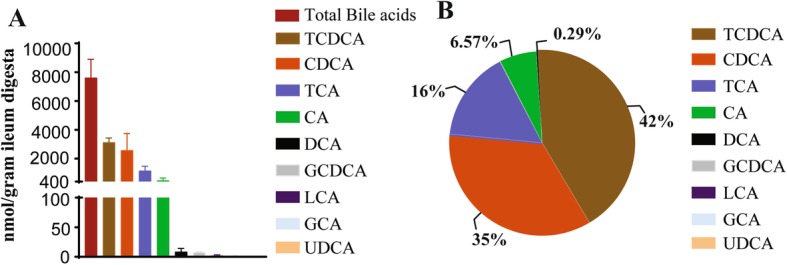
Composition of bile acids in ileal digesta of healthy birds. Bile acids in ileal digesta of 5 healthy birds were extracted and quantified using targeted metabolomics. a Bile acids quantification in the healthy bird ileum. b Relative composition of bile acid in the healthy birds. All graphs showed mean ± SEM. Results are representative of 3 independent experiments
Fig. 6
Fig. 6
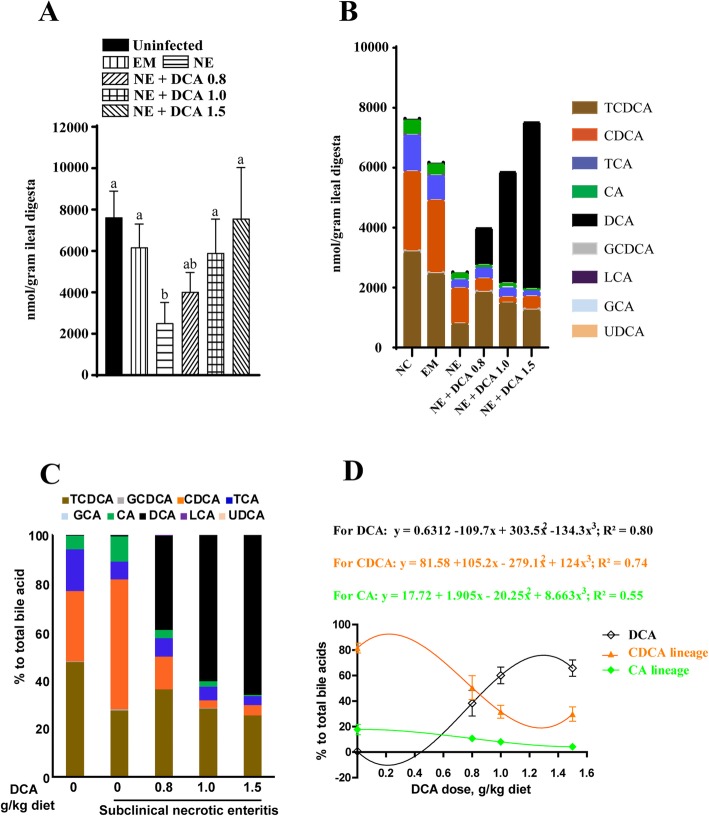
DCA modulated NE-induced bile acid reduction. Cohorts of 16 broiler chicks were fed basal and DCA supplemented diets (0.8, 1.0 and 1.5 g/kg) and infected as in Fig. 1. a Total bile acids quantification in NE and DCA treated birds. b Individual bile acids quantification in the birds. c Relative composition of bile acid in the birds. d Fitting curve for DCA, CDCA lineage (T/GCDCA, CDCA), and CA lineage (T/GCA, CA) in response to different doses of DCA. All graphs showed mean ± SEM. Results are representative of 3 independent experiments

References

    1. Caly DL, D'Inca R, Auclair E, Drider D. Alternatives to antibiotics to prevent necrotic enteritis in broiler chickens: a Microbiologist's perspective. Front Microbiol. 2015;6:1336. - PMC - PubMed
    1. Diarra MS, Malouin F. Antibiotics in Canadian poultry productions and anticipated alternatives. Front Microbiol. 2014;5:282. doi: 10.3389/fmicb.2014.00282. - DOI - PMC - PubMed
    1. Silva RO, Salvarani FM, Assis RA, Martins NR, Pires PS, Lobato FC. Antimicrobial susceptibility of Clostridium perfringens strains isolated from broiler chickens. Braz J Microbiol. 2009;40(2):262–264. doi: 10.1590/S1517-83822009000200010. - DOI - PMC - PubMed
    1. Wade B, Keyburn A. The true cost of necrotic enteritis. Poultry World. 2015;31:16–17.
    1. Timbermont L, Haesebrouck F, Ducatelle R, Van Immerseel F. Necrotic enteritis in broilers: an updated review on the pathogenesis. Avian Pathol. 2011;40(4):341–347. doi: 10.1080/03079457.2011.590967. - DOI - PubMed

LinkOut - more resources