


Assessment of DCE Utility for PCa Diagnosis Using PI-RADS v2.1: Effects on Diagnostic Accuracy and Reproducibility
- PMID: 32192081
- PMCID: PMC7151226
- DOI: 10.3390/diagnostics10030164
Assessment of DCE Utility for PCa Diagnosis Using PI-RADS v2.1: Effects on Diagnostic Accuracy and Reproducibility
Abstract
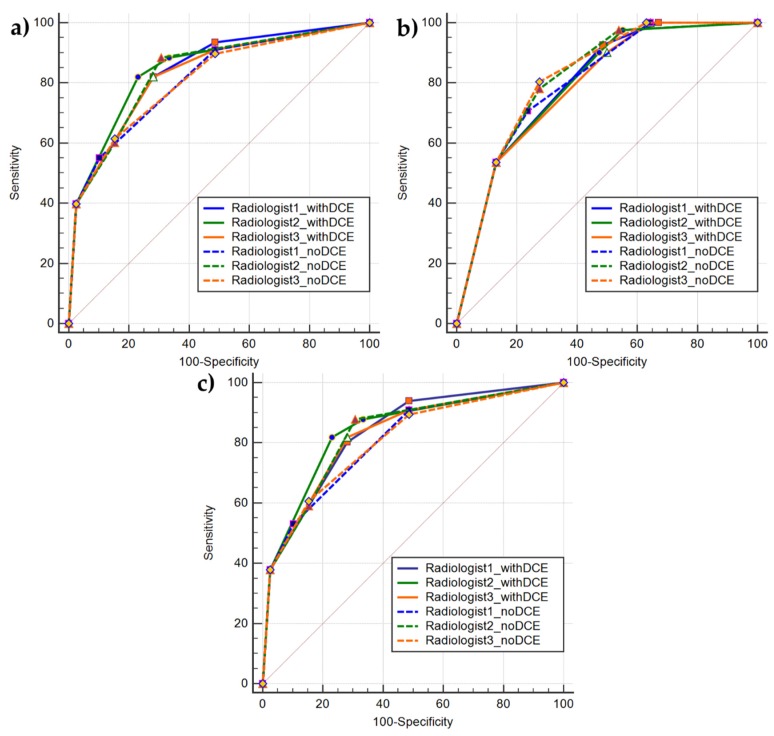
The role of dynamic contrast-enhanced-MRI (DCE-MRI) for Prostate Imaging-Reporting and Data System (PI-RADS) scoring is a controversial topic. In this retrospective study, we aimed to measure the added value of DCE-MRI in combination with T2-weighted (T2W) and diffusion-weighted imaging (DWI) using PI-RADS v2.1, in terms of reproducibility and diagnostic accuracy, for detection of prostate cancer (PCa) and clinically significant PCa (CS-PCa, for Gleason Score ≥ 7). 117 lesions in 111 patients were identified as suspicion by multiparametric MRI (mpMRI) and addressed for biopsy. Three experienced readers independently assessed PI-RADS score, first using biparametric MRI (bpMRI, including DWI and T2W), and then multiparametric MRI (also including DCE). The inter-rater and inter-method agreement (bpMRI- vs. mpMRI-based scores) were assessed by Cohen's kappa (κ). Receiver operating characteristics (ROC) analysis was performed to evaluate the diagnostic accuracy for PCa and CS-PCa detection among the two scores. Inter-rater agreement was excellent for the three pairs of readers (κ ≥ 0.83), while the inter-method agreement was good (κ ≥ 0.73). Areas under the ROC curve (AUC) showed similar high-values (0.8 ≤ AUC ≤ 0.85). The reproducibility of PI-RADS v2.1 scoring was comparable and high among readers, without relevant differences, depending on the MRI protocol used. The inclusion of DCE did not influence the diagnostic accuracy.
Keywords: DCE; PI-RADS; ROC analysis; magnetic resonance imaging; mpMRI; prostate cancer; reproducibility.
Conflict of interest statement
The authors declare no conflict of interest. The funders had no role in the design of the study; in the collection, analyses, or interpretation of data; in the writing of the manuscript, or in the decision to publish the results.
Figures
References
-
- Hegde J.V., Mulkern R.V., Panych L.P., Fennessy F.M., Fedorov A., Maier S.E., Tempany C.M. Multiparametric MRI of prostate cancer: An update on state-of-the-art techniques and their performance in detecting and localizing prostate cancer. J. Magn. Reson. Imaging. 2013;37:1035–1054. doi: 10.1002/jmri.23860. - DOI - PMC - PubMed
-
- Futterer J.J., Briganti A., De Visschere P., Emberton M., Giannarini G., Kirkham A., Taneja S.S., Thoeny H., Villeirs G., Villers A. Can Clinically Significant Prostate Cancer Be Detected with Multiparametric Magnetic Resonance Imaging? A Systematic Review of the Literature. Eur. Urol. 2015;68:1045–1053. doi: 10.1016/j.eururo.2015.01.013. - DOI - PubMed
LinkOut - more resources
Full Text Sources
Research Materials
Miscellaneous
