


Candidate Genes for Freezing and Drought Tolerance Selected on the Basis of Proteome Analysis in Doubled Haploid Lines of Barley
- PMID: 32192224
- PMCID: PMC7139788
- DOI: 10.3390/ijms21062062
Candidate Genes for Freezing and Drought Tolerance Selected on the Basis of Proteome Analysis in Doubled Haploid Lines of Barley
Abstract
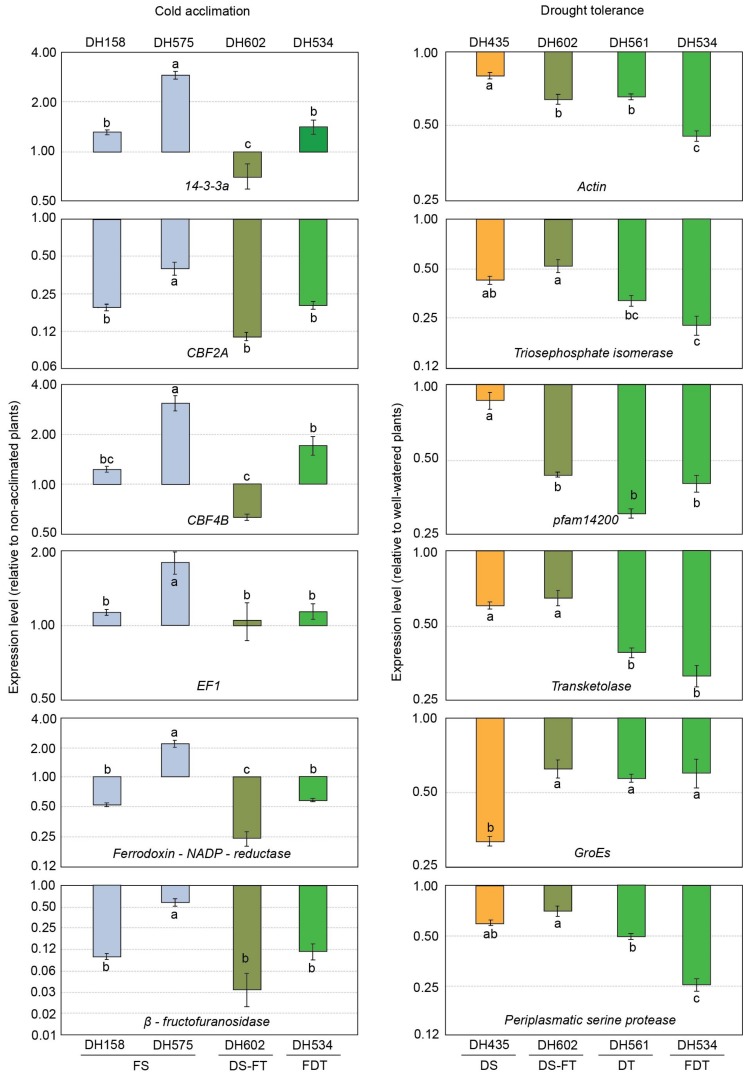
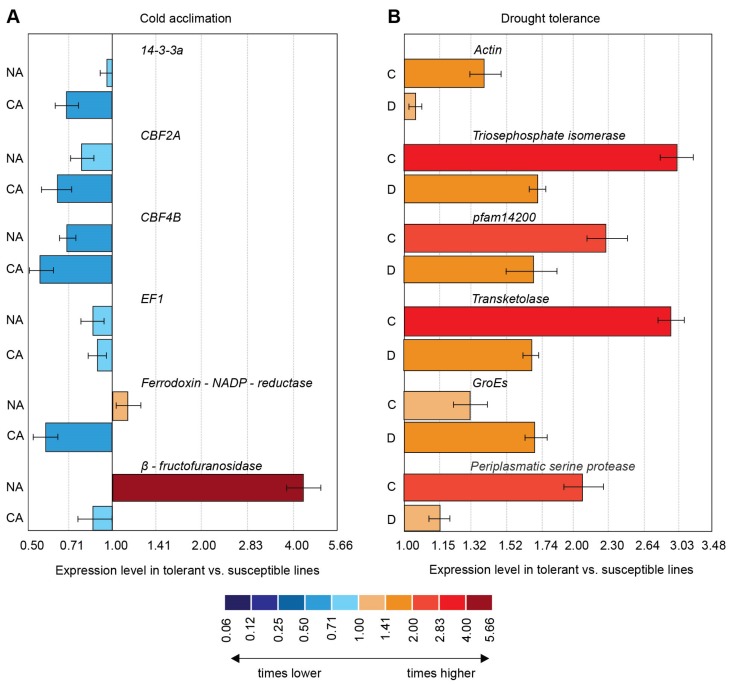
Plant tolerance to environmental stress is determined by a very complicated network composed of many intra- and extracellular factors. The aim of this study was to select candidate genes involved in responses to freezing and drought in barley on the basis of previous proteomic studies and to analyze changes in their expression caused by application of both stress factors. Six candidate genes for freezing tolerance (namely the genes encoding elongation factor 1 alpha (EF1A), ferredoxin-NADP reductase, a 14-3-3a protein, β-fructofuranosidase, CBF2A and CBF4B) and six for drought tolerance (encoding transketolase, periplasmic serine protease, triosephosphate isomerase, a protein with a co-chaperon region (GroEs), pfam14200 and actin) were chosen arbitrarily on the basis of in silico bioinformatic analyses. The expression levels of these genes were measured under control and stress conditions in six DH (doubled haploid) lines with differing freezing and drought tolerance. The results of gene expression analysis confirmed the roles of the candidate genes preselected in this study on the basis of previous proteome analysis in contributing to the differences in freezing and drought tolerance observed in the studied population of DH lines of winter barley.
Keywords: barley; candidate genes; doubled haploid lines; drought tolerance; freezing tolerance; gene expression.
Conflict of interest statement
The authors declare no conflict of interest.
Figures
References
-
- Sheoran S., Malik R., Narwal S., Tyagi B.S., Mittal V., Kharub A.S., Tiwari V., Sharma I. Genetic and molecular dissection of drought tolerance in wheat and barley. J. Wheat Res. 2016;7:1–13.
-
- Byrne P.F., McMullen M.D. Defining genes for agricultural traits: QTL analysis and the candidate gene approach. Probe. 1996;7:24–27.
-
- Pflieger S., Lefebvre V., Causse M. The candidate gene approach in plant genetics: A review. Mol. Breed. 2001;7:275–291. doi: 10.1023/A:1011605013259. - DOI
MeSH terms
Substances
Grants and funding
LinkOut - more resources
Full Text Sources
