doi: 10.3324/haematol.2019.233320.
Epub 2020 Mar 19.
Myelodysplastic syndrome patient-derived xenografts: from no options to many
Affiliations
- PMID: 32193253
- PMCID: PMC7109759
- DOI: 10.3324/haematol.2019.233320
Item in Clipboard
Myelodysplastic syndrome patient-derived xenografts: from no options to many
Haematologica.
2020 Apr.
No abstract available
Figures
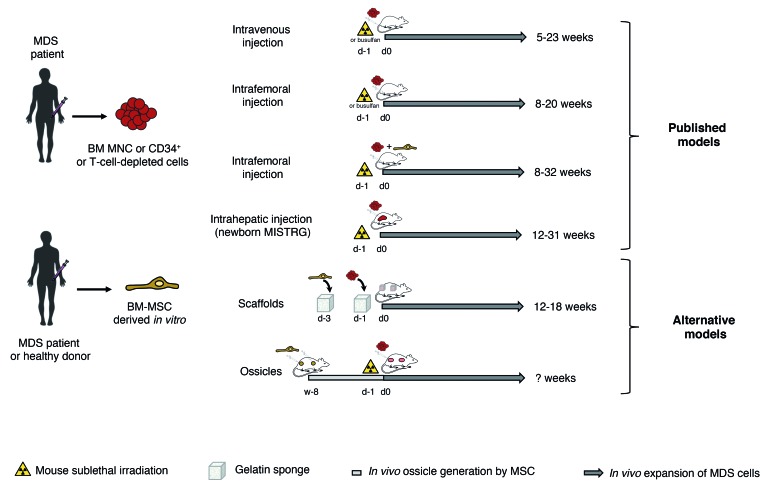
Key features of published and alternative patient-derived xenograft models of myelodysplastic syndrome. The left panel depicts the sources of cells from patients with myelodysplastic syndrome (MDS) which are injected to generate MDS patient-derived xenografts. Tumor cells (red circles) are constituted of bone marrow (BM) cells, mononuclear cells (MNC), or CD34+ purified or T-cell depleted BM cells. Supporting cells (yellow) are BM-derived mesenchymal stromal cells (MSC) derived from patients or healthy donors. The time periods for ossicle development and engraftment of MDS cells are illustrated by light and dark gray bars, respectively. The time of conditioning of the animal, by either irradiation or busulfan treatment is indicated, and the injection route is illustrated by a syringe.
References
-
- Arber DA, Orazi A, Hasserjian R. The 2016 revision to the World Health Organization classification of myeloid neoplasms and acute leukemia. 2016;127(20):2391–2405. - PubMed
-
- Strupp C, Nachtkamp K, Hildebrandt B, et al. New proposals of the WHO working group (2016) for the diagnosis of myelodysplastic syndromes (MDS): Characteristics of refined MDS types. Leuk Res. 2017;57:78–84. - PubMed
Publication types
MeSH terms
Grants and funding
LinkOut - more resources
Full Text Sources
Medical